
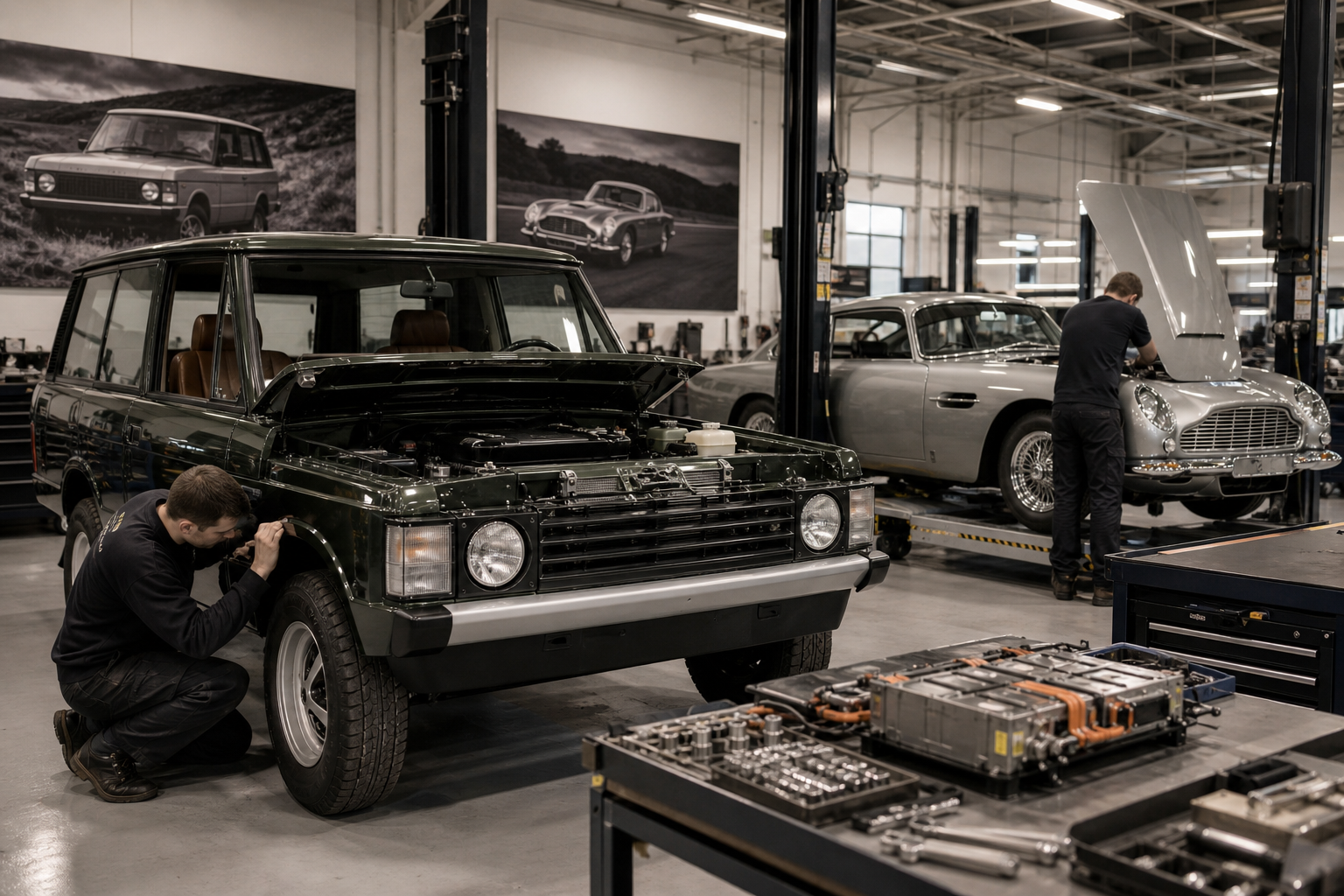

Lunaz is adding a second shift at its Silverstone facility after U.S. collectors bought every available commissioning slot for its Range Rover Classic and Aston Martin projects. The move will double the company’s workforce at the site, turning what was already a highly specialized restoration operation into a rather busier place.
That is a notable development for a company whose products are built one vehicle at a time, with each commission requiring considerably more than a quick polish and a set of fashionable wheels. Lunaz takes classic vehicles apart, reworks their mechanical systems and restores them to a modern standard while preserving the character that made them desirable in the first place. It is a painstaking business, and not one that responds particularly well to being hurried by a spreadsheet.
U.S. Collectors Have Filled the Order Book
The immediate trigger is demand from the United States. According to Lunaz, American buyers have taken every available slot for Range Rover Classic and Aston Martin commissions. The company has not disclosed the number of vehicles involved, the value of the order book or how long customers must wait, but the basic message is clear: demand has outgrown the current production rhythm.
That matters because a bespoke restoration company cannot simply build another assembly line and start producing vehicles by the thousand. Each classic arrives with its own history, condition and collection of mechanical surprises. One Range Rover may need extensive structural work before it can become a polished collector’s machine; another may be remarkably solid but require attention in entirely different areas. Old cars are wonderfully individual in this regard, much like elderly relatives who all insist their knees are perfectly fine until asked to climb stairs.
Adding a second shift gives Lunaz more hours in which to work on those vehicles without abandoning the low-volume, highly managed character of the business. Doubling the Silverstone workforce should also allow the company to spread specialist skills across more projects, although the quality and consistency of that expansion will matter just as much as the number of people hired.
Why the Range Rover Classic Remains Such a Strong Foundation
The Range Rover Classic is an obvious candidate for this kind of treatment. Its shape is instantly recognizable, its cabin can be made considerably more comfortable by modern standards and its upright proportions still give it a presence that many newer luxury SUVs struggle to match. It also occupies an unusually useful position in the collector market: historically important enough to attract serious interest, yet practical enough to be driven rather than locked away under a sheet.
That combination helps explain the model’s appeal to buyers who want more than a static investment. A carefully restored Range Rover Classic can deliver the visual charm of a 1970s or 1980s utility vehicle while offering a more refined ownership experience. The trick is avoiding the temptation to erase everything that made the original interesting. Nobody commissions a classic Range Rover because they are desperate for another anonymous luxury crossover.
Lunaz’s work sits in the increasingly busy space between traditional restoration and modernized classic-car construction. The company is known for re-engineering classic vehicles, including electrified conversions, while retaining their original design language. That approach appeals to owners who want the shape, craftsmanship and history of an older vehicle without accepting every mechanical compromise that came with it.
There is a delicate line here. Improve too little and the finished car remains difficult to use. Improve too much and it becomes a modern interpretation wearing vintage clothing. The best examples understand that a classic vehicle should feel considered, not cosmetically preserved like a museum exhibit that has been given a Bluetooth speaker.
Aston Martin Brings a Different Kind of Challenge
Aston Martin commissions broaden the picture. Unlike the Range Rover Classic, an Aston Martin is judged as much by its sporting character and proportions as by its ability to cruise comfortably. Buyers expect the finished car to retain the sense of occasion associated with the brand, even when its mechanical systems have been substantially revised.
That makes Aston Martin work particularly demanding. The visual details must remain faithful, but the driving experience cannot be allowed to become merely decorative. Steering feel, chassis response, braking performance and the relationship between the driver and the car all carry more weight in a sports car than they do in a luxury SUV.
It is also a reminder that the classic-car market is no longer defined solely by originality. There remains a strong appetite for untouched, factory-correct vehicles, but another group of buyers wants something more usable and more personal. They may value the craftsmanship of a historic Aston Martin while also wanting modern reliability, contemporary convenience and a mechanical specification tailored to their preferences.
Silverstone Is an Appropriate Place for the Expansion
Lunaz’s Silverstone base is more than a convenient address. The circuit and its surrounding technology cluster give the company access to a deep pool of engineering, fabrication and motorsport expertise. That environment is particularly useful for a business dealing with low-volume vehicles that require a mixture of restoration skill, design judgment and modern systems integration.
Classic-car re-engineering is not the same as mass production. It requires people who can understand an original vehicle, identify what needs to be preserved and then fit new solutions without making the finished product feel disjointed. The work may involve metal fabrication, trim, electrical systems, battery integration, calibration and final assembly, depending on the vehicle and the customer’s brief. None of those disciplines becomes easier merely because the car is expensive.
The second shift should therefore be viewed as a capacity increase rather than a change in philosophy. Lunaz is not announcing a high-volume manufacturing program. It is responding to a full order book while attempting to keep its operation focused on commissioned, individually specified vehicles.
The Business of Electrifying Classics Is Still a Balancing Act
Companies such as Lunaz operate in a curious corner of the automotive business. Their customers are buying heritage, but they are also paying for engineering work that can be more complex than restoring a car to its original specification. An electric conversion, where commissioned, involves much more than removing an engine and installing a motor. Packaging, cooling, weight distribution, braking, controls and software all have to work together, while the result must remain suitable for a vehicle originally designed around a completely different powertrain.
That helps explain why these cars command specialist attention and why production cannot be expanded casually. Every additional commission increases revenue potential, but it also creates another opportunity for quality problems, delays or an inconsistent customer experience. Doubling the workforce is therefore a substantial operational decision, even without a headline production figure attached to it.
The U.S. demand is especially interesting because American collectors have long shown enthusiasm for distinctive European vehicles, from early Range Rovers to classic Aston Martins. The appeal is not difficult to understand. A familiar modern SUV can be purchased almost anywhere, but a carefully rebuilt classic with a discreetly modernized specification offers something far less common: individuality without the inconvenience of leaving the car entirely in its original mechanical state.
More Capacity, but Not a Factory Full of Identical Cars
Lunaz’s expansion will not suddenly make these vehicles accessible in the ordinary sense of the word. The company has not announced pricing, and the source information does not establish delivery timing or the exact specifications of the commissioned cars. What it does establish is that the available capacity for these Range Rover Classic and Aston Martin projects has already been claimed by U.S. buyers.
That distinction is important. This is not a new model launch with a production target and a dealer allocation system. It is a sign that a niche restoration business has found a level of demand strong enough to justify another shift and a much larger team at Silverstone.
Whether that growth can be managed without diluting the workmanship will be the real test. Customers commissioning a bespoke classic are not merely buying transportation. They are buying judgment, patience and the confidence that somebody has obsessed over the details that most owners would never notice until they went wrong.
For now, Lunaz has the kind of problem most manufacturers would happily accept: too many affluent customers asking for beautifully reworked old cars. The company’s next challenge is making sure that a busier Silverstone still feels like a specialist workshop, rather than a classic-car version of an airport departures lounge.
0 Comments