
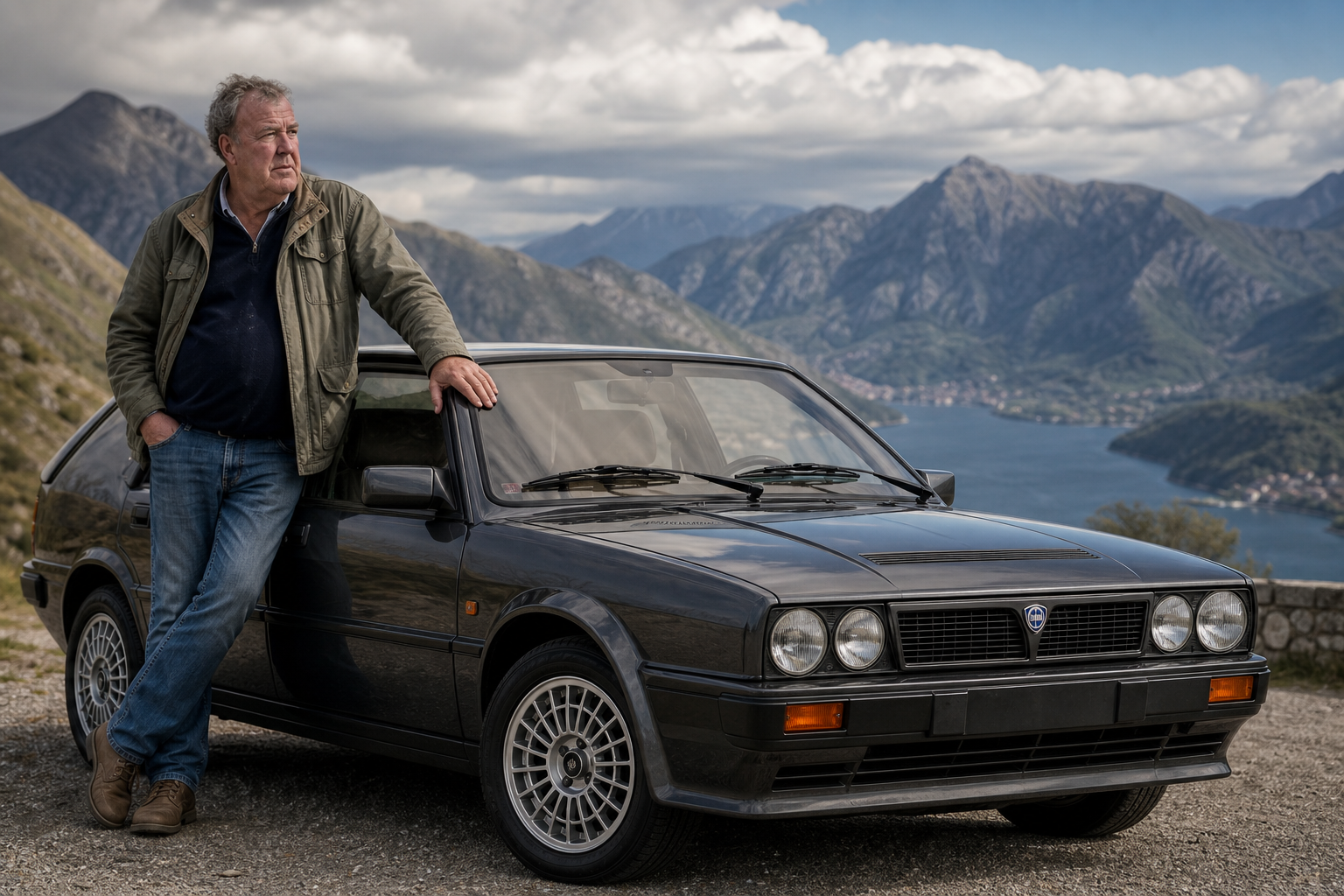

Jeremy Clarkson is putting three memorable cars from The Grand Tour up for sale, giving fans a chance to buy pieces of the show’s history rather than merely another used car with a celebrity name attached to it.
The most significant of the trio is the Lancia Clarkson drove in the final episode of the series. That gives the car a rather unusual kind of provenance: it is tied not just to one of Clarkson’s many televised automotive adventures, but to the closing chapter of the program itself.
The Lancia Carries the Biggest Story
Clarkson has spent decades turning ordinary cars into television characters. Some were quick, some were hopeless, and some were selected precisely because they looked as though they had been stored in a damp shed since the last government. The Lancia from the final Grand Tour episode belongs to a more important category. It was part of the show’s farewell.
That distinction matters. A car used in a television challenge may have a memorable scene attached to it, but a car from the final episode carries an obvious piece of program history. It represents the end of the long-running partnership between Clarkson, Richard Hammond, and James May on The Grand Tour, following their years together on Top Gear.
Whether a buyer wants to preserve it exactly as seen on screen or simply own an unusual Lancia with a remarkable story, the appeal is easy to understand. Few cars come with a ready-made conversation starter quite this effective. “It was Clarkson’s Lancia” is considerably more interesting than “I found it online last spring.”
Television Provenance Is Not the Same as a Normal Used-Car History
Cars from automotive television occupy an odd space in the market. They are vehicles, but they are also props, souvenirs, and physical records of a production. Their value depends on more than mileage, condition, and service history.
A famous car can attract attention because viewers remember what happened to it. That attention can be a blessing, particularly for someone who wants a display piece or a car for events. It can also be a nuisance if the buyer expects a conventional ownership experience. A vehicle that has been part of a television production may have a life considerably less gentle than the average commuter car.
That does not automatically make it mechanically suspect. It does mean prospective buyers should establish exactly what has been changed, repaired, replaced, or removed before treating the celebrity connection as the whole story. Famous cars still need tires, brakes, fluids, documentation, and the occasional stern conversation with a mechanic.
The sensible approach is to separate the emotional value from the mechanical value. The first comes from Clarkson and The Grand Tour. The second depends on the individual car.
Three Cars, Three Different Kinds of Appeal
The sale includes three cars associated with The Grand Tour, although the available announcement does not establish that all three carry the same level of significance or appeared in the same episode. That is worth keeping in mind, because “television car” covers a wide range of possibilities.
One might be important because Clarkson drove it. Another could be remembered for a particularly absurd challenge, an ill-advised modification, or an entertaining mechanical failure. The third may appeal mainly to collectors of the show’s memorabilia. Without treating the group as though every car has identical status, buyers can judge each vehicle on its own provenance.
That individual history will probably be central to the sale. The strongest questions are straightforward: Which episode featured the car? Was it driven by Clarkson, Hammond, or May? Did it survive the filming in the same specification? Is it being offered as a running road car, a preserved production vehicle, or something closer to a museum object?
Those details matter far more than a glossy photograph and a famous name. Television cars often acquire a mythology of their own, but mythology does not tell you whether the doors close properly.
Why the Sale Feels Different From Ordinary Grand Tour Merchandise
The Grand Tour generated plenty of merchandise, but a car is a rather more substantial souvenir than a mug or a jacket. It takes up a great deal more room, consumes more fuel, and is unlikely to fit comfortably on a bookshelf. It also offers something merchandise cannot: the possibility of continuing the story on the road.
That is particularly true of the Lancia. It is connected to the final episode, but it remains a real car with a life beyond the screen. A new owner could preserve it, display it, take it to enthusiast events, or use it as an excuse to tell the same story repeatedly to increasingly trapped guests. All are legitimate applications.
The cars also demonstrate why Clarkson’s television career has had such a long afterlife among car enthusiasts. The programs were never only about acceleration figures or lap times. They made cars memorable through personalities, rivalry, failure, scenery, and the occasional engineering decision that appeared to have been made during a power cut.
A Fitting Set of Cars for the Show’s Final Chapter
The final episode’s Lancia gives this sale its emotional center, but the wider group is arguably more interesting than a single piece of memorabilia. Together, the three cars offer a snapshot of how The Grand Tour treated automobiles: as machines to be driven, tested, abused, celebrated, and occasionally rescued from the consequences of their own design.
For a collector, the challenge will be deciding how much value lies in the car itself and how much lies in the association. That calculation is intensely personal. Someone looking for a pristine classic will approach the sale differently from a fan who wants a tangible reminder of a television series that spent years making car culture entertainingly ridiculous.
Either way, the Lancia is the obvious headline car. It was part of the final journey, and now it is leaving the show behind for another chapter. That is a rather good ending for a television car: not being locked away forever, but heading off to confuse neighbors, attract questions at gas stations, and keep the story running long after the cameras stopped.
0 Comments