
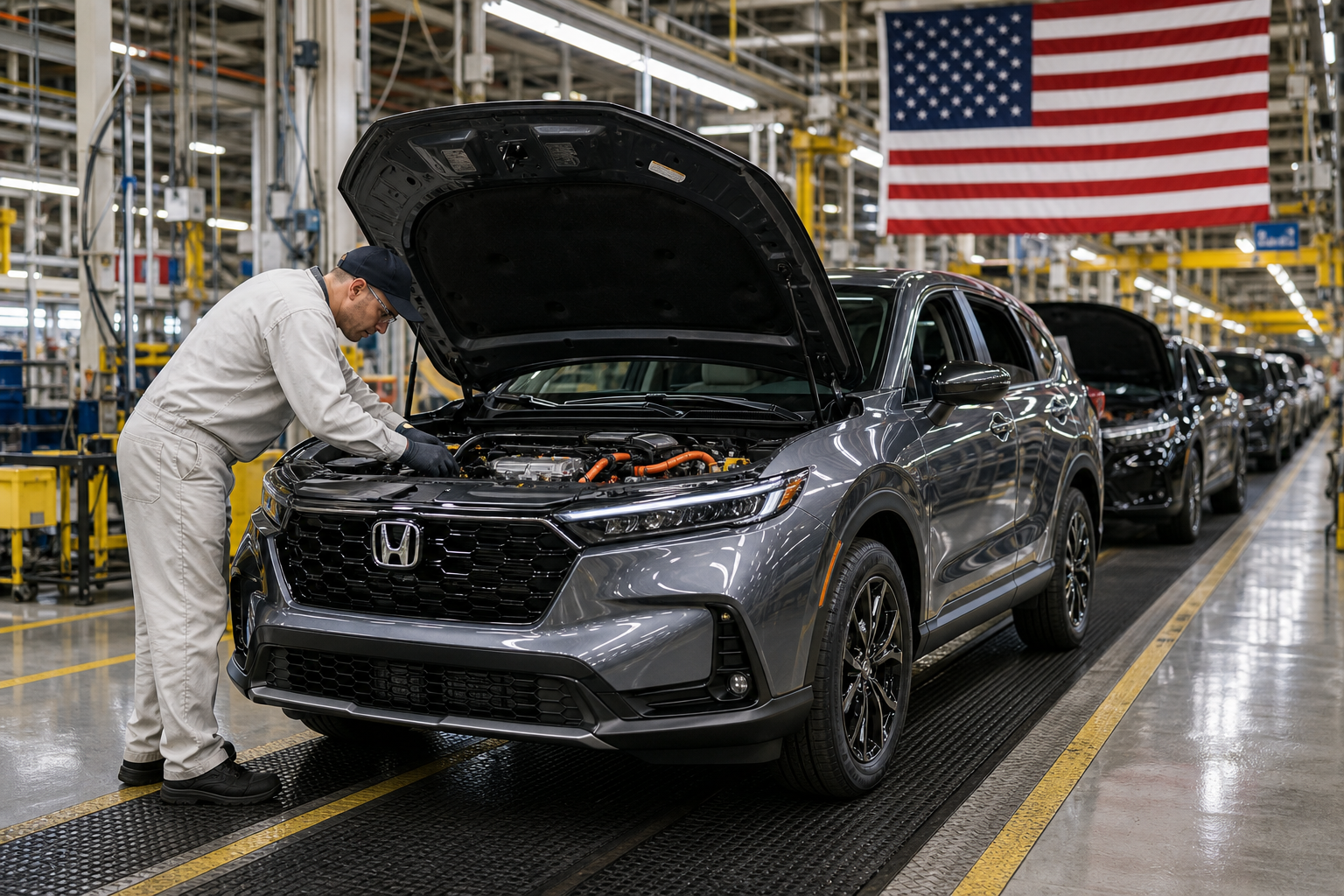

Honda may be preparing to add another major manufacturing site in Ohio, with the state reportedly emerging as the automaker’s preferred location for a new U.S. assembly plant focused on hybrid vehicles.
That would be a notable development for a company that has spent the past few years talking loudly about electric vehicles. Honda’s North American manufacturing strategy has increasingly revolved around electrification, but hybrids now appear to be earning a more prominent place in the plan. Sensible, really. Battery-electric vehicles may dominate corporate presentations, yet hybrids remain easier for many customers to buy, fuel, and live with today.
Ohio Is Already Honda Country
Ohio would hardly be a random choice. Honda has been building vehicles in the state for decades, beginning U.S. automobile production at its Marysville Auto Plant in 1982. The company also operates the East Liberty Auto Plant and the Anna Engine Plant, creating an established manufacturing network with a deep supply base, trained workers, and plenty of institutional knowledge.
That existing footprint gives Honda several advantages over starting from scratch somewhere with no connection to its North American production system. Components can potentially move through familiar logistics channels, engineers and manufacturing specialists are already nearby, and the company has a long history of working with local suppliers and state officials.
Ohio has also been central to Honda’s recent electrification plans. The automaker previously identified the state as the core of its North American EV production effort, including major investment in existing facilities and a planned battery operation developed with LG Energy Solution. A new hybrid-oriented assembly plant would add another layer to that strategy rather than replacing the electric-vehicle work already associated with the region.
Why Build a Hybrid Factory Now?
The answer is partly economic and partly practical. Hybrids require more than a conventional gasoline vehicle, but they do not demand the same charging infrastructure or battery capacity as a full EV. That makes them a useful middle ground for customers who want lower fuel consumption without planning every long trip around a charging stop.
Honda’s two-motor hybrid system, used in models such as the Accord and CR-V, is designed around electric drive at lower speeds and efficient gasoline-engine operation when conditions demand it. The system can also operate as a generator-driven setup, with the engine producing electricity for the motors rather than mechanically driving the wheels all the time. It is a technically interesting arrangement, and one that can deliver the quiet, immediate response associated with an EV while retaining the convenience of gasoline.
A dedicated or heavily optimized hybrid assembly operation could allow Honda to build those vehicles in larger numbers and with more consistent component flow. Hybrid production has its own requirements, including high-voltage battery handling, electric motors, power-control hardware, and additional software calibration. It is not merely a gasoline vehicle with a battery awkwardly bolted on as an afterthought, despite the way some marketing departments occasionally make it sound.
The Location Is Not Yet Official
The important word here is “reportedly.” Honda has not publicly confirmed the final location, construction schedule, investment amount, production capacity, or the vehicles that would be assembled at the proposed facility. Until the company makes a formal announcement, the Ohio plan remains a reported preference rather than a settled production program.
That distinction matters because large automotive plants involve an enormous number of moving parts. Land acquisition, tax incentives, utility capacity, transportation links, labor agreements, supplier commitments, and environmental approvals all have to line up before a factory becomes more than a promising patch of ground and a great many PowerPoint slides.
Honda would also need to decide how the new operation fits alongside its existing Ohio plants. The company could use the facility for a new generation of hybrid crossovers, expand production of existing models, or create a flexible line capable of handling both hybrid and battery-electric vehicles. Without official details, it would be premature to attach a particular model name to the project.
A Different Kind of Electrification Bet
Honda’s reported interest in a hybrid-focused factory reflects the awkward reality facing nearly every automaker: the transition away from conventional gasoline vehicles is not happening at the same speed in every market or customer segment.
Full EVs remain important, particularly as manufacturers face tighter emissions rules and invest in dedicated battery technology. But hybrids can generate immediate fuel-saving benefits without asking buyers to change their habits quite so dramatically. They also allow automakers to use smaller battery packs than those required by long-range EVs, reducing dependence on battery materials and potentially making production less costly.
That does not make hybrids a permanent substitute for electric vehicles. They still burn gasoline, carry two power sources, and introduce additional mechanical and electronic complexity. A hybrid powertrain is clever, but cleverness does not come free. There are more components to package, more systems to control, and more expensive hardware to service if something goes wrong outside the warranty period.
Even so, the technology gives Honda a way to reduce fuel consumption across popular vehicles while the charging network, battery supply chain, and customer demand for EVs continue to develop. Crossovers are especially important here because they represent the bulk of modern showroom traffic and offer enough packaging space for hybrid hardware without turning the cargo area into a game of automotive Tetris.
What the Ohio Project Could Mean
If confirmed, the factory would reinforce Ohio’s role as Honda’s American manufacturing base and give the state another large-scale automotive investment tied to electrification. It could also create additional demand for regional suppliers producing battery modules, electric motors, inverters, thermal-management equipment, and the specialized tooling needed for hybrid assembly.
For Honda, the bigger prize would be manufacturing flexibility. A company that can build gasoline, hybrid, and electric vehicles within a closely connected North American production network is better placed to adjust as demand changes. That flexibility may prove more valuable than betting everything on one powertrain before the market has made up its mind.
There is still plenty to learn. Honda must confirm whether the site is genuinely new, explain how it relates to the company’s existing Ohio expansion, and identify the products that would come out of the gates. For now, the clearest takeaway is that hybrids are not being treated as a fading technology waiting in the departure lounge.
Honda appears to see them as a serious part of its next manufacturing phase—and Ohio, already one of the company’s most important industrial homes, may be where that strategy takes shape.
0 Comments