
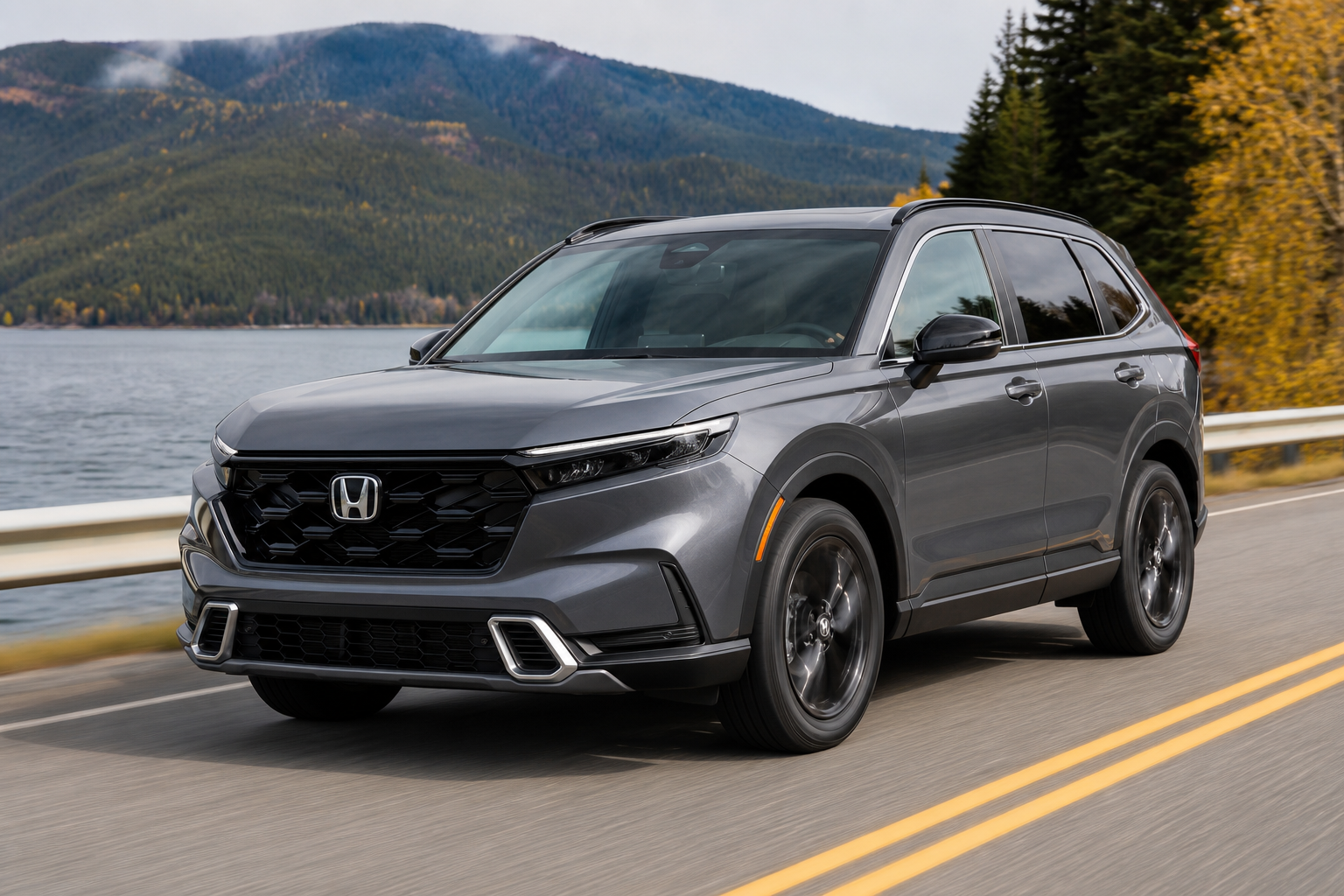

Honda may be moving faster than expected with its next wave of hybrid vehicles. According to a report, production of a new CR-V Hybrid could begin as soon as February, putting one of the company’s most important nameplates at the front of its electrification plans.
That timing is notable because the CR-V is not some obscure niche model sold to three people and a particularly committed dog. It is one of Honda’s central global products, competing in the crowded compact SUV class against vehicles such as the Toyota RAV4, Hyundai Tucson, Kia Sportage, and Ford Escape. Any major change to its hybrid strategy will therefore affect a considerable slice of Honda’s business.
A Rapid Move for Honda’s Hybrid Program
The report says Honda will begin producing the new CR-V Hybrid as soon as February. It also indicates that the company is fast-tracking additional hybrid models, although the available information does not identify every vehicle involved or explain whether the acceleration affects production, launch timing, or both.
That distinction matters. Automakers can announce a vehicle long before it reaches dealerships, and production can begin in one country while sales start months later in another. Without a confirmed market, factory, or model-year designation, the February timing should be treated as an early report rather than a complete launch schedule.
Still, the suggestion of an accelerated program is meaningful. Honda has already made hybrids a major part of its strategy in the mainstream market, particularly with the CR-V, Accord, and Civic. Moving the next CR-V Hybrid into production quickly would allow the company to keep its most visible electrified SUV current while consumer interest in hybrids remains strong.
Why the CR-V Hybrid Is So Important
The CR-V occupies the sort of territory automakers desperately want: a practical, familiar SUV with broad appeal and enough space for family duty without the bulk of a full-size crossover. Its hybrid version can attract buyers who want better fuel economy but are not ready to plan their lives around charging stops.
That makes the CR-V Hybrid a particularly useful tool for Honda. A compact hybrid SUV does not require customers to abandon gasoline entirely, yet it gives the company a way to reduce fuel consumption and emissions without asking buyers to embrace a completely new ownership routine.
It also places Honda in direct competition with Toyota, which has spent years making hybrid powertrains a defining part of its product range. The RAV4 Hybrid has helped normalize the idea that a hybrid SUV can be a mainstream choice rather than a technological curiosity. Honda cannot afford to treat the CR-V Hybrid as a side project while rivals continue expanding their hybrid offerings.
What the Report Does Not Tell Us
The early information does not include power figures, fuel-economy targets, battery details, styling changes, interior revisions, pricing, or drivetrain specifications for the next CR-V Hybrid. It also does not establish whether the vehicle represents a substantial redesign or a quicker update to the existing model.
Those details will determine how significant the change actually is. A revised hybrid system could bring improved efficiency, stronger acceleration, or better packaging. A modest update might be less dramatic but still useful if it reduces production costs or allows Honda to build more hybrid vehicles in response to demand.
There is also the question of where production will take place. Honda’s manufacturing footprint is spread across several markets, and the timing of production does not automatically mean that every region will receive the vehicle at once. U.S. buyers, in particular, will need confirmed information about local production and availability before February becomes a meaningful shopping date rather than an interesting line in an industry report.
Honda’s Hybrid Balancing Act
Honda is pursuing electrification while still operating in a market where gasoline-powered vehicles remain essential. Battery-electric vehicles are expanding, but their adoption varies considerably by region, price, charging access, and customer preference. Hybrids give Honda a way to keep moving toward lower-emission transportation without making its entire business dependent on one powertrain type.
That approach is less glamorous than declaring every new vehicle electric, but it is considerably more practical. A hybrid can use existing fueling infrastructure, deliver familiar range, and still reduce gasoline use in everyday driving. For a high-volume SUV, those advantages are difficult for a manufacturer to ignore.
The danger is that hybrid buyers are no longer impressed merely by a badge and a claim of efficiency. Toyota’s experience has raised expectations, while Hyundai and Kia have added technology, packaging flexibility, and strong warranties to the conversation. Honda’s next CR-V Hybrid will need to be competitive in the areas customers actually notice: fuel economy, refinement, cargo space, price, and the ease of living with it every day.
A February Production Start Would Be the First Clue
If the report proves accurate, beginning production as soon as February would give Honda an early opportunity to refresh one of its most important hybrid products. It would also signal that the company sees hybrid demand as immediate rather than something to revisit after its next round of battery-electric launches.
For now, the sensible position is to keep expectations measured. The production timing is the substantive piece of information; the technical story remains largely unwritten. Until Honda confirms the vehicle’s specification, market availability, and launch schedule, the next CR-V Hybrid is best viewed as a fast-moving development rather than a fully revealed product.
Even so, the direction is clear. Honda appears determined to put its hybrid program into a higher gear, and the CR-V is exactly the vehicle that makes that decision commercially important. In the compact SUV business, being late to the hybrid party is one thing. Arriving with a half-empty buffet would be rather worse.
0 Comments