
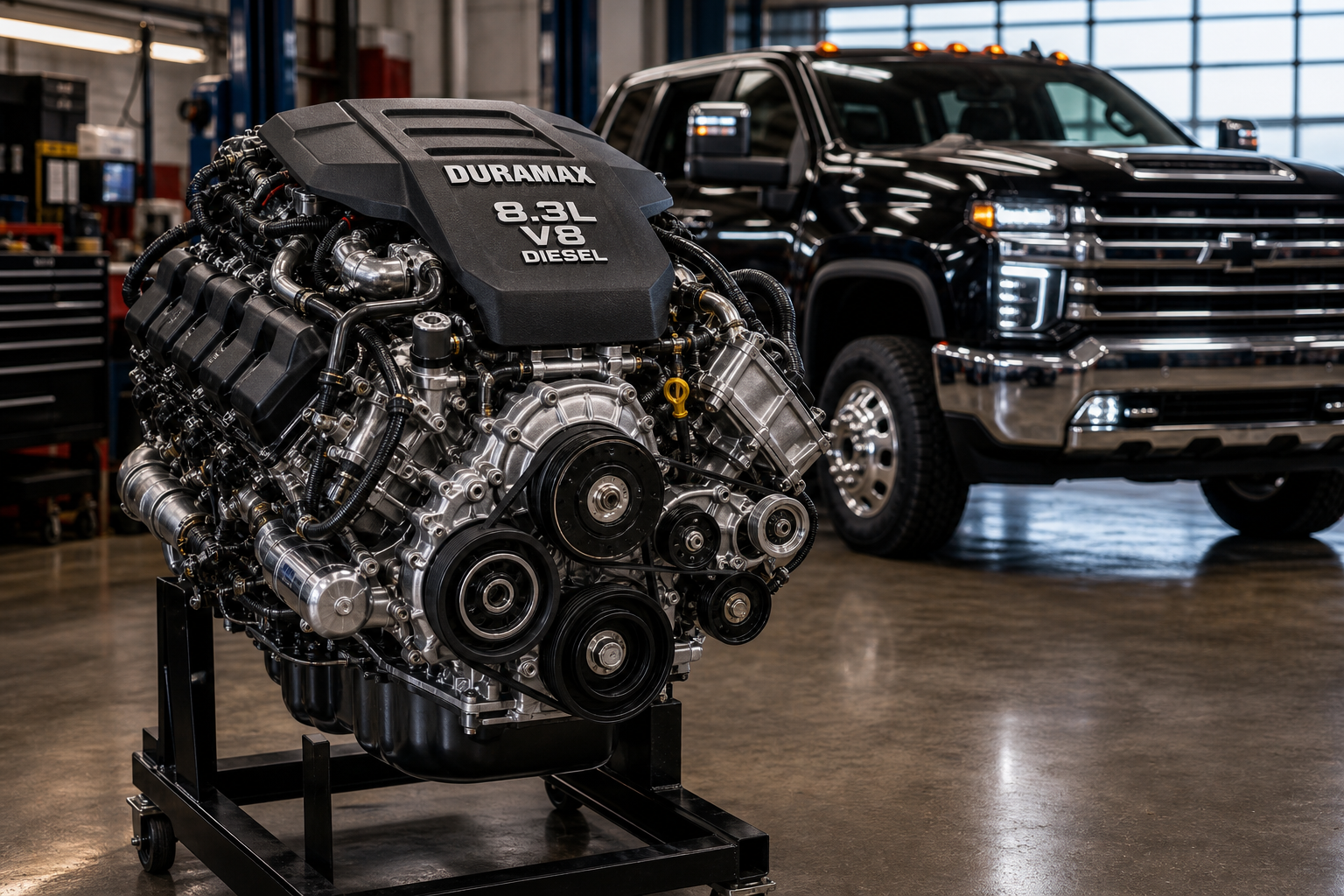

General Motors has dangled a rather large mechanical carrot in front of the heavy-duty truck market: a new 8.3-liter Duramax diesel V8, apparently known as “Mongoose.” No power figures, torque numbers, launch date, or production confirmation have been provided, but the displacement alone is enough to make Ford and Ram glance nervously toward the engineering department.
The teaser positions the engine as a challenger to Ford’s 6.7-liter Power Stroke V8, referred to as “Scorpion.” That means GM may be preparing to answer Ford’s heavy-duty diesel with a considerably larger engine rather than attempting to extract every last molecule of performance from its existing displacement. There are many ways to win an engine war. Adding 1.6 liters is among the least subtle.
What GM Has Actually Revealed
The confirmed information is limited but important. The engine is identified as a Duramax diesel V8 with 8.3 liters of displacement, and GM says it is intended for heavy-duty trucks. The project reportedly carries the name Mongoose. Beyond that, the company has not released the details buyers and diesel enthusiasts will immediately want to know.
- Horsepower and torque remain undisclosed.
- There is no confirmed production timetable.
- GM has not announced which truck models would receive the engine.
- Transmission compatibility and towing ratings have not been specified.
- The engine’s architecture, induction system, emissions hardware, and fuel-system details are unknown.
That lack of information matters. An engine’s displacement tells us something about its potential, but not how it will behave in a truck. A large diesel can deliver formidable low-speed torque, yet its real-world usefulness depends on cooling capacity, transmission calibration, axle gearing, emissions strategy, engine braking, durability testing, and the vehicle’s gross combination weight rating. The badge on the fender is the easy bit.
An 8.3-Liter Answer to Ford’s 6.7-Liter Power Stroke
On paper, the Mongoose has a substantial size advantage over Ford’s 6.7-liter Power Stroke V8. The difference is 1.6 liters, which makes the proposed Duramax roughly 24 percent larger by displacement. That is not a rounding error. It is the sort of difference that makes an engineer reach for a larger calculator and a marketing executive reach for the word “stronger.”
Displacement alone does not guarantee superiority, of course. Modern diesel engines rely on turbocharging, high-pressure fuel injection, sophisticated combustion management, and extensive aftertreatment systems. A smaller engine with more aggressive boost and a well-matched transmission can outperform a larger unit in specific areas. The Ford 6.7-liter Power Stroke has spent years evolving around the demands of Super Duty trucks, where towing performance, thermal management, payload, and long-term durability matter just as much as peak output.
Still, a larger engine gives GM more room to generate torque without leaning quite so heavily on boost pressure. It could also provide a broader torque curve, improved performance under sustained load, or a more relaxed character when pulling a heavy trailer up a long grade. Those are possibilities, not confirmed attributes. Until GM publishes the figures, the 8.3-liter number is a promise of potential rather than proof of victory.
The Duramax Name Carries Some Baggage—and Some Credibility
Duramax is hardly a newcomer to the diesel truck conversation. GM has used the name on its heavy-duty diesel engines for decades, most prominently in the Chevrolet Silverado HD and GMC Sierra HD. The current 6.6-liter Duramax V8 has become a familiar competitor to Ford’s Power Stroke and the diesel engine used in Ram heavy-duty pickups.
That history gives the Mongoose project a useful foundation. GM does not need to explain what a Duramax is or persuade truck buyers that the name belongs in a heavy-duty pickup. It does, however, need to show why an entirely new 8.3-liter engine is worth the engineering expense at a time when diesel engines face increasingly complicated emissions requirements and tightening efficiency expectations.
Building a bigger diesel is not merely a matter of boring out cylinders and attaching a larger turbocharger, despite what certain internet forums may suggest after midnight. The engine must meet emissions regulations, survive extended high-load operation, fit within an existing or revised engine bay, and work with a transmission capable of handling its output. The cooling package may need to grow as well, which affects front-end design, airflow, packaging, and curb weight.
Why Heavy-Duty Truck Buyers Will Care About More Than Peak Torque
Heavy-duty truck buyers often use horsepower and torque figures as shorthand for capability, but those numbers only tell part of the story. A truck used to tow a fifth-wheel trailer across the Rockies places very different demands on its powertrain than one used for occasional equipment hauling. Sustained load, transmission temperatures, engine braking, trailer stability, and serviceability can matter more than a headline figure displayed in a dealership brochure.
If the Mongoose reaches production, GM will need to demonstrate how the engine performs in those less glamorous situations. Can it maintain speed without constantly shifting? Does it provide predictable response at low rpm? How effectively does it control a trailer on a descent? Does the cooling system remain comfortable when the truck is loaded near its limit in hot weather? These are the questions that separate a genuinely useful heavy-duty powertrain from a dyno-sheet celebrity.
There is also the question of weight. A larger diesel may produce more torque, but additional mass over the front axle can affect payload calculations, ride quality, and chassis balance. Heavy-duty trucks already operate in a world of complicated ratings, where the most powerful engine is not automatically the best choice for every buyer. An 8.3-liter option could be ideal for serious towing while being unnecessary—and potentially less efficient—for drivers who spend most of their time unloaded.
GM’s Challenge Is Bigger Than the Engine
GM’s decision to tease the engine rather than reveal a complete specification sheet suggests the company may be setting up a longer product announcement. The name Mongoose is particularly intriguing. Whether it becomes an official production name or remains an internal project label is unknown, but it gives the teaser a combative tone. Ford has the Scorpion. GM has a mongoose. Somewhere, a branding meeting has apparently turned the pickup segment into a wildlife documentary.
The real contest will involve the entire truck, not merely the engine. A powertrain with considerable output is useful only when the chassis, transmission, driveline, brakes, suspension, and cooling systems can convert that output into dependable towing capability. GM would also need to explain whether the new engine supplements the existing 6.6-liter Duramax or replaces it in selected applications.
That distinction could shape the truck’s character. A larger engine positioned above the current Duramax would give Chevrolet Silverado HD and GMC Sierra HD buyers a higher-performance option for extreme towing. A full replacement would be a more consequential move, especially if the new engine brings higher purchase and maintenance costs. At present, GM has not said which path it intends to take.
What We Still Need to Know
The next announcement will need to answer several practical questions. Output figures will be the obvious headline, but serious truck buyers will also want towing ratings, payload impact, transmission details, fuel-economy expectations, service intervals, and the engine’s emissions-system design.
Availability will matter just as much. Will the Mongoose be offered across Chevrolet and GMC heavy-duty lineups, or reserved for particular configurations? Will it require dual rear wheels, a specific cab style, or a revised chassis? Will it be available only in the most expensive trims? GM has provided none of those answers yet.
For now, the 8.3-liter Duramax is best viewed as an unusually bold signal rather than a finished product. The displacement makes it a serious threat on paper, and the comparison with Ford’s 6.7-liter Power Stroke gives the teaser a clear target. But diesel truck buyers have learned to distrust simple numbers. The engine that wins the brochure contest still has to tow a mountain without cooking its transmission.
GM has shown the size of the mongoose. The bite remains unmeasured.
0 Comments