
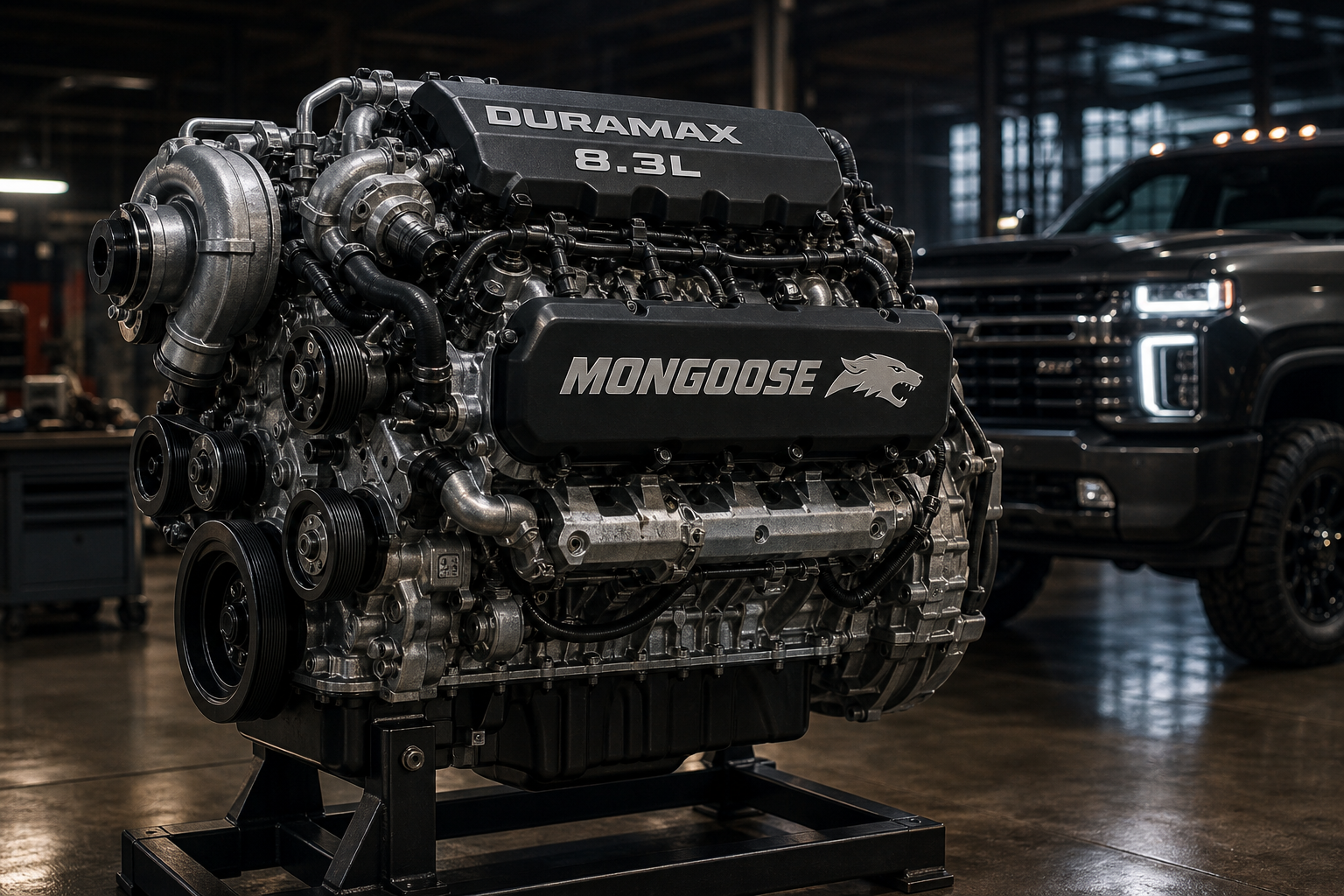

General Motors has dropped a rather intriguing breadcrumb into the diesel pickup world: a new 8.3-liter Duramax engine carrying the name Mongoose. That is all the company has formally revealed so far, but the displacement alone is enough to make the heavy-duty truck crowd sit up and stop pretending it was busy.
The engine is also being positioned with an unmistakable Detroit rivalry in mind. General Motors is not merely hinting at a larger diesel; it appears to be preparing to take a swing at the competition from Ford and Stellantis, whose Power Stroke and Cummins-powered Ram trucks dominate the same fiercely contested corner of the market.
What General Motors Has Actually Revealed
The confirmed information is pleasingly short and annoyingly tantalizing. General Motors has teased a new Duramax diesel with an 8.3-liter displacement and the internal or promotional name “Mongoose.” The automaker has also indicated that it intends to call out its rivals in the process.
Everything else remains behind the curtain. General Motors has not disclosed horsepower, torque, cylinder configuration, forced-induction hardware, transmission pairing, emissions strategy, fuel-system details, production timing, or the trucks that might receive the engine. There is no confirmed launch date, pricing information, towing rating, payload rating, or indication of whether Mongoose will reach dealerships at all.
That distinction matters. Automakers tease engines and vehicles for several reasons, including gauging public reaction, previewing future technology, or simply reminding competitors that their engineers have not gone home. A teaser is not yet a production announcement, and an engine name is not the same thing as a specification sheet.
Why an 8.3-Liter Duramax Is Significant
Duramax is already a familiar name in heavy-duty pickup circles, particularly through General Motors’ Chevrolet Silverado HD and GMC Sierra HD trucks. The current generation of GM’s heavy-duty diesel offering uses a 6.6-liter V8, so an 8.3-liter engine would represent a considerable increase in displacement rather than a modest revision with a new sticker and an optimistic press release.
That extra displacement could give engineers more room to pursue torque, durability, or lower engine stress under sustained load. Heavy-duty truck engines spend their lives doing work that would make an ordinary passenger-car powertrain file for early retirement: pulling trailers up grades, carrying substantial payloads, operating in hot weather, and enduring long periods of high load. More displacement can help deliver the required output without relying entirely on aggressive boost pressure and extreme cylinder pressures.
Of course, displacement is only one part of the machinery. A large diesel can still be compromised by an overly ambitious emissions system, excessive weight, poor thermal management, an unsuitable transmission, or packaging requirements that turn routine service into a battle with a box of angry snakes. The final result will depend on the entire powertrain, not merely the number cast into the specifications.
There is also a weight and efficiency trade-off. A larger engine may provide useful low-speed authority, but it can add mass to the vehicle and consume more fuel when unloaded. Heavy-duty truck buyers generally accept a fuel penalty in exchange for capability, but they still notice when a truck behaves like it has swallowed a small industrial plant.
The Mongoose Name Is a Deliberate Choice
Engine names are rarely selected at random. “Mongoose” is a compact, memorable word with an obvious aggressive edge, and it carries a built-in association with taking on something larger and more dangerous. That makes it a rather pointed choice for an engine aimed at a segment where manufacturers spend enormous sums trying to prove that their truck can tow more, last longer, or produce one additional pound-foot of torque than the next truck.
It also gives General Motors a convenient way to talk about the engine before it publishes the numbers that will matter to buyers. A name can create recognition; the dyno chart eventually has to do the heavy lifting.
The naming strategy fits the increasingly theatrical nature of heavy-duty pickup marketing. These trucks are working tools, but they are also status symbols, family tow vehicles, mobile offices, and occasionally enormous shopping carts. Their engineering is serious. The advertising can be gloriously unsubtle.
General Motors Is Walking Into a Serious Rivalry
Any new heavy-duty diesel from General Motors will be judged against established opponents. Ford’s Super Duty lineup uses the Power Stroke name, while Ram relies on Cummins diesel engines in its heavy-duty trucks. Those brands have spent years building customer loyalty around towing performance, reliability, service networks, resale value, and the simple human pleasure of telling a neighbor that one’s truck is stronger than the neighbor’s truck.
That is why an 8.3-liter Duramax could be strategically important even before its output is known. A larger engine gives GM a fresh technical talking point and potentially more room to compete at the top of the segment. It could be aimed at customers who regularly tow large fifth-wheel trailers, equipment haulers, and commercial loads, rather than buyers who merely want the visual drama of a diesel badge on the fender.
Yet maximum output is not the only contest. Heavy-duty customers tend to care about how power is delivered, how confidently the transmission handles a loaded trailer, how the truck behaves on long descents, how much cooling capacity it has, and whether routine maintenance remains manageable. A spectacular peak torque figure is useful, but a truck that becomes unpleasant or expensive when worked hard has missed the point rather badly.
The Questions GM Still Needs to Answer
The Mongoose teaser leaves several important issues unresolved:
- Will the 8.3-liter engine use a V8 layout, or take another form?
- Which Chevrolet and GMC trucks will receive it, if it reaches production?
- How much horsepower and torque will it produce?
- Will it be paired with an existing heavy-duty automatic transmission or a new unit?
- What towing, payload, and gross combined weight ratings will result?
- How will General Motors manage emissions, cooling, noise, and fuel consumption?
- Is Mongoose intended for pickups, commercial vehicles, or both?
Those details will determine whether the engine is a genuine response to Ford and Ram or simply a very large piece of engineering theater. The modern diesel powertrain is constrained by emissions regulations, packaging, calibration, and durability requirements. Building a powerful engine is difficult. Building one that can meet regulations, fit beneath a production truck’s hood, survive years of abuse, and remain profitable is the part that ruins everyone’s weekend.
A Promising Tease, Not Yet a Truck-Buying Decision
For now, Mongoose is best understood as a promise of intent. General Motors appears ready to make a louder entry into the heavy-duty diesel arms race, and the 8.3-liter figure suggests that the company is not planning a timid refresh of the existing Duramax formula.
That does not mean buyers should postpone a truck purchase or assume the next Silverado HD will suddenly arrive with a giant diesel. There is no confirmed production specification to evaluate yet. The sensible response is to watch for the figures that cannot be dressed up with a dramatic animal name: rated torque, towing limits, transmission details, fuel economy, service requirements, and the conditions under which the engine can deliver its advertised performance.
Still, the teaser has done its job. General Motors has put the heavy-duty truck market on notice, named the weapon, and hinted that Detroit’s familiar rivalry is about to become considerably louder. Now it needs to show the mongoose.

0 Comments