
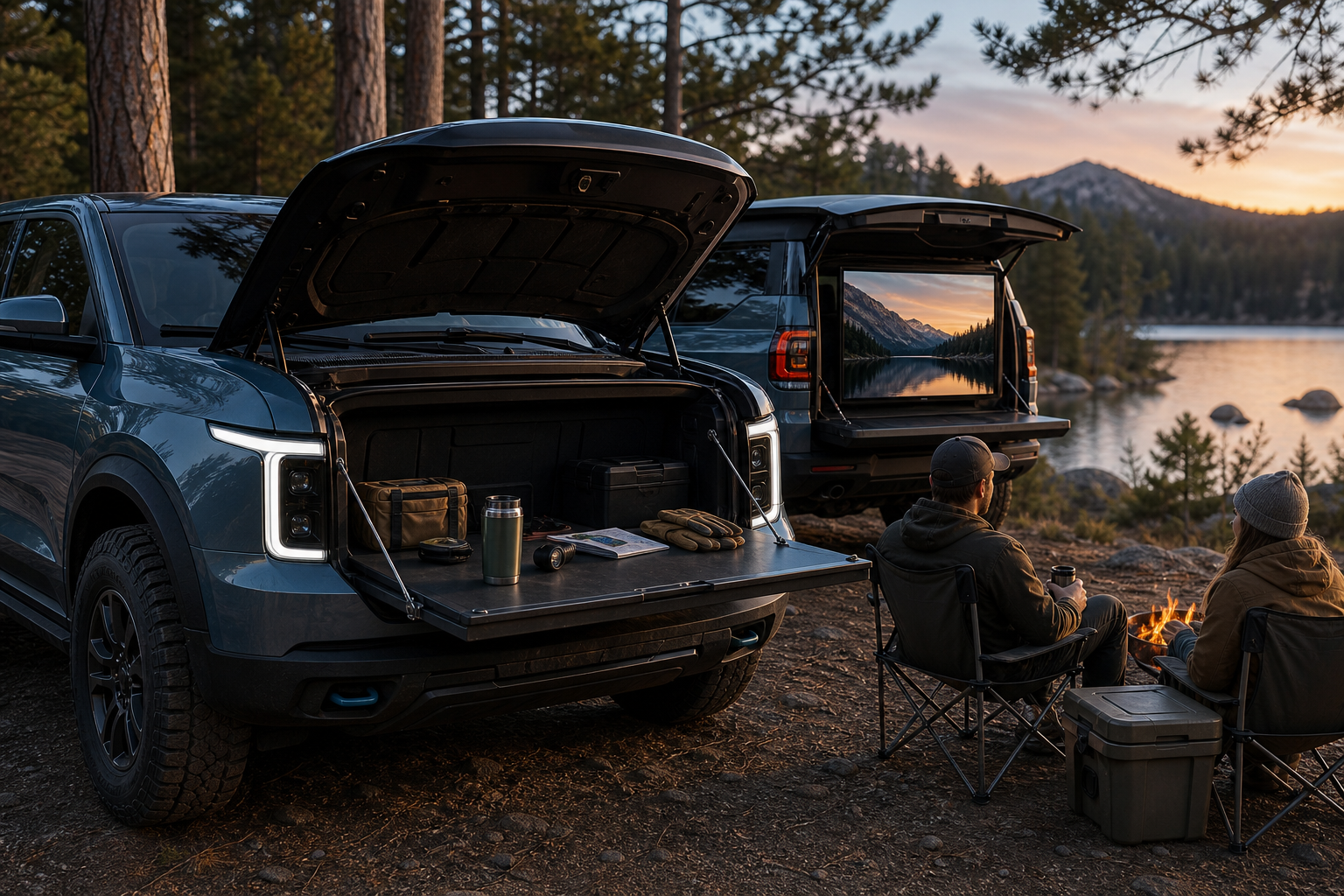

Ford has patented a vehicle concept that appears to treat both ends of the vehicle as outdoor furniture: a front cargo area that can open into a work surface and a rear-mounted television that folds down for viewing. It is a wonderfully strange pairing, somewhere between a mobile workshop and a tailgate party hosted by an electrical engineer.
The drawings are associated with Ford Fathom and outline two separate ideas. Up front, the vehicle appears to feature a front trunk—often called a frunk—with a folding panel or tailgate-style section that creates a usable work surface. At the rear, another folding panel accommodates a television display that can be deployed when the vehicle is parked.
That is the substance of the patent. Ford has not confirmed that either feature will reach production, and the drawings do not establish a launch date, vehicle price, powertrain, dimensions, or even a final model designation. As ever with automotive patents, the paperwork shows what a manufacturer has considered protecting, not necessarily what it intends to sell next Tuesday.
A Front Trunk That Does More Than Hold a Charging Cable
Front storage has become a useful packaging opportunity on vehicles without a conventional gasoline engine occupying the nose. A front trunk can provide a place for smaller cargo, tools, groceries, or charging equipment, although many modern designs still treat it as a novelty rather than a genuinely useful compartment.
Ford’s Fathom concept appears to take the idea further by turning the front compartment into a work area. A folding section at the front of the vehicle would provide a horizontal surface for tasks that are awkward to perform on the ground or on the vehicle’s roof. The patent drawings suggest a setup intended to be accessed from outside the vehicle, rather than merely a clever way of rearranging luggage space.
The usefulness would depend heavily on details that are not yet available. A work surface needs to be at a sensible height, remain stable when deployed, and avoid becoming a shallow plastic tray with the structural confidence of a cafeteria table. It would also need protection from rain, dirt, road spray, and the sort of sticky residue that appears mysteriously whenever a vehicle is used outdoors.
Ford could be considering applications such as roadside work, outdoor recreation, equipment preparation, or tailgate use. But the patent does not state a specific customer or activity, so it would be premature to describe Fathom as a dedicated work vehicle. At present, it is best understood as a flexible body and storage concept.
The Rear Television Is the More Unexpected Trick
The rear feature is less practical in the traditional automotive sense and considerably more attention-grabbing. The drawings show a television that folds down from the back of the vehicle, allowing occupants outside the vehicle to watch it while parked.
That immediately places the idea in tailgating territory, though a fold-down screen could also suit outdoor movies, sports viewing, family events, or simply distracting children while adults attempt to assemble something from a box containing one mysteriously unnecessary Allen key. Ford has not provided screen size, resolution, audio arrangements, connectivity details, or any explanation of how the display would be protected when not in use.
Those missing details matter. A large exterior screen would need a robust mounting system and weather resistance. It would also have to cope with wind, dust, accidental contact, and the inevitable person who believes every vehicle-mounted display is an appropriate place to hang a jacket. Power consumption would be another consideration, particularly if the vehicle is parked for an extended period.
There is also the question of whether the screen is meant to be permanently integrated into the vehicle or stored in a covered compartment. A built-in system could look tidy and work quickly, but it would add cost and complexity. A removable display might be easier to replace or upgrade, though that rather undermines the convenience of having it ready at the push of a button.
Why Put Both Ideas on the Same Vehicle?
The front work surface and rear TV may appear unrelated, but they point toward the same basic ambition: making a vehicle useful while stationary, not merely while traveling from one place to another.
That is a meaningful shift in how manufacturers think about vehicle packaging. A car traditionally spends most of its life parked, yet its design is dominated by the requirements of driving. Features such as fold-out tables, external power outlets, built-in coolers, and deployable screens attempt to make the parked vehicle part of the activity rather than an object sitting beside it.
Ford has explored similar territory across its broader vehicle range, particularly with trucks and utility-focused models that turn the bed, cabin, or power system into equipment for work and recreation. The Fathom patent appears to extend that thinking to the front and rear ends of the vehicle. Instead of treating body panels as purely protective surfaces, it treats them as potential platforms.
That approach could be especially useful for vehicles designed around camping, sporting events, mobile work, or outdoor leisure. It also reflects the growing expectation that vehicles should provide outlets, screens, storage solutions, and workspace on demand. Whether this is genuine utility or merely another way to add a screen to a car depends on how thoughtfully the final system is engineered.
A Patent Is Not a Production Announcement
The most important caveat is the simplest one: Ford has patented the concept, but the existence of a patent does not confirm that Fathom will become a showroom vehicle or that these features will appear exactly as shown.
Automakers routinely file patents to protect possible designs, packaging solutions, mechanisms, and user interfaces. Some reach production with only minor changes. Others remain in the filing cabinet forever, alongside abandoned dashboards, peculiar door systems, and ideas that seemed better before somebody calculated the warranty cost.
The drawings therefore provide a glimpse into Ford’s thinking rather than a firm product plan. There is no announced production vehicle, no confirmed market, and no published technical specification attached to the concept in the available material. Any assumptions about a particular platform or powertrain would be just that: assumptions.
Useful Innovation or Automotive Theater?
The front work surface has a clear argument if Ford can make it sturdy, weatherproof, easy to clean, and large enough to use without requiring the owner to crouch beside the vehicle like a mechanic repairing a lawn mower. The rear television is more niche, but that does not make it pointless. Tailgate culture has already created demand for built-in power, audio, lighting, and entertainment equipment.
The challenge will be keeping these features from becoming expensive gadgets that look impressive in patent illustrations but rarely earn their keep in daily use. A vehicle can be clever without being useful, and the automotive industry has spent decades proving that it is perfectly capable of confusing the two.
For now, Ford Fathom remains an intriguing design exercise: a vehicle with a front end that could become a workstation and a rear end that could become an outdoor cinema. Whether customers ever get to use either feature will depend on the decisions made long after the patent drawings stop looking tidy and start encountering weather, cost targets, safety requirements, and real human beings.
0 Comments