
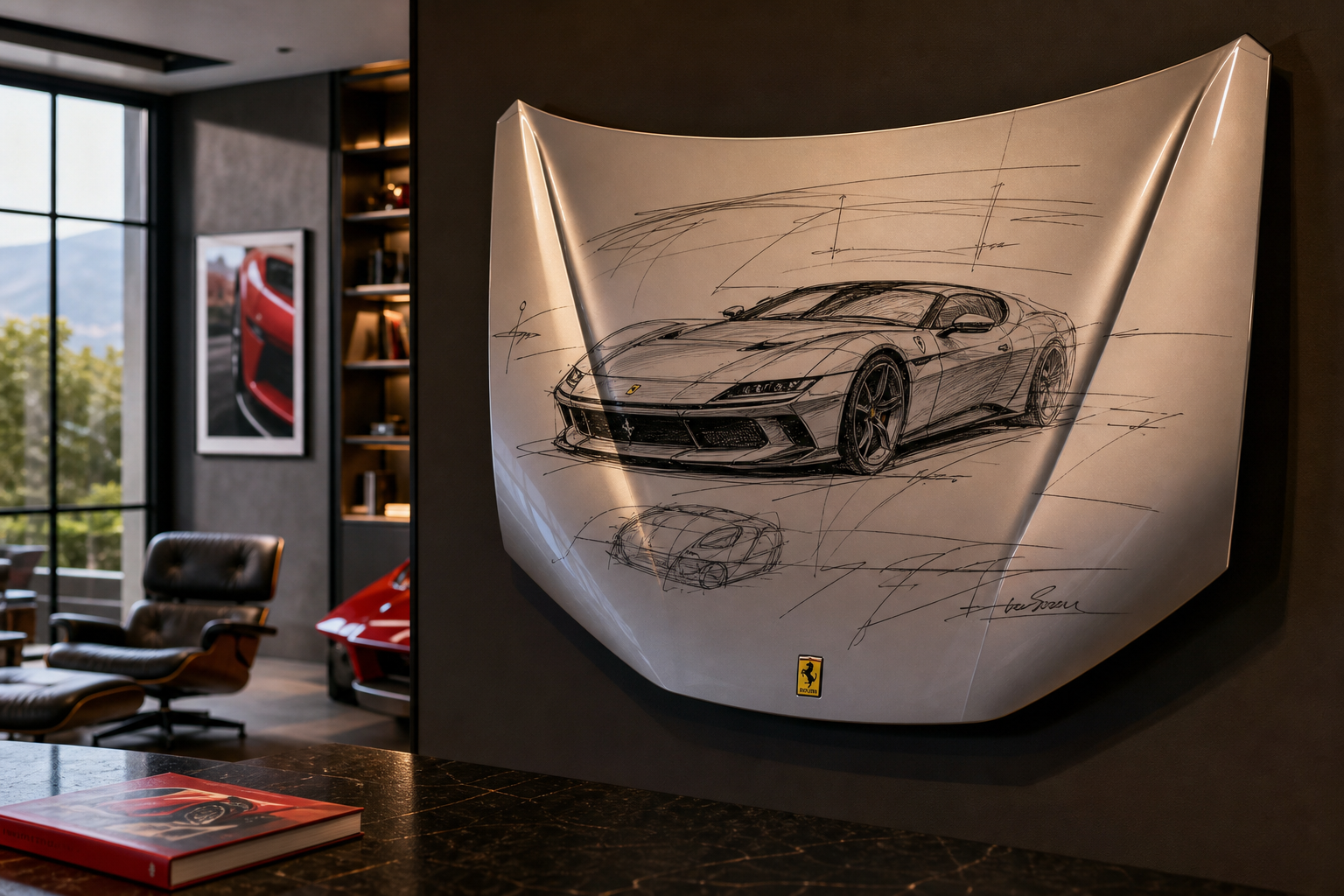

Ferrari is offering a rather unusual way to bring one of its cars into the living room: buy a body panel, keep it safely away from traffic, and hang it on the wall as artwork.
The idea centers on panels associated with the Ferrari 12Cilindri, including its hood, with the surface treated as a canvas for sketches by Ferrari’s chief designer. In other words, this is not a spare part rescued from a repair shop or an old racing panel with a glamorous story attached to it. It is a piece of Ferrari design work presented as an object in its own right.
When the Hood Becomes the Canvas
Car manufacturers have spent decades turning their design departments into part studio, part laboratory and part theater. Ferrari is simply taking the theatrical element a step further. Rather than showing only the finished 12Cilindri, the company is offering enthusiasts a glimpse of the thinking that produced it.
A sketch on paper is intimate, but it remains a sketch. A sketch drawn across an actual vehicle panel has a different presence. The shape underneath still carries the physical logic of the car: the sweep of the surface, the edges, the curvature and the scale. Even sitting motionless on a wall, the panel retains a connection to the machine it was intended to become.
That makes the proposition more interesting than simply selling a framed Ferrari print. A print can reproduce an image. A body panel is part of the object’s physical vocabulary. It is automotive design with the polite pretense of furniture.
The 12Cilindri Is an Appropriate Subject
Ferrari’s choice of the 12Cilindri is hardly accidental. The name itself announces the car’s defining feature, while the model occupies a particularly visible place in Ferrari’s grand touring tradition. Its design is meant to be studied from several angles, and a large exterior panel provides considerably more room for a designer’s lines than a pocket-sized sketchbook ever could.
The hood is especially effective as a display surface. It is large enough to command attention, yet familiar enough that viewers can immediately understand its relationship to a real car. Put one in a living room and guests may not know whether they are looking at sculpture, industrial design or an extremely expensive argument against minimalist interior decoration. That uncertainty is part of the appeal.
It also brings the design process closer to the customer. Ferrari buyers are accustomed to personalization, special finishes and carefully curated specifications. This takes that appetite away from the driveway altogether. The owner does not have to choose a paint color, wheel design or leather combination for a car. Instead, the owner gets an artifact linked directly to the visual creation of one.
More Than a Spare Part, Less Than a Car
There is an important distinction here. The panel is not being presented as a practical component for somebody’s 12Cilindri restoration project. Nor is it a substitute for owning the car itself. It occupies the peculiar middle ground where luxury goods become collectibles and automotive components acquire gallery manners.
That category has grown because manufacturers have learned that enthusiasts often want access to the story around a car, not merely the car. Design sketches, clay-model fragments, scale models and signed memorabilia all provide a sense of proximity to the creative process. A sketched body panel makes that process unusually tangible, even if it would be hopelessly impractical to store in the average hallway.
It also avoids pretending that the object is something it is not. Ferrari is not disguising a design exercise as a usable household item. The panel’s purpose is visual. Its job is to be looked at, discussed and admired, rather than fitted, painted or sent through an automatic car wash. Frankly, that is probably for the best.
The Designer’s Hand Is the Point
The involvement of Ferrari’s chief designer gives the panel its central value. Without that connection, a body panel would remain a beautifully made but fairly anonymous piece of automotive material. With the designer’s sketches across it, the panel becomes a record of authorship.
That does not mean every line needs to be decoded like an ancient manuscript. The appeal is less about understanding each mark and more about seeing the movement from surface to idea. Automotive design is usually hidden behind finished paint, production tolerances and the enormous machinery required to turn a proposal into a road car. Here, the marks remain visible.
For Ferrari, that is a useful reminder that its products are sold through design as much as through mechanical specification. The company’s badge carries enormous weight, but the shape beneath it does much of the emotional work. Offering a designer-sketched panel makes that creative labor part of the product rather than leaving it behind the studio doors.
A Ferrari for the Wall
The obvious question is who will buy one. The answer is unlikely to be somebody searching for a sensible way to decorate a modest apartment. A full-size hood is an assertive piece of wall art, the sort of thing that turns a room into a conversation and perhaps causes a nearby interior designer to stare silently into the middle distance.
But Ferrari has never built its business around strict necessity. A 12Cilindri is not bought because a less expensive sedan could not perform the same basic transportation duties. The same logic applies here. The panel is an object of desire, tied to a specific model and elevated by its connection to Ferrari’s design leadership.
The crucial details for buyers will be the details Ferrari has not provided in the supplied announcement: price, dimensions, production quantity, materials, authentication and whether each panel carries a unique sketch. Those points will determine whether the piece behaves like limited-edition art, premium memorabilia or an especially lavish form of automotive merchandise.
For now, the concept is clear enough. Ferrari is selling a fragment of the design process rather than another miniature model or glossy poster. It is a clever, gloriously unnecessary object, which is precisely why it feels so thoroughly Ferrari.


0 Comments