
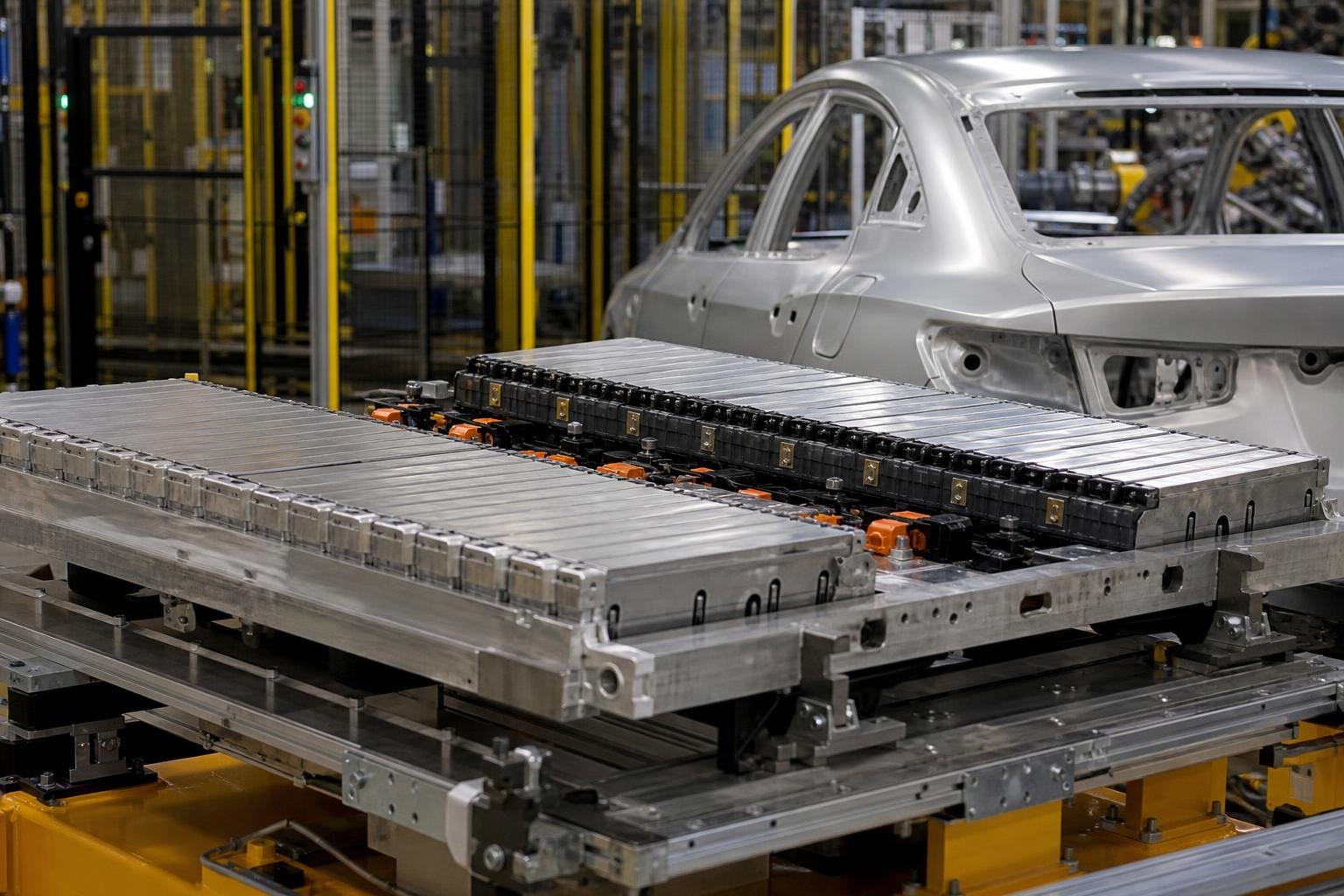

Europe’s effort to build a domestic electric-vehicle supply chain could strengthen the region’s automotive industry, but a new policy analysis warns that consumers may pay for much of the transition. For a typical electric car with a 60-kWh battery, requiring EU-made cells could add an estimated €2,100 to manufacturing costs.
The figure comes from a policy brief by Brussels-based think tank Bruegel, as reported by InsideEVs. The calculation is based on an estimated increase in battery-cell costs from €50 to €85 per kilowatt-hour if manufacturers are required to source cells made within the European Union.
Why European battery cells cost more
Battery manufacturing is central to the competitiveness of the modern car industry. Cells represent a substantial share of an EV’s cost, while battery plants also anchor jobs, suppliers and technical expertise in the regions where they are built. That makes local production attractive to European policymakers, particularly as China remains dominant across much of the global battery supply chain.
However, European factories have struggled to match the scale, supply networks and production costs established in Asia. A €35-per-kWh increase, multiplied across a 60-kWh pack, produces the €2,100 estimate. That is not necessarily the final increase on a showroom sticker: manufacturers could absorb some of the expense, governments could provide subsidies, and larger production volumes could gradually narrow the gap.
Even so, the cost is particularly important for smaller and less expensive EVs. Adding several thousand euros to a premium vehicle may be easier to absorb than adding the same amount to a compact hatchback intended to bring electric driving to a mass-market audience.
Other industrial rules could add to the bill
Bruegel’s calculation also includes an estimated €200 increase associated with a proposed low-carbon steel requirement. The policy objective is to reduce emissions from vehicle manufacturing, but cleaner steel generally requires additional investment in production facilities, energy supply and processing.
There could be modest savings elsewhere. Simplifying vehicle-approval procedures is estimated to save manufacturers about €61 per vehicle. That reduction, however, would be small compared with the potential battery and materials costs. The result illustrates the broader challenge facing European industrial policy: individual rules may appear manageable, but their combined effect can influence the affordability of new cars.
None of these figures represents a confirmed surcharge that every European EV buyer will pay. The final result would depend on the details of any “Made in Europe” requirements, the timing of implementation, state aid and how manufacturers divide the cost between profits and vehicle prices.
Europe has a strong reason to protect its car industry
The argument for intervention is not simply about preserving familiar brands. The automotive sector supports approximately 14 million jobs across Europe, including manufacturing, engineering, logistics, retail and maintenance. According to the figures cited in the report, EU vehicle production has fallen 19% since 2019, while new-car demand in 2025 remained 2.2 million vehicles below its 2019 level.
The transition to electric powertrains also changes the industrial map. Traditional engine and transmission manufacturing employs large numbers of specialist suppliers, while batteries, software, power electronics and charging systems are becoming more important sources of value. If European companies lose those capabilities, the region could remain dependent on imported technology even if final vehicle assembly stays local.
Bruegel also points to continued exports and roughly €3 billion in quarterly investment in battery and EV factories, while warning that Europe could gradually lose technology, suppliers and overseas customers. That competition matters because battery plants are expensive, long-term projects. Europe needs to attract capital while also offering enough market certainty for companies to invest in factories that may take years to reach competitive output.
Local production has already faced setbacks
Europe’s battery ambitions have encountered several obstacles. Northvolt’s failure, Porsche’s decision to retreat from planned Cellforce battery manufacturing and delays affecting Automotive Cells Company projects have highlighted the difficulty of competing with established Asian producers.
Building a factory in Europe does not automatically create an entirely European supply chain, either. Plants may still depend on Asian machinery, materials and technical expertise. Research cited by InsideEVs indicates that South Korean companies control a large share of Europe’s existing battery-cell manufacturing capacity, while Chinese companies account for much of the capacity currently under construction.
Foreign investment can therefore be part of the solution rather than a failure of European industrial policy. The more immediate question is whether overseas companies build lasting European capabilities, employ local workers and develop suppliers in the region.
Trade restrictions can protect production while raising prices
Europe has already introduced additional duties on Chinese-made electric vehicles, with rates reaching as high as 35.3% for some manufacturers. The measures are intended to offset concerns about state support and protect European producers from rapidly expanding Chinese competition. They may also reduce the availability of some lower-priced EVs.
The policy trade-off is visible in the market. Bruegel’s analysis, as reported by InsideEVs, points to flattening battery-electric imports from China alongside rising plug-in-hybrid imports, which were not covered by the same duties. The report also cites French research suggesting that EVs excluded from purchase subsidies suffered a 60% sales decline compared with eligible models. That finding reinforces how sensitive demand remains to upfront pricing.
Protection can buy manufacturers time, but it does not guarantee that they will use that time effectively. If restrictions reduce competitive pressure without accelerating cost reductions, consumers could face more expensive vehicles while the industry remains unprepared for global competition.
Affordability may be the decisive test
The pressure is greatest at the affordable end of the market, where several thousand euros can determine whether an electric car is within reach. The battery calculation makes clear why local production could create a difficult trade-off: Europe may gain industrial resilience while making entry-level EVs harder to price competitively.
Local battery production could eventually support cheaper vehicles by reducing supply-chain risk and creating economies of scale. In the short term, however, protectionist measures risk making the affordable end of the market even harder to serve.
Bruegel’s proposed answer is temporary protection, potentially combined with an agreement to limit Chinese electric-car and plug-in-hybrid exports to Europe for a defined period. Such a system would give European companies time to develop cheaper products without creating a permanent shield from competition. Its success would depend on firm deadlines and measurable industrial progress.
Europe’s battery strategy therefore faces a difficult balance. Domestic production may be necessary to protect technological capability and industrial employment, but a policy that simply transfers higher costs to EV buyers could slow adoption. The strongest approach would link public support and trade protection to clear reductions in vehicle prices, stronger local expertise and faster development of genuinely affordable electric cars.
Sources: InsideEVs.
0 Comments