
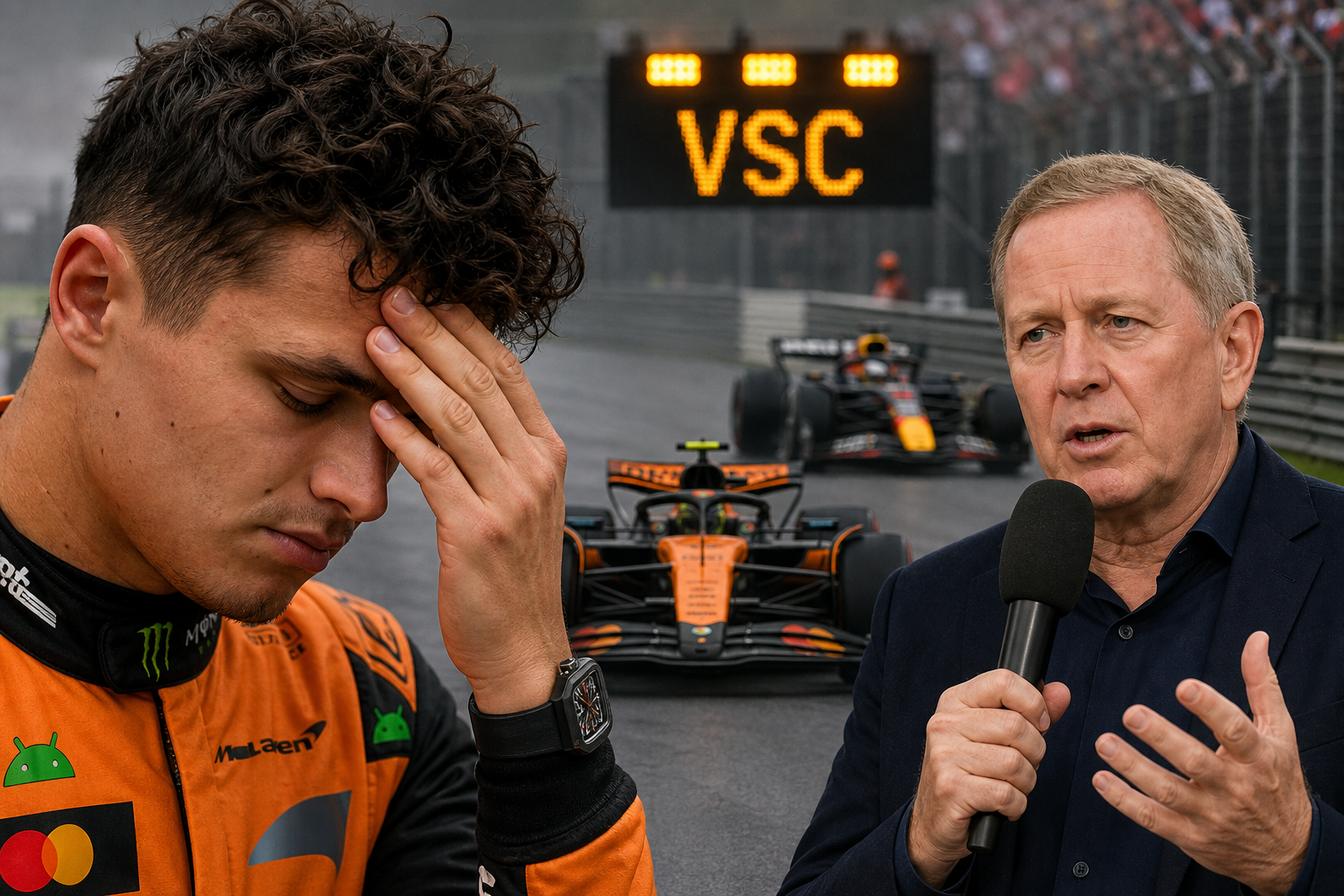

Martin Brundle has entered the growing debate over Formula 1’s virtual safety car rules after Lando Norris lost what looked like a potential victory in Madrid. The issue has revived a familiar question in grand prix racing: should a race leader be protected from losing a place to a late caution, or should strategy and timing remain part of the game even when the field is neutralised?
The circumstances in Spain made the debate especially pointed. A virtual safety car can compress the field and alter the outcome of a race without the full intervention of a safety car, and that can create situations where a driver’s track position is effectively taken away through no direct on-track battle. In Norris’s case, Brundle believes the outcome exposed a flaw in the current approach and has proposed a fix that would stop a leader from being disadvantaged by the timing of a VSC deployment.
Why the virtual safety car has become such a talking point
The virtual safety car was introduced to slow the field in a controlled way when marshals or debris make double-waved yellows insufficient, but a full safety car is not required. Cars must reduce speed to a delta time, and the system is designed to neutralise risk without bunching the pack into a pit-lane-style restart.
That principle sounds straightforward, yet the regulation can still create tactical chaos. If a driver pits just before a VSC is triggered, he can gain a substantial advantage over a rival forced to continue at reduced speed. Conversely, a race leader caught out by the timing can see a likely win slip away despite having controlled the race on merit.
Brundle’s intervention reflects the unease many within the sport feel about that imbalance. In his view, the rules should be adjusted so that the leading car is not punished by a neutralisation that arrives at the wrong moment. The exact mechanism of any solution has long been a matter for debate, but the principle is clear: a race result should not hinge too heavily on a random timing effect created by race control.
The Norris example brought the issue into focus
Norris’s lost Madrid victory offered an unusually clear case study. The McLaren driver had been in position to convert his race into a win before the VSC altered the competitive order. That kind of result is never easy for fans, teams, or drivers to accept, because it sits in the grey area between sporting fairness and the realities of modern Formula 1 race management.
Unlike a full safety car, which carries obvious strategic consequences and usually resets the race in a more visible way, a VSC can feel more clinical. The field slows, the gaps shrink or expand in less obvious ways, and the outcome can change without the dramatic spectacle associated with an incident on track. That makes the rule feel administrative rather than sporting when it flips a race on its head.
For teams, this is not just about one lost result. Pit-wall strategy in Formula 1 already depends on an enormous number of variables, from tyre wear and degradation to traffic, stint length, and weather. When the rules can also award or remove a win based on the exact lap a neutralisation is called, the sense of competitive control becomes harder to defend.
What Brundle’s proposal is trying to solve
Brundle’s argument is rooted in fairness rather than in nostalgia for a simpler racing era. He is not suggesting that race control should ignore dangerous situations. Instead, the concern is how to avoid a scenario where the leader is effectively penalised by a safety measure intended to protect the field.
Any fix would need to preserve the VSC’s core safety function while reducing the chance of arbitrary sporting consequences. That is a difficult balance. Formula 1 wants race control tools that are fast, precise, and safe, but it also wants results determined as much as possible by lap time, racecraft, and strategy rather than timing luck.
The challenge is that there is no perfect solution. A full safety car creates its own distortions, while a VSC can produce quieter but equally decisive swings. The sport has spent years refining its procedures in response to criticism, yet incidents like the Madrid race show that the debate is far from settled.
A familiar Formula 1 problem with no simple answer
This is not the first time Formula 1 has wrestled with how race-neutralisation rules should work. The sport has long searched for a way to respond to incidents quickly without allowing competition to become hostage to timing quirks. Whether the discussion centers on safety cars, virtual safety cars, or red flags, the same underlying tension remains: how much influence should race control have over the result?
Brundle’s comments carry weight because he has spent years analysing the sport from both a driver’s and broadcaster’s perspective. He knows how a race feels from inside the cockpit, but also how the audience sees the bigger picture. That combination makes his criticism of the current VSC setup harder to dismiss as simple frustration over one result.
For fans, the Madrid example is likely to keep the conversation alive because it touches on one of the most sensitive issues in modern Formula 1. The sport is at its best when the best car, the best driver, and the best strategic call decide the outcome. When a late neutralisation becomes the decisive factor, even a technically correct procedure can leave the impression that the race was taken out of the drivers’ hands.
Whether Formula 1 changes the regulation or merely refines how it is applied, Brundle’s intervention has ensured the issue will not quietly disappear. Norris’s lost win in Madrid has become another reminder that the sport’s most sophisticated rules can still produce results that feel blunt when viewed through a competitor’s eyes.

0 Comments