
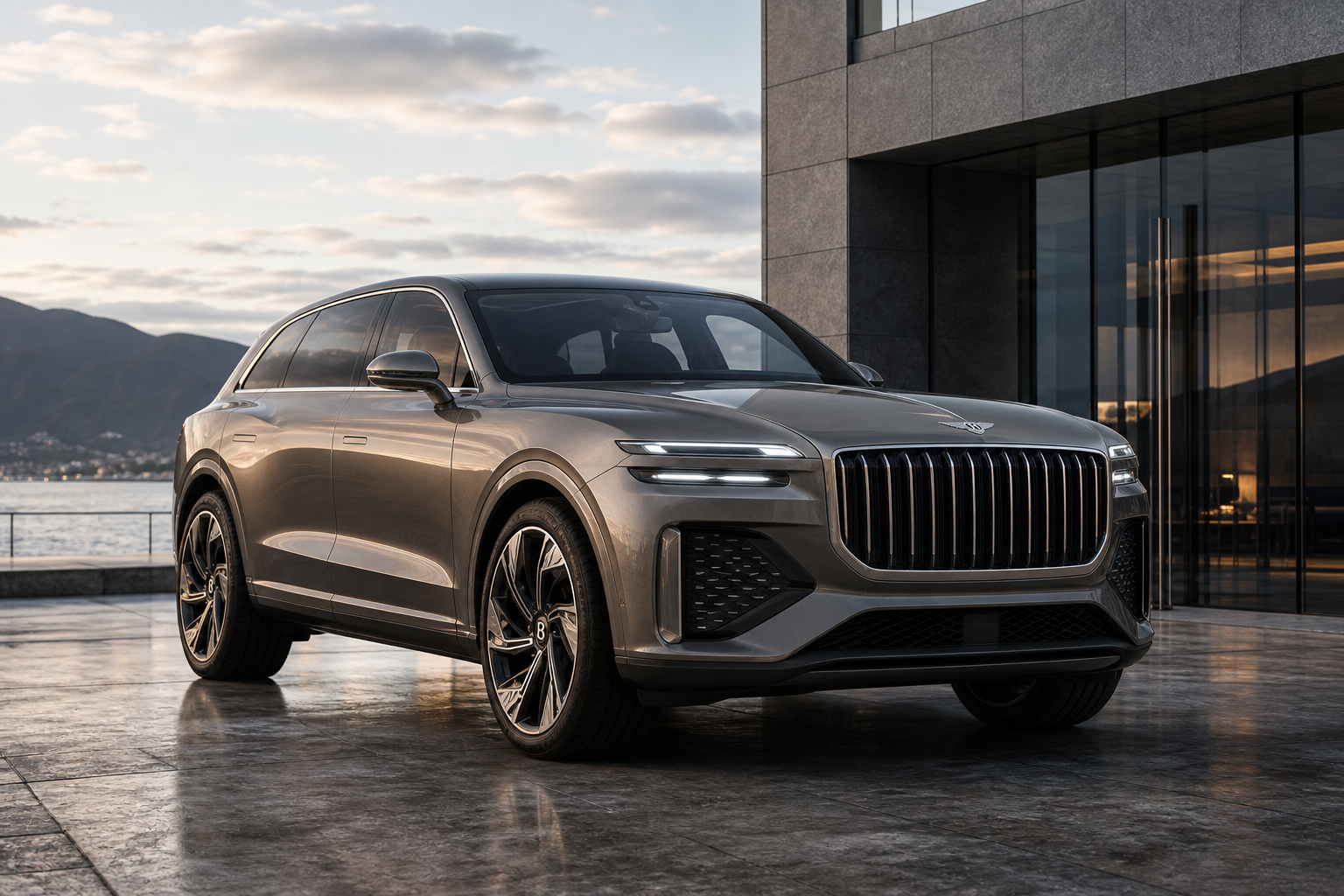

Bentley’s first electric vehicle has arrived with an awkward job description: it must be fast, luxurious, unmistakably Bentley, and sufficiently modern without looking like a rolling piece of consumer electronics. That is a difficult brief. The Torcal, having now been seen in person, appears to understand it.
The new Bentley Torcal makes a strong first impression because it does not seem desperate to advertise its electric identity. There is no need for visual shouting, no obvious attempt to turn the car into a science-fiction prop, and no suggestion that Bentley has abandoned the design language that made its grand tourers recognizable from half a mile away. It looks like a Bentley first and an EV second. That may be the smartest decision the company could have made.
The Torcal Has the Right Problem to Solve
Electric vehicles have made enormous strides in acceleration, refinement, and day-to-day usability. They have also developed a rather predictable visual habit. Many arrive wearing a collection of smooth surfaces, narrow lighting elements, enormous wheels, and enough blank bodywork to make a traditional grille look like an antique fireplace.
Bentley cannot simply follow that recipe. Its customers are not buying anonymous transport with a large battery. They are buying presence. A Bentley needs to look expensive before anyone notices the badge, and it needs to retain a sense of occasion even when it is parked outside a hotel, office, or particularly smug golf club.
The Torcal appears to have been shaped around that reality. Its styling is unmistakable, which is an important achievement for a first electric model. The design does not need to copy Bentley’s existing cars piece by piece, but it must carry the same visual authority. A new powertrain can be silent. The car itself cannot be anonymous.
Performance Without the Mechanical Theater
Bentley has also given the Torcal serious performance, although the available information does not include detailed power, acceleration, range, or battery figures. That omission makes it impossible to judge the car by the usual spreadsheet standards, but the underlying intention is clear enough: this is not meant to be a quiet luxury appliance that happens to wear a winged badge.
Performance has always been part of Bentley’s appeal. Not necessarily in the stripped-out, helmet-and-harness sense of the word, but in the ability to cover ground rapidly while keeping its occupants in an atmosphere of extravagant calm. An electric Bentley has a chance to deliver that character rather well. Instant torque can provide the effortless shove expected of the brand, while electric propulsion can remove much of the vibration and mechanical noise that would otherwise intrude on a long-distance grand tour.
That does not mean the Torcal can rely on acceleration alone. Any modern EV can produce a startling launch if its software, tires, and battery cooling are up to the task. The more difficult trick is delivering speed without turning the car into an exhausting gadget. Bentley’s advantage should be its ability to make performance feel substantial rather than frantic.
There is a difference between a car that is quick and a car that makes quick progress feel natural. The Torcal needs to be the second sort.
Why Seeing It in Person Matters
Photographs flatten cars. They reduce presence to pixels, hide proportions behind carefully chosen angles, and make almost every vehicle look slightly more dramatic than it does in a parking lot. That is particularly relevant for an expensive luxury vehicle, where the relationship between size, stance, surface treatment, and detail is a major part of the experience.
In person, the Torcal’s success comes from its ability to look considered rather than merely elaborate. Bentley has not needed to cover the body with decorative flourishes to make it appear special. The styling has enough confidence to stand on its own, which is preferable to the increasingly common practice of adding another crease whenever a designer fears the panel has become too quiet.
The car’s unmistakable appearance also gives Bentley room to move. The company can develop a new electric identity without abandoning the cues that connect the Torcal to its wider range. That is crucial for a manufacturer whose cars are purchased partly for their sense of continuity. Owners want something new, but they do not necessarily want to feel as though they have bought a completely unrelated machine wearing a familiar emblem.
A Bentley EV Should Feel Expensive in the Right Ways
Luxury in an electric vehicle is not created by a large touchscreen or a heroic list of digital functions. Those things can be useful, but they are also the easiest features for competitors to imitate. The harder task is creating an environment that feels calm, tactile, and properly resolved.
That is where the Torcal will be judged more harshly than an ordinary EV. Buyers will expect the materials, fit, finish, seating position, and cabin atmosphere to justify its Bentley identity. They will also expect the technology to remain subordinate to the experience. A luxury interior should not feel like an electronics showroom that happens to contain some leather.
The same applies to the way the car delivers its performance. If the Torcal launches violently but feels busy, heavy, or overmanaged at normal speeds, it will have missed the point. Bentley’s traditional appeal lies in effortlessness: the car should make difficult distances seem easy and high speeds feel almost indecently relaxed.
The Risk Is Trying Too Hard
The Torcal’s strongest quality may be its restraint. Bentley’s first EV does not need to prove that electric power is clever. The market already knows that. Nor does it need to imitate a sports car, a limousine, and a technology demonstrator at the same time. That way lies a vehicle with twelve personalities and no particularly convincing one.
There is also a danger in chasing novelty for its own sake. Electric vehicles already carry plenty of conceptual baggage: hidden controls, complicated menus, theatrical lighting, and design details that will look dated as soon as the next software update arrives. Bentley should be careful not to confuse newness with luxury. A feature can be modern and still be annoying. The two conditions are not mutually exclusive.
The Torcal seems more promising because its appeal does not depend entirely on gimmicks. The serious performance gives it substance, while the styling provides the recognition a Bentley needs. Those are more durable qualities than a clever animation on a screen or an unnecessarily dramatic startup sequence.
Why the Torcal Could Work
There is no shortage of unanswered questions. Bentley has not provided the full technical picture here, so power output, battery capacity, charging performance, driving range, dimensions, pricing, and production timing remain essential pieces of the story. They will determine whether the Torcal is merely attractive in person or genuinely convincing as a luxury EV.
Even so, the first impression is encouraging. The Torcal appears to understand that Bentley does not need to become a different kind of company simply because its propulsion system has changed. It needs to preserve the qualities that made the brand desirable—presence, speed, comfort, and a sense of ceremony—while accepting that the mechanical soundtrack will be rather less theatrical.
That is no small challenge. An electric Bentley cannot lean on a big engine to do the emotional work. The shape, the cabin, the way it gathers speed, and the quality of its silence must carry more of the burden. If the Torcal can make those elements feel deliberate rather than compensatory, Bentley may have found a very credible route into electric luxury.
The car does not need to shout that it is the future. It merely needs to make the future look like somewhere a Bentley owner would actually want to go.
0 Comments