
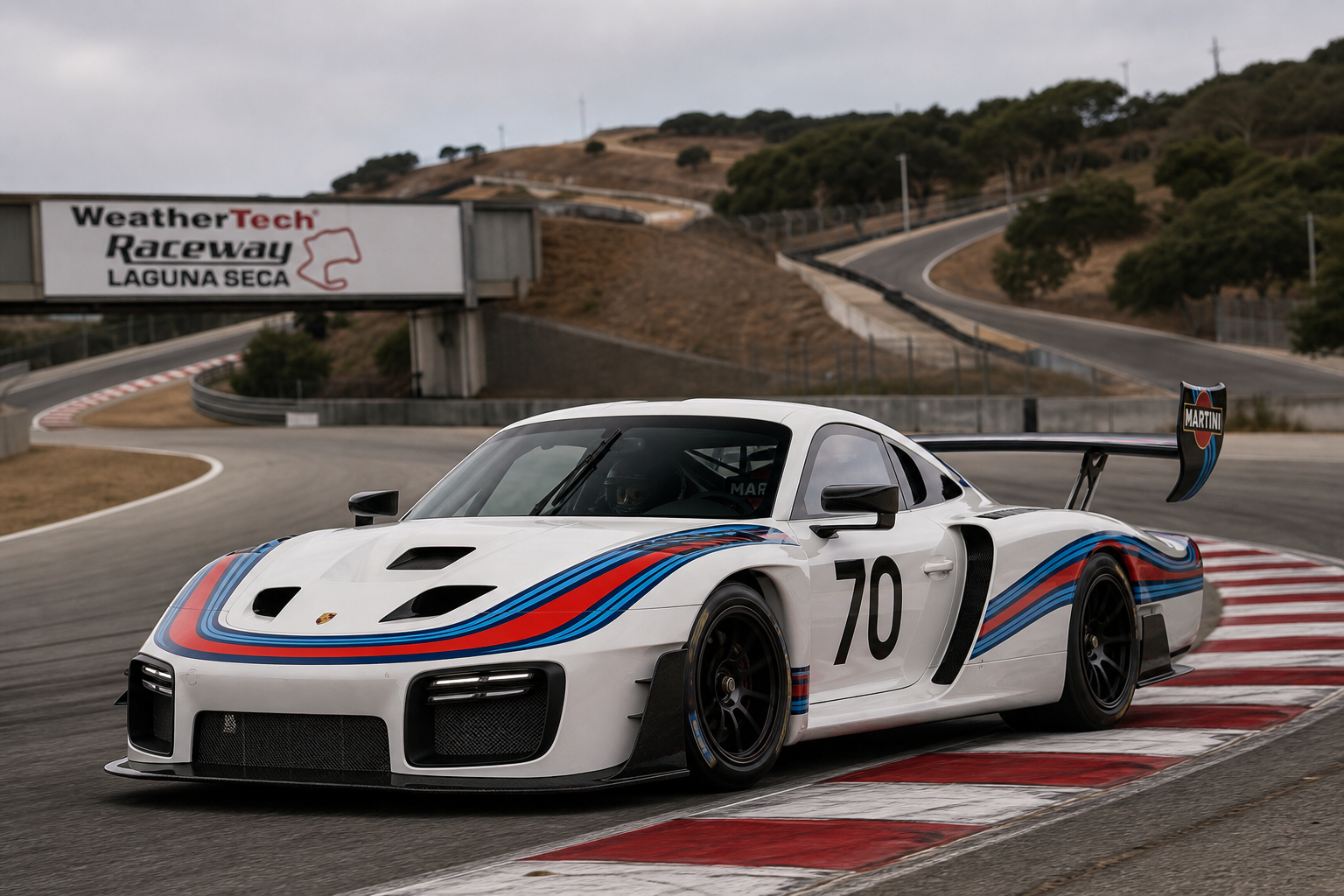

Apple’s new CEO apparently has a rather more interesting answer to the question, “What do you drive?” than most technology executives. John Ternus reportedly owns a Porsche 935, the brutally fast, track-only machine built in tiny numbers, and has taken it to WeatherTech Raceway Laguna Seca, where he has posted lap times below 1 minute, 40 seconds.
That is not the sort of company car one finds waiting outside a glass headquarters building. It is a 700-horsepower racing special with no pretense of being sensible, practical, or remotely interested in the daily commute. In other words, it is an excellent choice.
The Porsche 935 Is Not a Road Car With Racing Stickers
Porsche revived the 935 name in 2018 for a very specific audience: customers who wanted something dramatically closer to a factory race car than a road-going 911 with a loud exhaust and a large invoice.
The modern 935 is based on the 911 GT2 RS, but Porsche transformed it into a track-only machine with a wide carbon-fiber body, a long tail, serious aerodynamic hardware, and styling inspired by the legendary 935 race cars of the late 1970s. The most obvious visual reference is the 935/78, better known as “Moby Dick,” whose elongated rear bodywork became one of the great shapes in Porsche racing history.
There is no license plate, no attempt to satisfy pedestrian-impact regulations, and no need to pretend that the car will be used for grocery shopping. The 935 exists to circulate quickly on a circuit and make ordinary track-day machinery look faintly apologetic.
Power comes from a 3.8-liter twin-turbocharged flat-six producing approximately 700 horsepower. A seven-speed dual-clutch transmission sends that output to the rear wheels. Porsche quoted a weight of roughly 1,380 kilograms, or about 3,042 pounds, giving the car the sort of power-to-weight ratio that makes long straights feel rather shorter than expected.
The suspension, brakes, aerodynamics, and cockpit are all built around circuit use. This is not a Porsche with a few race-inspired flourishes. It is a race car wearing a historical costume, albeit a very expensive and extremely well-tailored one.
One of the Rarest Porsches Modern Collectors Can Buy
Porsche produced just 77 examples of the modern 935. That number was not an accident. The company positioned the car as a limited-run tribute for selected customers, with each vehicle carrying the exclusivity that comes from being both scarce and spectacularly specialized.
Pricing was reported at about $701,948 before taxes and options when the car was announced. That was an enormous amount of money for a machine that cannot legally be driven on public roads, although “enormous” becomes a slightly slippery concept once the discussion involves collectible Porsches, factory race machinery, and buyers who regard a seven-figure weekend toy as a perfectly reasonable form of asset allocation.
The 935 also occupies an unusual place in Porsche’s modern portfolio. It is not a successor to the company’s road-going 911 GT3 RS, nor is it a direct replacement for a customer racing car such as a 911 GT3 R. Instead, it sits between those worlds: developed with serious motorsport hardware, sold to private owners, and intended for track use without the full operational demands of an international racing program.
That distinction matters. A GT3 RS can be driven to a circuit, run hard, and driven home. A 935 generally requires transportation, track support, suitable tires, and a willingness to accept that public-road practicality was never part of the plan. It is a spectacular toy, not a particularly elaborate commuter.
Why a Sub-1:40 Laguna Seca Lap Is Significant
WeatherTech Raceway Laguna Seca is only 2.238 miles long, but its compact layout is not an easy place to hide a poor lap. The circuit demands heavy braking, precise positioning, commitment through fast corners, and a willingness to negotiate the famous Corkscrew without becoming an expensive collection of carbon-fiber fragments.
A lap below 1:40 is serious pace. It is not enough, on its own, to establish a formal record or prove that one driver is faster than another; track conditions, tire specification, traffic, weather, timing equipment, and whether the lap was part of an official session all matter. But it does indicate that Ternus’s 935 is being used as intended rather than polished into submission and parked in a climate-controlled room.
The Porsche’s hardware is well suited to Laguna Seca. The combination of high power, substantial downforce, racing brakes, and a relatively low curb weight gives it the tools to attack the circuit’s short straights and technical corners. The challenge is using those tools without allowing the car’s performance to outrun the driver’s judgment. Seven hundred horsepower is a generous quantity in any environment. At Laguna Seca, it arrives with curbs, elevation changes, and a very unforgiving runoff philosophy.
The reported lap time should therefore be treated as an intriguing personal benchmark, not a grand claim about the fastest Porsche ever to lap the circuit. That would require much more information than is currently available. Still, anything beginning with “under 1:40 in a Porsche 935” has already cleared the automotive equivalent of a fairly high bar.
John Ternus Is a Different Sort of Executive Car Guy
Ternus is widely associated with Apple’s hardware engineering operation, a world of product launches, component tolerances, thermal management, and devices designed to disappear into daily life. The Porsche 935 represents almost the opposite philosophy.
Apple products are generally praised for making complicated technology feel simple. The 935 makes complicated technology feel gloriously unnecessary. It has a massive rear wing, dramatic bodywork, a competition-style cockpit, and the mechanical urgency of a machine that would rather be discussing apexes than email synchronization.
That contrast is what makes the story appealing. High-profile executives often collect luxury cars, but the 935 is not merely an expensive object with a famous badge. It demands involvement. The owner must arrange track access, transport the car, understand its systems, manage tires and brakes, and develop the confidence required to use a vehicle capable of operating at a level far beyond normal road traffic.
There is also a pleasing lack of subtlety about it. A contemporary supercar can be presented as a grand tourer, a status symbol, or a technological showcase. The 935 is much more honest. It says, quite plainly, that someone spent a considerable fortune to go around a race track very quickly and look like a Le Mans hallucination while doing it.
A Rare Porsche That Is Meant to Be Driven
The most interesting detail is not necessarily that Ternus owns one. It is that the car reportedly sees circuit use. Limited-production Porsches are often treated as financial instruments with tire pressures, and plenty of rare cars spend their lives moving between storage facilities, concours lawns, and auction paddocks.
A 935 is different when it is being used properly. Its value comes partly from rarity, but its character comes from speed, noise, aerodynamic load, and the sense that every control has been designed around going faster. Leaving one stationary forever would be rather like buying a grand piano and admiring the hinges.
There is no indication that Ternus intends to race the car professionally, and the reported Laguna Seca times should not be confused with an official championship result. The available information is more modest: Apple’s incoming chief executive apparently owns one of the rarest modern Porsches and has taken it to one of America’s best-known circuits.
That is still a much better automotive footnote than another executive arriving in a silent luxury SUV. The Porsche 935 was built for people who wanted a direct connection to racing, and a sub-1:40 lap at Laguna Seca suggests that at least one of its owners has understood the assignment.

0 Comments