
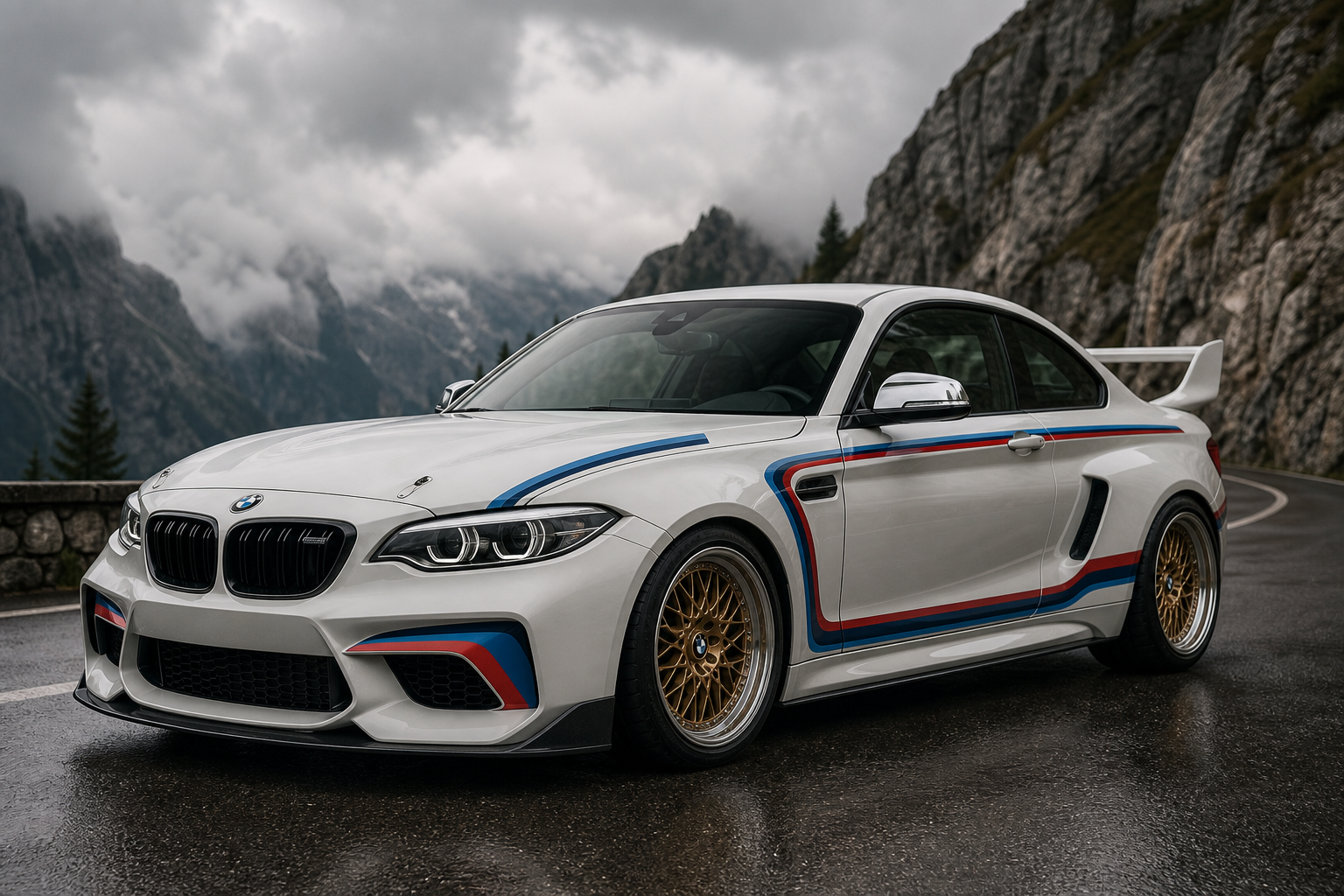

The BMW M2 is already a fairly serious piece of kit: compact, rear-wheel drive, powered by a turbocharged inline-six, and shaped with the sort of swollen arches that suggest it has just eaten something expensive. An Italian company now wants to give it a rather different identity by dressing the modern coupe as a 1970s BMW 3.0 CSL racing icon.
The idea is simple enough to understand and surprisingly difficult to execute well. Take a contemporary performance car with all the electronic sophistication and crash structure of the modern age, then wrap it in the visual language of one of BMW’s most famous competition machines. Done properly, it becomes a clever meeting of eras. Done badly, it becomes a regular M2 wearing a historical costume and hoping nobody notices the sneakers.
Why the 3.0 CSL Is Such a Powerful Reference
The 3.0 CSL was never merely a pretty BMW coupe. Developed from the E9 platform, it was created to satisfy racing homologation requirements and became one of the defining BMW competition cars of the 1970s. Its lightweight construction, straight-six power, aerodynamic appendages, and unmistakable long-nose shape gave it an appearance that was both purposeful and slightly theatrical.
That drama earned the car its famous “Batmobile” nickname. The tall rear wing, deep front spoiler, roof-mounted aerodynamic details, and squared-off wheel arches made the road-going CSL look like it had escaped from a touring-car paddock before anyone had finished bolting the mirrors on.
The racing version helped establish BMW’s reputation in European touring-car competition, while the road car became a coveted collector piece. The recipe remains familiar to performance-car fans: reduce weight, increase power, improve aerodynamic stability, and make the bodywork look considerably more aggressive than anything your neighbors are driving.
The Modern M2 Makes an Unusually Good Starting Point
Visually, the current BMW M2 has enough muscle to carry the concept without requiring an entirely new silhouette. Its compact proportions, broad fenders, short rear deck, and upright grille already give it a more assertive stance than the softer BMW coupes that preceded it.
Mechanically, it also provides the right foundation. The M2 uses BMW’s turbocharged 3.0-liter inline-six and sends its power to the rear wheels, preserving the basic layout that made the older car so appealing to drivers. Depending on configuration and model year, the modern M2 can be ordered with either a manual transmission or an automatic, a choice that feels almost quaintly generous in an age when many manufacturers are treating three pedals as an endangered species.
That means the Italian transformation does not need to manufacture sporting credibility from thin air. The M2 already has the engine, chassis hardware, and rear-drive architecture to justify a more competition-inspired appearance. The visual treatment is therefore less about pretending the car has become a 1970s race car and more about emphasizing the parts of its character that are already there.
From Touring-Car Legend to Modern Bodywork
The source material identifies the project as a modern BMW performance car wrapped to resemble the legendary 3.0 CSL. It does not provide a detailed list of the company’s modifications, so the important distinction is between the car’s proven mechanical specification and its intended visual character.
That character will depend on the details. A convincing interpretation needs more than a historic color scheme and a few racing stripes. The 3.0 CSL’s appeal came from its proportions and functional-looking aerodynamic hardware. The arches were not decorative flourishes; they announced wider track, larger tires, and the needs of a competition car. The spoiler was not there to make Instagram photographs more energetic. It was part of the car’s aerodynamic identity.
On a modern M2, those cues have to be translated rather than copied literally. Contemporary crash regulations, cooling requirements, lighting, sensors, and complex underbody aerodynamics leave much less freedom than designers enjoyed in the 1970s. A modern car also has a far higher beltline and a substantially different cabin-to-body relationship, which makes a direct replica impossible without producing something rather odd.
The best result would preserve the M2’s basic shape while borrowing the CSL’s visual vocabulary: a low, purposeful front end, prominent fender treatment, carefully proportioned rear aero, and graphics that refer to BMW’s racing history without turning the car into a rolling museum exhibit.
Retro Styling Without the Replica Problem
There is a temptation with heritage-inspired projects to reproduce every famous detail. That approach can work on a dedicated continuation car, but it is riskier on a modern production vehicle. The M2’s original design is unmistakably contemporary, and pretending otherwise could make the proportions look confused.
A successful conversion should therefore be selective. The goal is not to make people mistake the M2 for an E9 from across a parking lot. That would be impossible, and probably rather alarming once the parking sensors began protesting. The goal is to make the connection immediately legible while allowing the newer car to remain itself.
This is where an experienced coachbuilder or design house earns its keep. Historic references need to be edited. The famous elements must be reduced to their essential shapes and then adapted to the donor car’s structure. A wing that looks perfect on an old touring car may appear comically oversized on a modern coupe. A stripe that flatters a long, low hood may fight with the M2’s taller front end. Retro design is not a photocopying exercise.
The Mechanical Question
Unless the Italian company has also altered the suspension, brakes, engine calibration, or aerodynamics, the project’s known transformation is primarily visual. That is not a criticism. Not every special car needs more power, and the modern M2 already has enough performance to make public roads feel like a place where lawyers occasionally gather.
Keeping the mechanical package intact could also be the sensible choice. The M2’s factory development program accounts for cooling, electronic stability systems, tire compatibility, braking performance, and the interaction between the chassis and its driver aids. Once those systems are modified, the engineering burden becomes much larger than fitting new bodywork and graphics.
There is also something appealing about a car that looks like a historic racing weapon but retains modern usability. The original 3.0 CSL demanded compromises that buyers today might find less charming after a week of commuting. The M2 brings air conditioning, modern safety equipment, contemporary refinement, and the ability to navigate a grocery-store parking lot without requiring a spotter and a small prayer.
Why Projects Like This Keep Appearing
Manufacturer-built heritage editions have become increasingly elaborate and expensive, which leaves room for independent designers and specialist companies to explore the same emotional territory from a different angle. A customer may want the drama of a famous historic BMW without paying collector-car money for an original example or accepting the mechanical demands of a decades-old machine.
The M2 is particularly well suited to that treatment because it remains relatively compact and driver-focused compared with BMW’s larger performance models. It has enough visual aggression to support a bold makeover, but it has not yet become so large that the connection to older sports coupes disappears completely.
There is a wider lesson here, too. Modern performance cars often have astonishing capability, but their designs are shaped by regulation, aerodynamics, technology, and the sheer physical size of current safety structures. Historic racing cars remain attractive partly because their purpose is visible. Their wings, vents, arches, and spoilers look like they were fitted for a reason.
A 3.0 CSL-inspired M2 taps into that clarity. It tells the observer what kind of car it wants to be before the engine even fires.
A Promising Idea That Will Live or Die in the Details
The Italian company’s concept is compelling because it starts with a genuine mechanical relationship rather than an arbitrary badge swap. The M2 and the 3.0 CSL are separated by decades, but both revolve around the same broad BMW formula: a compact coupe, a straight-six engine, rear-wheel drive, and a willingness to make the bodywork look gloriously unnecessary when viewed from the supermarket checkout.
Whether the finished car feels elegant or excessive will come down to proportion, restraint, and the quality of the execution. The historic reference is strong enough to carry a modern interpretation, but only if the designers understand why the original CSL looked the way it did.
Get that right, and the result could be a genuinely appealing collision of BMW eras: modern performance underneath, 1970s touring-car attitude on top. Get it wrong, and the M2 will merely look as though it has joined a very enthusiastic historical re-enactment society.
0 Comments