
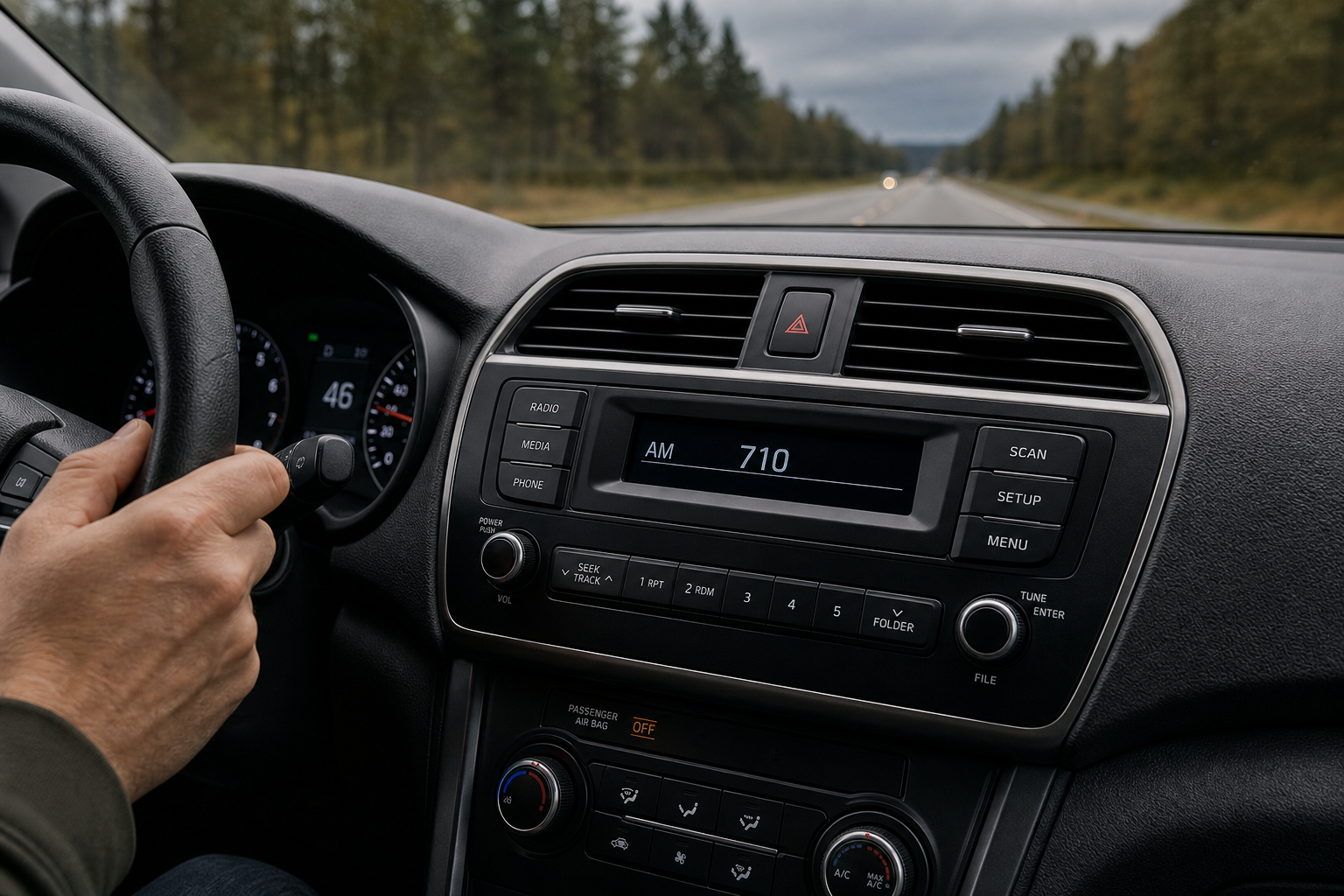

AM radio has survived dashboard CD players, smartphone integration, satellite radio, and the alarming rise of giant touchscreens. Now it is being dragged into the machinery of federal law.
The AM Radio for Every Vehicle Act has passed the U.S. House of Representatives and is moving to the Senate. If it eventually becomes law, new vehicles sold in the United States would be required to include AM radio capability. That would be a fairly unusual intervention in vehicle equipment rules: Congress deciding that a technology many drivers barely use must remain part of the car.
It sounds faintly like a legislative demand that every new kitchen still include a slot for cassette tapes. The reasoning, however, is less about nostalgia than communications, infrastructure, and the peculiar technical problems created by modern vehicles.
Why AM Radio Is Disappearing From New Cars
AM radio has been losing ground in dashboards for years. Drivers have moved toward FM, satellite radio, streaming services, podcasts, and smartphone-based audio. Automakers, meanwhile, have become increasingly willing to remove equipment that occupies space, costs money, or creates engineering headaches without adding much showroom appeal.
The issue is particularly noticeable with electric vehicles. Electric propulsion systems use high-voltage electrical components, power inverters, motors, and extensive electronic control hardware. Those systems can generate electromagnetic interference in the same broad territory used by AM broadcasts. Filtering and shielding can reduce the problem, but doing so adds complexity and cost.
Some automakers have therefore dropped conventional AM reception from certain EVs, while others have tried to reproduce AM programming through digital tuners or connected services. That may preserve access to a particular station, but it is not identical to receiving an over-the-air AM signal. A streamed station depends on cellular coverage, a working data connection, compatible software, and a service that has not been quietly redesigned by a marketing department.
Traditional AM radio is comparatively simple. The signal arrives through the air, the receiver decodes it, and the driver hears the broadcast. No account is required. No app needs updating. No subscription screen appears at 70 mph, although modern infotainment systems would probably attempt one if given the opportunity.
The Case for Keeping It in the Dashboard
Supporters of the legislation point to AM radio’s role in emergency communication. Broadcast signals can deliver weather alerts, evacuation information, traffic updates, and other urgent announcements across large areas. That makes AM particularly useful during disasters when cellular networks are overloaded, damaged, or unavailable.
Its range is another part of the argument. AM stations can cover broad geographic areas, especially at night, and many local broadcasters remain important sources of information outside major cities. A driver traveling through rural areas may encounter patchy cellular service long before losing access to a powerful broadcast signal.
That does not mean AM is the only useful emergency channel. Vehicles already contain FM receivers, smartphones, navigation systems, and increasingly sophisticated connected services. Many drivers also carry battery-powered radios. The practical question is whether preserving AM in every new vehicle provides enough public value to justify a federal requirement.
Supporters clearly believe it does. The House passage gives that argument a significant boost, although it does not make the requirement law. The Senate must still consider the measure, and the legislative process can turn apparently straightforward bills into elaborate mechanical objects with several missing bolts.
Why Automakers May Resist a Mandate
From an automaker’s perspective, a requirement for AM hardware is not merely a matter of checking one more box on a parts list. A conventional AM receiver needs to work properly in a vehicle packed with electronic systems that can interfere with reception. Engineers must account for wiring, shielding, antenna placement, power electronics, infotainment software, and the vehicle’s overall electromagnetic behavior.
That challenge is most obvious in EVs, but modern gasoline-powered vehicles are hardly electrically primitive. Even an ordinary crossover may contain multiple computers, radar sensors, wireless systems, electric motors for accessories, LED lighting, and a transmission control unit with more processing power than entire offices possessed a few decades ago. The radio antenna is now sharing the vehicle with a small electronic bureaucracy.
Automakers may also argue that buyers have other ways to access AM programming. Smartphone apps, connected infotainment systems, HD Radio, satellite services, and station-specific streams can all carry similar content. In that view, the physical AM tuner is an outdated component being protected by legislation rather than demand.
There is a reasonable engineering distinction here. Requiring a vehicle to provide access to AM programming is not necessarily the same as requiring it to include a traditional over-the-air AM receiver. The exact language of any final law would matter enormously. A mandate could affect hardware, software, signal reception, or some combination of the three.
The EV Problem Is More Complicated Than a Missing Button
Electric vehicles have become the center of the AM debate because their propulsion systems can create interference that makes conventional AM reception noisy or unusable. The problem is not that engineers forgot to install a tuner. The problem is that a vehicle can technically include AM hardware while producing an unpleasant soundtrack of electrical whine whenever the accelerator is pressed.
That distinction matters. A receiver that exists only to satisfy a compliance test, while delivering poor real-world performance, would be of limited value. Proper shielding and filtering can help, but those solutions must be integrated into the vehicle rather than bolted on at the last minute like an aftermarket spoiler on a family sedan.
There is also a packaging question. New vehicles increasingly use windshield-mounted antennas, compact antenna modules, and software-controlled infotainment systems. The traditional radio architecture is changing even when the dashboard still displays a familiar frequency scale. Preserving AM may require manufacturers to maintain older components alongside newer digital systems.
What House Passage Does—and Does Not—Change
The bill’s passage in the House is an important step, but it does not mean AM radio is immediately returning to every new vehicle. The Senate must act before the proposal can advance further, and any differences between the chambers would need to be resolved. The legislation would also need to become law before automakers faced a binding federal requirement.
Until then, vehicle equipment decisions remain largely in the hands of manufacturers. Some automakers may continue offering AM reception, while others may rely on internet-connected alternatives or omit the function entirely, particularly in EVs.
For buyers, the issue is a reminder to check the actual equipment in a vehicle rather than assuming an old feature remains standard. The presence of a radio icon on a touchscreen does not necessarily tell you whether the car receives AM broadcasts directly. A test drive—or a careful look through the specifications—can settle that question rather more efficiently than discovering the omission during a tornado warning.
A Small Feature With an Unusually Large Argument Around It
AM radio is not glamorous, and it is unlikely to sell many cars. Nobody walks into a dealership demanding a luxury package because it includes particularly handsome medium-wave reception. Yet its value is not measured only by entertainment. Broadcast resilience, geographic reach, and independence from cellular networks give it a role that streaming cannot perfectly duplicate.
At the same time, forcing every new vehicle to retain aging hardware raises legitimate questions about regulation and engineering freedom. Cars are becoming more electrically complex, and preserving a legacy feature is not cost-free—especially when the vehicle’s own propulsion system can interfere with it.
The House vote has turned that technical disagreement into a national policy debate. Whether the Senate agrees remains unresolved. For now, AM radio occupies an odd position: too old to be fashionable, too useful to dismiss, and apparently stubborn enough to require an act of Congress to keep it in the car.

0 Comments