
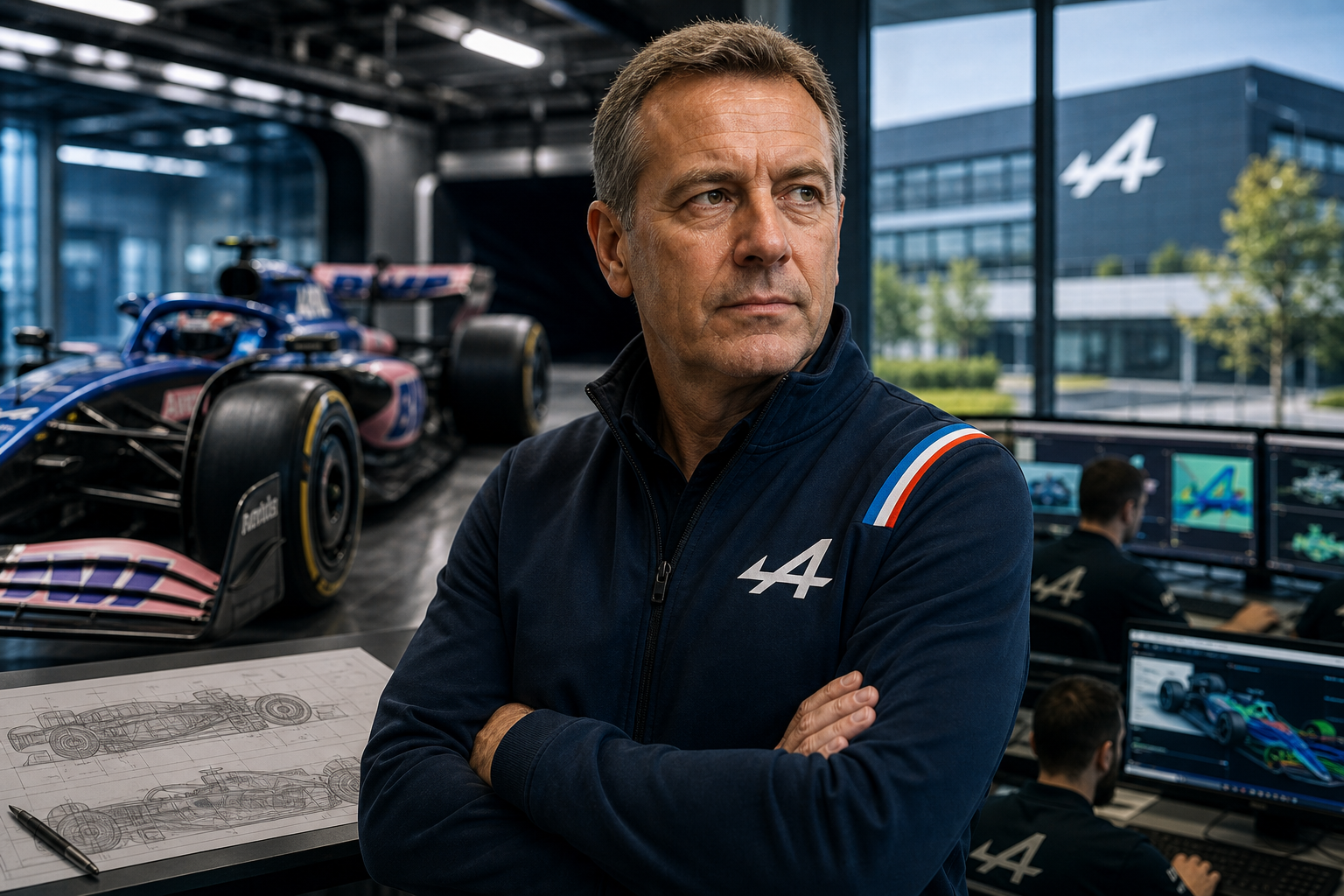

Alpine has moved to strengthen its Formula 1 operation with the appointment of Mike Elliott as chief technical director, a newly created role that puts one of the sport’s most experienced technical figures back at Enstone.
The team said Elliott will oversee the technical and engineering functions at its factory in Oxfordshire, a significant addition to the structure around a squad that has spent the past few seasons reshaping its F1 organisation. For Alpine, the move signals a desire to bring clearer technical leadership into a team that has been trying to improve competitiveness and stabilise its development process against a deeply resourceful midfield and front-running opposition.
Elliott’s return to Enstone is notable in its own right. The 52-year-old Briton is no stranger to the team’s headquarters, having worked there earlier in his career before becoming one of the most recognised technical names in Formula 1. His move back to the factory reconnects Alpine with a familiar base of engineering experience at a time when technical structure matters as much as outright ideas on car performance.
A new role aimed at tightening Alpine’s technical chain
Alpine described the position as chief technical director, with Elliott responsible for the full technical and engineering operation at Enstone. In practice, that means the role sits near the top of the car-development hierarchy, linking design, aerodynamics, vehicle dynamics, and broader engineering direction under a single technical lead.
That kind of structure is especially important in modern F1, where a team’s ability to translate simulator work, trackside data, manufacturing output, and aerodynamics development into lap time depends on how efficiently the organisation is run. The creation of a new CTO-style post suggests Alpine wants a clearer line of accountability in the technical department and a stronger framework for development decisions.
For a team like Alpine, which has repeatedly spoken about the need to raise performance and organisation across the board, the appointment is as much about process as it is about personnel. F1 teams don’t simply need talented engineers; they need technical leadership that can align long-term car philosophy with the day-to-day demands of race weekends, update cycles, and the regulatory constraints that shape every design choice.
Why Elliott’s Enstone background matters
Rejoining a team where he previously worked gives Elliott a level of institutional familiarity that can be valuable in an environment as complex as a Formula 1 factory. Enstone has a long and frequently successful lineage, with various incarnations of the team producing world championship-winning cars over the decades. The site’s engineering culture and workflow have always been central to its identity.
That continuity matters because F1 development is rarely about starting from scratch. It is about understanding what already exists, where the weaknesses are, and how to prioritise the next phase of improvement. An experienced technical director who knows the environment can often move more quickly through those questions, especially when the task is to connect the factory’s capabilities with the demands of a changing technical cycle.
Alpine’s decision to bring Elliott in therefore looks like a deliberate effort to reinforce the core of the team rather than simply add another layer of management. In a category where technical structures are often finely tuned to individual personalities, bringing in someone with both Enstone history and broader F1 experience can help bridge the gap between strategy and execution.
What the appointment says about Alpine’s direction
The timing also says something about Alpine’s current priorities. The team has been working through a period of adjustment as it tries to sharpen its competitiveness and improve the consistency of its technical operation. Creating a new senior technical position is a strong sign that the team sees leadership and organisation as key areas for progress, not just car concept or power unit performance.
F1’s technical arms race leaves little room for drift. Even when a team has decent facilities and strong personnel, misalignment between departments can stall development. Alpine’s decision to appoint a chief technical director suggests it wants a more integrated approach, with Elliott overseeing the engineering side in a way that should, in theory, improve communication and speed up decision-making.
That is particularly relevant for a team based at Enstone, where the engineering operation is only one part of a wider competitive package that also includes execution on race weekends and the ability to adapt quickly to new information. The stronger the technical structure, the easier it becomes to turn factory work into track performance.
A familiar name in Formula 1 engineering
Elliott’s career has made him one of the more recognisable technical figures in the sport, and his move back to Alpine adds another experienced voice to the team’s leadership group. While personnel changes in F1 are common, they are most meaningful when they alter how a team functions rather than just who occupies a title. This appointment appears to be aimed squarely at the former.
For Alpine, the challenge now is to make the most of that experience. A new technical director can help shape direction, but the real test will be how effectively the structure around him responds: how the factory develops parts, how engineering choices are made, and how quickly the team can extract performance from its package on track.
In a sport where the margins are often tiny, a well-defined technical hierarchy can be just as important as the wind tunnel, the simulator, or the latest upgrade package. Alpine’s latest move suggests it understands that, and that Enstone will once again be asked to deliver with a sharpened leadership structure in place.

0 Comments