
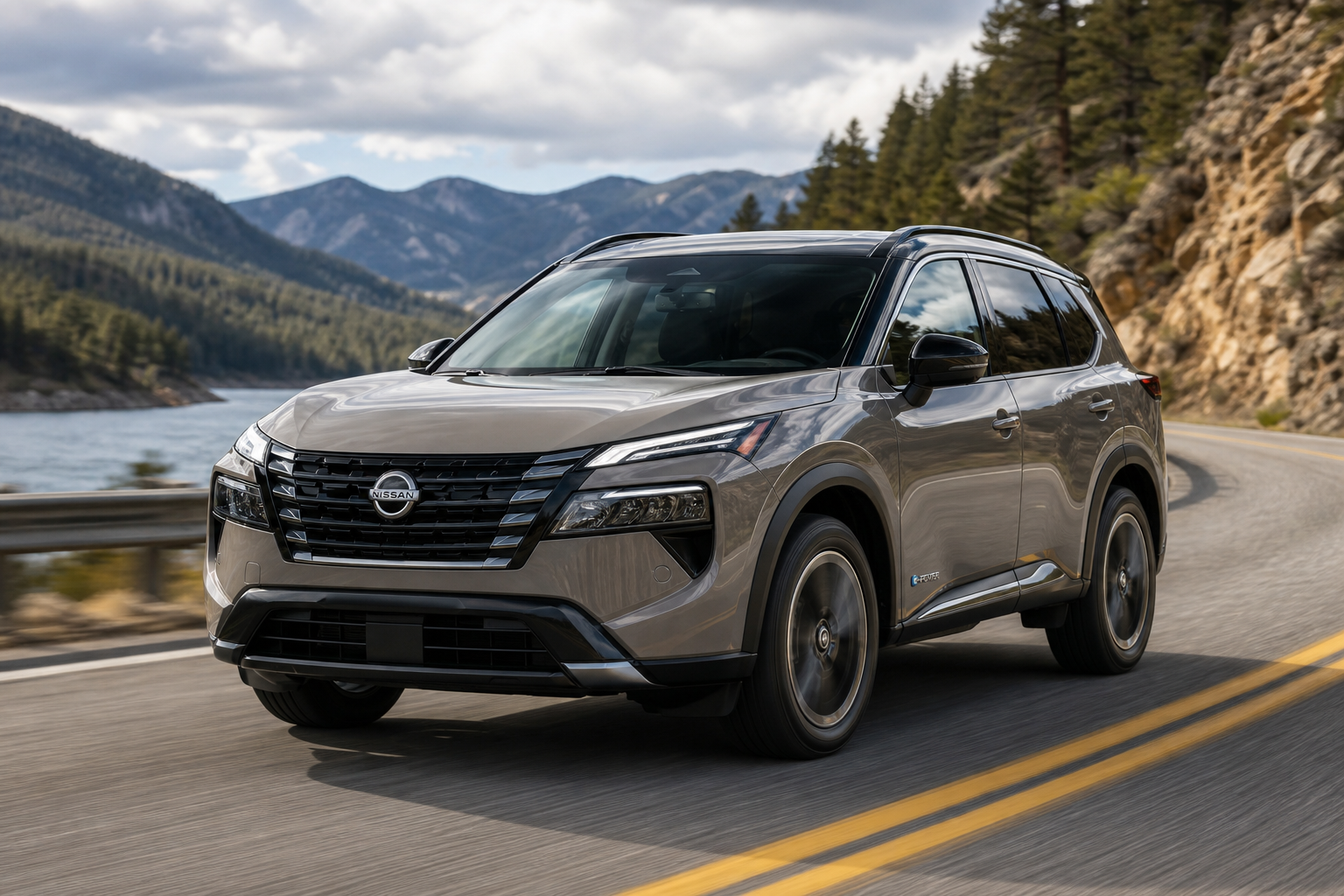

The 2027 Nissan Rogue Hybrid arrives with a number that will get attention in any showroom: 38 mpg. But the more interesting detail is hiding behind the word “hybrid.” This Rogue isn’t using the familiar parallel-hybrid formula found in many competing SUVs. It is Nissan’s first U.S.-market model to use the company’s e-POWER system, a setup that treats the gasoline engine rather differently from the usual hybrid playbook.
In a conventional hybrid, the gasoline engine and electric motor can both send power to the wheels. Depending on the vehicle, they may work together, operate separately, or hand over responsibility through a planetary gearset or other mechanical connection. Nissan’s e-POWER arrangement takes a different route: the gasoline engine generates electricity, while an electric motor provides the drive to the wheels.
A Hybrid That Drives Like an EV
That distinction is the defining feature of the 2027 Rogue Hybrid. The engine is not there to mechanically propel the SUV in the traditional sense. Instead, it acts as an onboard power station, producing electricity for the system and helping maintain the battery’s charge. The wheels are driven electrically.
It is a clever halfway house between a gasoline vehicle and a battery-electric vehicle. Drivers get an electric motor’s immediate response without needing to rely on a large traction battery or stop for a charging session. The gasoline engine remains part of the equation, but its job is closer to that of a compact generator than a conventional engine connected directly to the drivetrain.
That should give the Rogue Hybrid a noticeably different character from a standard gas-electric crossover, at least in principle. Electric motors deliver their torque quickly and smoothly, without the delay and gear changes associated with a conventional automatic transmission. Whether that translates into a genuinely more satisfying drive will depend on Nissan’s calibration, but the underlying layout gives the Rogue a clear technical identity instead of another anonymous hybrid badge.
Why Nissan Is Bringing e-POWER to America Now
Nissan has used e-POWER in other markets, making the 2027 Rogue Hybrid an important introduction rather than a clean-sheet experiment. The system gives Nissan a way to add electrified driving behavior without turning the Rogue into a full battery-electric SUV.
That matters because the Rogue occupies a part of the market where buyers still care about fuel stops, road-trip convenience, and familiar ownership habits. A battery-electric replacement would bring questions about charging access, charging time, winter efficiency, and long-distance planning. A series-hybrid Rogue avoids most of that hassle while still placing electric drive at the center of the experience. It is a rather sensible bit of engineering, which is not always the first phrase that springs to mind when someone mentions a new automotive powertrain.
The 38-mpg figure gives Nissan a straightforward sales argument, too. Fuel economy is easy to understand. “The engine generates electricity and the electric motor drives the wheels” takes slightly longer to explain, particularly when a customer has already been trapped in a dealership lounge with a coffee of suspicious origin. The efficiency number will likely be the headline, while e-POWER is the detail that separates this Rogue from more familiar hybrid SUVs.
How e-POWER Differs From a Traditional Hybrid
The term “hybrid” covers several different mechanical arrangements, and that can make showroom comparisons needlessly murky. Not every hybrid behaves the same way, even when the badges look similar.
A traditional parallel hybrid generally connects the gasoline engine to the drive wheels. Its electric motor can assist the engine, move the vehicle on electric power under certain conditions, and recover energy during deceleration. The engine remains a direct participant in propulsion.
With e-POWER, the gasoline engine’s primary task is generating electricity. The electric motor handles propulsion, giving the system a more consistent relationship between accelerator input and wheel torque. Nissan can also use software to control when the engine runs and how much electricity it produces, rather than asking the engine to respond directly to every change in road speed.
That does not make the system a pure electric vehicle. The engine still has to run, fuel still has to be burned, and the vehicle does not gain the quiet, zero-tailpipe-emission operation of a battery EV over an entire trip. But it does allow Nissan to deliver an electric-style drivetrain without installing the much larger battery required for a long-range electric SUV.
The Rogue Is a Logical Place to Start
Nissan’s decision to introduce e-POWER in the Rogue is hardly random. Compact and midsize crossover buyers tend to value easy daily use above mechanical novelty, yet they are also receptive to better fuel economy. The Rogue’s format gives the system room to make sense: enough space for a generator, battery, and electric-drive hardware, without asking buyers to accept the size, weight, or charging routine of a full EV.
The SUV body style also gives Nissan a familiar product around which to explain an unfamiliar drivetrain. This isn’t a niche sports car or a futuristic design exercise. It is a mainstream Rogue with a different answer to the question of how gasoline and electricity should work together.
That familiarity could be useful. Hybrid buyers do not necessarily want a science project parked in the driveway. They want lower fuel consumption, predictable operation, and the ability to take a long trip without plotting a route around charging stations. e-POWER is aimed at that middle ground.
What the 38-MPG Figure Tells Us—and What It Doesn’t
The quoted 38 mpg figure establishes the efficiency target for the 2027 Rogue Hybrid, but it does not tell the whole story. Fuel economy is only one part of the ownership equation, and the available information does not yet establish the Rogue Hybrid’s price, power output, battery size, towing capacity, cargo impact, or acceleration.
Those details will determine how persuasive the package becomes. A hybrid system can deliver excellent economy while adding weight, cost, or packaging compromises. The electric motor’s response may make the Rogue feel more immediate, but buyers will still want to know how the system behaves during sustained highway driving, steep climbs, cold weather, and heavy loads. Series hybrids are not magic; they simply move the mechanical responsibilities around.
The engine-as-generator layout may also produce a different sound under hard acceleration. Because engine speed does not have to correspond directly to road speed, the gasoline engine can operate at a point chosen for efficiency rather than one that feels perfectly synchronized with the vehicle’s pace. That can be clever from an engineering standpoint and slightly peculiar from the driver’s seat. Nissan’s control software will have a major role in making the system feel natural rather than like a small power plant having an argument with the accelerator pedal.
A Different Kind of Hybrid for a Familiar Nissan
The 2027 Nissan Rogue Hybrid is interesting precisely because it avoids the usual hybrid template. Its 38-mpg figure gives the launch a clear practical benefit, but e-POWER is the real story. Nissan is bringing an electric-drive experience to a gasoline-powered SUV without asking customers to make the full jump to battery-electric ownership.
Whether that compromise proves better than a conventional hybrid will depend on price, refinement, packaging, and real-world economy—facts still to come. For now, the Rogue Hybrid represents a thoughtful alternative to the increasingly crowded collection of hybrid systems. It is not a traditional hybrid, and Nissan clearly wants buyers to understand why.
0 Comments