
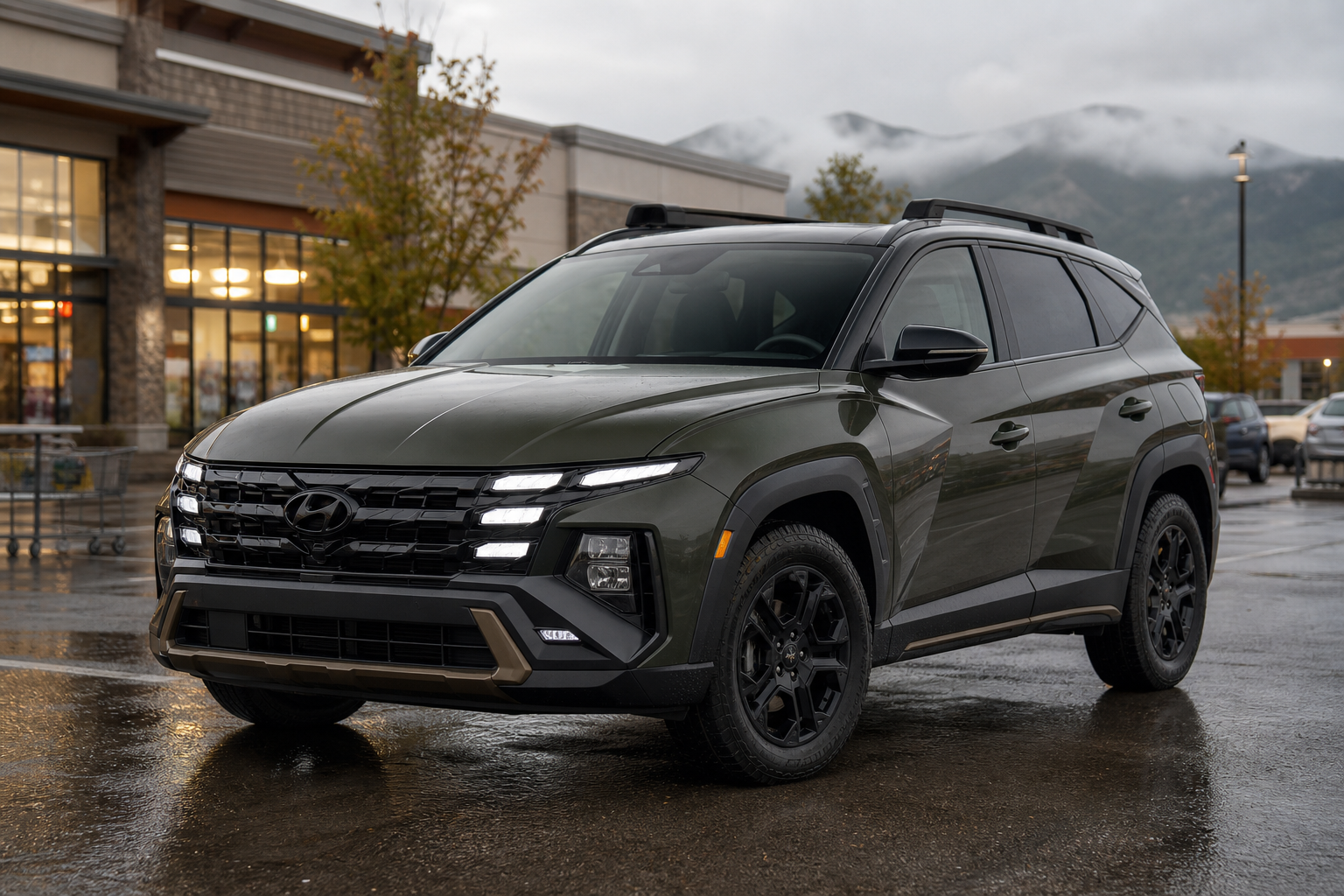

The 2027 Hyundai Tucson XRT has appeared with a familiar mission: make a compact crossover look as though it has just returned from a muddy expedition, even if its most demanding terrain is the speed bump outside a grocery store.
Hyundai has not yet released a full technical rundown for the new XRT, so the important news is the vehicle’s positioning rather than a sudden transformation into a dedicated off-road machine. The Tucson XRT is being presented as the rugged-looking member of the lineup, giving Hyundai’s compact crossover a more adventurous visual identity without claiming that every owner is about to tackle the Rubicon Trail.
The XRT Recipe Remains Mostly About Attitude
The XRT name has become Hyundai’s shorthand for a tougher-looking version of an existing SUV. That usually means a more outdoorsy appearance and a visual break from the standard Tucson, rather than a wholesale re-engineering of the vehicle’s suspension, drivetrain, or body structure.
That distinction matters. The modern crossover buyer often wants the suggestion of capability more than the inconvenience of actually using it. A vehicle can wear the visual language of exploration while remaining perfectly suited to school runs, commuting, and the occasional battle with a parking garage ramp. There is no shame in that. Most off-road-themed SUVs spend their lives on pavement, where clean upholstery and a manageable turning circle are more useful than a winch.
The XRT trim gives Hyundai a way to serve that appetite without pushing every Tucson toward the same chunky, expedition-inspired look. It also helps the model stand apart in a crowded compact SUV class where black exterior trim, tougher bumpers, roof accessories, and all-terrain visual cues have become nearly as common as cupholders.
What the 2027 Tucson XRT Does—and Does Not—Tell Us
At this stage, the appearance of the 2027 Tucson XRT does not confirm the details buyers will care about most: powertrain availability, drivetrain configuration, ground clearance, suspension tuning, approach and departure angles, towing capacity, interior equipment, pricing, or fuel economy.
Those figures will determine whether the XRT is merely a styling package or something with meaningful hardware changes underneath. A darker color palette and tougher-looking exterior details can alter the Tucson’s character, but they do not automatically improve traction in loose terrain or make the vehicle happier when the pavement disappears.
That is not a criticism of the XRT. Appearance trims exist because customers buy them. The error would be assuming that visual confidence equals mechanical capability. A crossover can look ready for a forest road while retaining the same basic limitations as the standard vehicle. The brochure may whisper “adventure”; the tires may have other opinions.
A Sensible Place in the Tucson Range
The Tucson sits in one of the most fiercely contested parts of the U.S. market, surrounded by compact SUVs that promise comfort, efficiency, practicality, and occasional freedom from civilization. In that environment, a distinctive trim can be useful even when it does not fundamentally change the vehicle’s engineering.
The XRT gives Hyundai a visual hook for buyers who find a conventional compact crossover a bit too anonymous but have no interest in paying for a high-performance model or living with the compromises of a genuinely specialized off-roader. It is the automotive equivalent of wearing hiking boots to a restaurant: not strictly necessary, but it does communicate an intention.
That positioning also leaves room for Hyundai to keep the Tucson broadly approachable. The vehicle can retain its everyday crossover role while offering a version with more personality. For many buyers, that may be the entire point. They want the practicality of a compact SUV, the elevated seating position, and a bit of visual theater when they walk back across the parking lot.
The Details That Will Matter Later
Once Hyundai releases complete information, the key question will be whether the 2027 XRT receives anything beyond styling and equipment changes. Buyers should look for confirmation of standard and optional drivetrains, available all-wheel drive, tire specifications, suspension alterations, and any changes to the vehicle’s clearance or protective hardware.
Those details separate a genuine hardware upgrade from an appearance-led trim. Neither approach is inherently wrong, but they serve different customers. Someone who wants a Tucson that looks more rugged may be entirely satisfied with the former. Someone planning regular trips onto rough trails will need to inspect the specifications rather than relying on the badge.
Pricing will also decide how persuasive the package becomes. The XRT needs to look meaningfully different without wandering so close to more capable or better-equipped versions of the Tucson that the value proposition starts wobbling. Compact crossover buyers are practical creatures, even when they enjoy a little theatrical styling.
For Now, It Is a Promise of Adventure
The 2027 Hyundai Tucson XRT is best understood as an early statement of intent. Hyundai is keeping the Tucson’s adventurous-looking variant in the conversation, targeting drivers who want their daily transportation to appear ready for a considerably more exciting life than it will probably lead.
That is hardly unusual, and it is not necessarily cynical. Cars have always sold a version of the owner’s imagined lifestyle. The XRT simply packages that fantasy with a compact SUV, some visual muscle, and the quiet confidence that the nearest trailhead is probably beside a shopping center.
The final judgment will have to wait for the specifications, equipment, and price. Until then, the 2027 Tucson XRT is doing precisely what this kind of trim is meant to do: making an ordinary commute look faintly like the beginning of an expedition.


0 Comments