
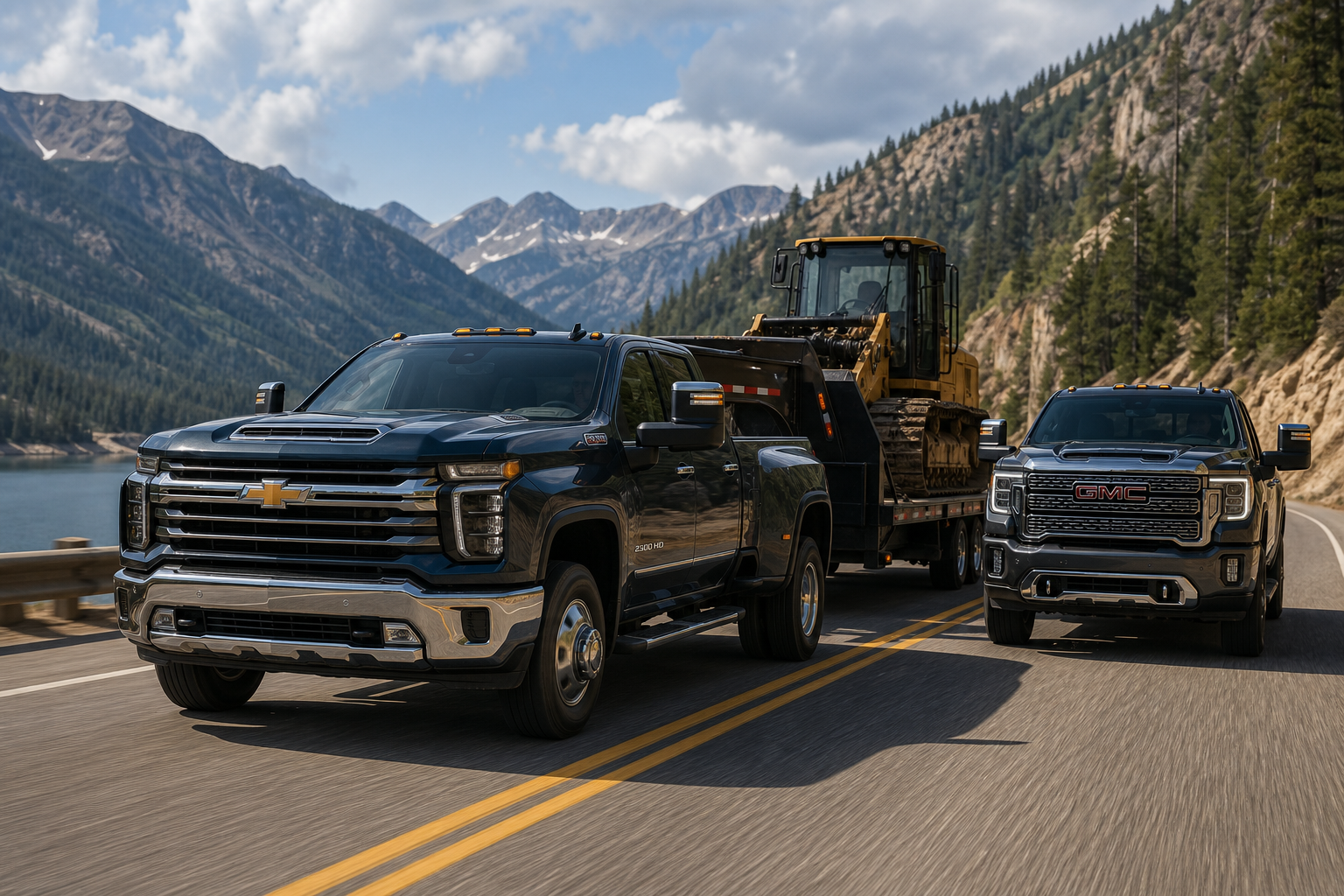

The 2027 Chevrolet Silverado HD and GMC Sierra HD are getting the sort of mechanical upgrade that makes heavy-duty truck buyers stop scrolling: a massive new 8.3-liter diesel V-8. Chevrolet and GMC have not supplied every technical detail yet, but the headline is already clear. The next-generation heavy-duty pickups will bring more diesel displacement, higher tow ratings, and a revised steering system intended to make these enormous machines less agricultural from the driver’s seat.
That is quite a shopping list. Heavy-duty trucks have become rolling power stations with leather upholstery, giant screens, and enough curb weight to make a small bridge nervous. Yet their basic job remains brutally simple: move heavy trailers, equipment, livestock, and other inconveniently large objects without drama. The new Silverado HD and Sierra HD appear to be taking that mission seriously.
A Much Larger Diesel V-8
The defining change is the arrival of an 8.3-liter diesel V-8. Chevrolet and GMC currently use a 6.6-liter Duramax diesel V-8 in their HD pickups, so the new engine represents a substantial increase in displacement. Exact output figures have not been announced in the supplied information, but the additional capacity points toward the sort of low-speed torque that matters when a trailer weighs several tons and the road has stopped pretending to be flat.
Displacement alone does not guarantee a better engine. Turbocharging, fuel injection, cooling, emissions equipment, transmission calibration, and thermal management all determine how a diesel behaves when it is working hard for hours at a time. Still, a larger engine can provide useful breathing room. It may produce the required power with less strain, maintain performance under sustained load, and deliver stronger response when pulling away from a stop.
That last point matters more to truck owners than a heroic number on a showroom poster. A heavy-duty pickup is often asked to tow in hot weather, climb long grades, and repeat the process several times in a day. Peak horsepower attracts attention, but broad torque delivery and durability under continuous load are what keep a workday from turning into an expensive roadside picnic.
The 8.3-liter engine will also have to fit into a world of increasingly strict emissions requirements. Modern diesel powertrains are remarkably capable, but they are not mechanically simple. Exhaust aftertreatment, sensors, electronic controls, and cooling systems all take space and add complexity. A larger diesel that delivers useful performance without becoming a packaging or service nightmare would be a considerable engineering achievement.
More Towing Capacity, Although the Number Is Still Missing
Chevrolet and GMC say the 2027 Silverado HD and Sierra HD will have higher tow ratings. That is good news, though the absence of a specific figure means it is too early to declare a new heavyweight champion. Tow ratings depend on configuration, axle ratio, cab style, bed length, hitch type, tires, and payload capacity, so one headline number never tells the entire story anyway.
A buyer towing a large fifth-wheel trailer needs to examine the truck’s complete weight ratings rather than becoming hypnotized by the biggest maximum trailer figure in a brochure. Payload is particularly important because the trailer’s pin weight, passengers, tools, fuel, and accessories all count against what the truck can carry. A pickup that can theoretically tow an enormous trailer but has little remaining payload is a rather expensive way to discover arithmetic.
The increased ratings should nevertheless give Chevrolet and GMC more room in the constant contest among heavy-duty pickups. Ford, Ram, Chevrolet, and GMC have spent years turning towing capacity into a competitive sport, complete with increasingly elaborate trailering cameras, electronic guidance systems, and carefully staged videos involving machinery that most owners will never actually tow. The useful part of the competition is that buyers now receive stronger frames, better cooling, more capable brakes, and smarter trailer-management systems. The slightly silly part is pretending every customer is one weekend away from hauling a construction site across the country.
The Steering Change Could Be the Everyday Upgrade
The engine will dominate the advertising, but the switch to a more sophisticated steering setup may be the change drivers notice most often. Heavy-duty pickups traditionally prioritize strength, durability, and load tolerance over delicate steering feel. That is understandable: the front axle has to cope with a diesel engine, heavy-duty suspension components, large tires, and the additional forces created by a loaded trailer.
It can also make an unloaded HD truck feel like it has been negotiating with the road rather than communicating with it. Steering may be heavy, slow, or vague around center, particularly compared with a half-ton pickup or a modern crossover. The source information does not specify the exact hardware Chevrolet and GMC are adopting, but it does confirm a move toward a more sophisticated arrangement.
That could improve several parts of the driving experience. More precise response would make lane changes less tiring, while better on-center control could reduce the constant small corrections that become especially noticeable on long highway trips. When towing, predictable steering is even more valuable. A trailer magnifies every unnecessary input, and a truck that responds cleanly is easier to place on a narrow road or around a crowded campground.
There is a compromise, naturally. Heavy-duty steering cannot be tuned like a sports sedan. It must remain robust enough for the truck’s weight and intended work. The goal is not to make a Silverado HD corner like a Camaro, which would be both unnecessary and faintly alarming. The goal is to make the truck feel less like industrial equipment when it is being driven to the hardware store without a trailer attached.
Chevrolet and GMC Keep Their Separate Personalities
The Silverado HD and Sierra HD share their underlying engineering, but Chevrolet and GMC will continue to use styling, trim, and brand presentation to separate them. That formula has worked for years. Chevrolet traditionally presents the Silverado as the more straightforward workhorse, while GMC leans harder into upscale materials, premium trims, and the Denali side of the business.
Underneath, however, buyers will be interested in the common mechanical changes: the larger diesel, increased towing capability, and revised steering. Those upgrades affect the truck’s usefulness regardless of which grille a customer prefers.
The bigger question is how much the new powertrain will affect price, weight, fuel consumption, and service costs. None of those details are available yet, and they will matter. A larger diesel may offer greater capability, but heavy-duty truck buyers do not purchase engines in isolation. They buy a complete working tool, and the cost of operating that tool over years can matter more than an impressive launch specification.
What Buyers Should Watch Before Ordering
Until Chevrolet and GMC publish full specifications, prospective buyers should hold off on drawing conclusions from the 8.3-liter headline alone. The details worth watching include:
- Horsepower and torque figures, particularly the torque curve and its usable range.
- Maximum conventional, fifth-wheel, and gooseneck tow ratings by configuration.
- Payload ratings and the effect of the larger engine on front-axle weight.
- Transmission details, cooling capacity, and the truck’s performance during sustained towing.
- The exact steering hardware and whether the improvement is felt equally across trim levels.
- Pricing, fuel economy, maintenance requirements, and availability of the diesel engine.
Those answers will determine whether the 2027 trucks are merely stronger on paper or genuinely better tools. A bigger diesel is an appealing starting point, particularly when paired with higher tow ratings. The steering revision suggests Chevrolet and GMC are also paying attention to the less glamorous side of truck ownership: the thousands of unloaded miles between serious jobs.
For now, the 2027 Silverado HD and Sierra HD look like a substantial mechanical step rather than a cosmetic refresh dressed up with new badges. An 8.3-liter diesel V-8 is gloriously excessive by ordinary passenger-car standards, but heavy-duty pickups have never been ordinary passenger cars. They are rolling arguments against subtlety, and the next Chevrolet and GMC versions appear ready to make that argument with more torque and slightly less wandering about.
0 Comments