
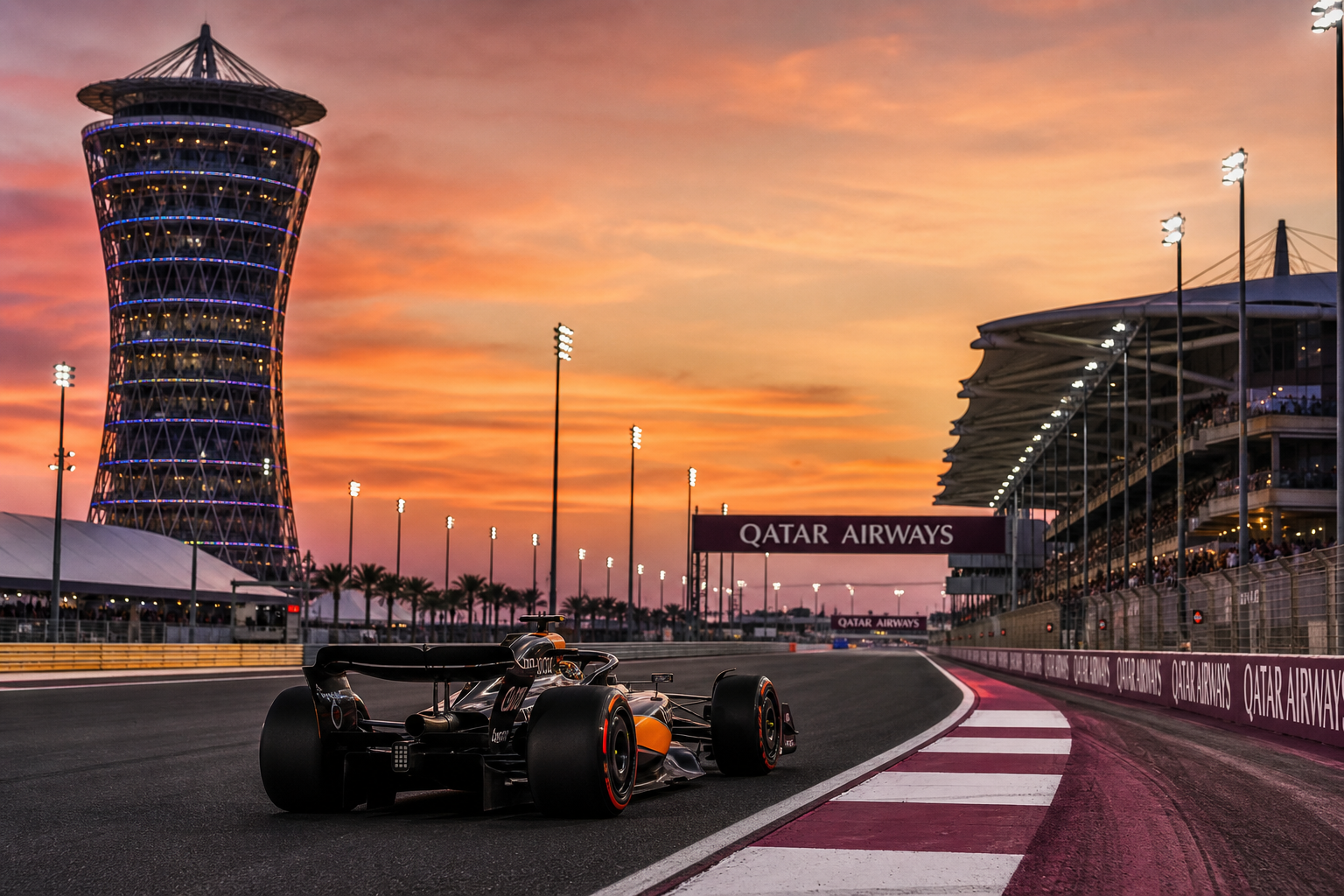

Formula 1’s season-ending trips to Qatar and Abu Dhabi have begun to look less like firm calendar commitments and more like two very expensive question marks. Yet despite the ongoing conflict in the Middle East—and the widespread assumption that both races will eventually be called off—there has been no formal cancellation.
That apparent contradiction is the interesting part. Behind the scenes, the commercial rights holder has reportedly been preparing contingency plans, while the public line remains that the races are still scheduled to go ahead. The paddock, meanwhile, has started behaving as though the final rounds may take place somewhere else, with hotels in Imola mentioned as part of the alternative planning.
In Formula 1, saying nothing is rarely an accident. It is usually a sign that several awkward conversations are still taking place in rooms where nobody wants to be the person who speaks first.
The Calendar Is Still Officially Intact
Until Formula 1, the FIA, or the relevant promoters announce otherwise, Qatar and Abu Dhabi remain on the calendar. That matters because a race weekend is not canceled merely because the paddock has stopped feeling optimistic about it.
Each event involves commercial agreements, broadcasting commitments, freight movements, hospitality arrangements, local authorities, teams, sponsors, and thousands of people whose travel plans depend on the official schedule. Removing a Grand Prix is therefore not as simple as crossing two names off a spreadsheet and booking everyone into a different hotel.
The need for a formal decision also explains why public messaging can remain cautiously upbeat even when private planning has moved in the opposite direction. Organizers may need time to assess security information, transport conditions, insurance arrangements, contractual obligations, and the practical feasibility of moving a race—or replacing it—before making a statement that cannot easily be reversed.
That is particularly true at the end of the season. The final races are not isolated events. They form the closing sequence of the championship, with teams, television partners, sponsors, and local promoters all building their plans around a known timetable. A late change creates a remarkable amount of administrative chaos, much of it involving people who have never once driven a racing car but can nevertheless make a team principal look physically unwell.
Why a Cancellation Has Not Been Announced
The most obvious explanation is that the parties involved are still trying to preserve their options. Publicly canceling two races would confirm that the original schedule is no longer viable. Keeping them officially alive allows negotiations and contingency planning to continue without closing the door entirely.
That does not mean the races are guaranteed to proceed. It means the decision has consequences beyond the sporting calendar.
Formula 1 has a commercial interest in avoiding premature announcements. If the situation changes, a cancellation made too early can look needlessly hasty. If the races can proceed safely, the championship retains its intended finale. If they cannot, a replacement venue may be announced once the practical details are ready rather than in a fog of half-confirmed rumors.
There is also a difference between preparing for a possible cancellation and deciding that cancellation is unavoidable. Contingency planning is the sensible thing to do when the risks are serious. It does not, by itself, prove that an alternative race has been approved, that a venue is ready, or that teams have been formally instructed to change their logistics.
Why Imola Has Entered the Conversation
The mention of hotels in Imola is significant because it suggests that contingency planning may have moved beyond abstract discussion. Finding accommodation for the Formula 1 circus is one of the less glamorous but very real challenges involved in changing a race schedule at short notice.
Imola is already a known Formula 1 venue, which makes it a logical name to appear in emergency planning. The circuit has hosted the Emilia-Romagna Grand Prix and is familiar territory for teams, officials, broadcasters, and freight operators. That existing knowledge would make a potential European alternative easier to organize than a completely new location.
But hotel availability is not the same thing as a confirmed race. Rooms can be held, moved, or reserved as part of a broad contingency exercise. A circuit also needs the necessary sporting approval, operational infrastructure, local coordination, medical provision, broadcast facilities, and a workable date. Then there are the teams’ cars and equipment, which cannot simply be teleported from one side of the world because somebody found a promising block of rooms near the paddock.
Imola’s involvement, if the reports are accurate, therefore indicates preparation rather than proof. It shows that alternative arrangements are being considered seriously. It does not establish that Imola will replace either Qatar or Abu Dhabi, or that both races would be replaced by a single event.
The Sporting Problem of Replacing the Finale
Replacing a race at the end of the season creates a sporting question as well as a logistical one. The teams prepare cars, engines, tires, and setup work around expected circuit characteristics. Qatar and Abu Dhabi present a very different challenge from a European circuit, and moving the championship finale would alter the demands placed on the cars and drivers.
A European replacement could also change the rhythm of the event. Weather, daylight, travel distances, freight routes, and track characteristics all matter. Even if the championship standings remain mathematically identical, the competitive circumstances would not be.
That is why a replacement cannot be treated as a simple venue swap. Formula 1 has to consider whether the circuit can host the required number of sessions, whether the teams can reach it in time, and whether the event would meet the sporting and commercial requirements attached to a World Championship round.
There is an additional complication in preserving the integrity of the championship. Any decision must be applied consistently to every team, even though some organizations may be better positioned than others to absorb a late change. A new circuit could favor a particular car concept, expose weaknesses in tire management, or reward teams with more useful historical data. The regulations would not change, but the practical contest might.
Security Decisions Are Not Made by the Paddock Alone
Formula 1 teams are accustomed to dealing with difficult travel schedules, political complications, and the occasional airport that appears to have been designed by someone with a personal dislike of luggage. Security decisions, however, sit well above the level of ordinary race logistics.
The sport must consider advice from governments, security specialists, local authorities, teams, personnel, and commercial partners. A venue may be technically capable of hosting a race while the wider travel or regional situation makes the event unacceptable. Conversely, a complicated international situation does not automatically make every scheduled event impossible. The judgment depends on current intelligence and the specific circumstances at the time.
That creates a moving target. A decision made weeks in advance may be overtaken by events, while a decision delayed until the final possible moment leaves teams with less time to prepare. Formula 1 is therefore caught between the need for certainty and the danger of making a commitment based on information that may soon be outdated.
A Familiar Formula 1 Tension
The public sees a calendar with dates, circuits, and a neat sequence of races. The people running the championship see a network of contracts, freight schedules, television windows, local agreements, insurance policies, staffing requirements, and security assessments. The two versions of the calendar are related, but they are not the same thing.
That is why the delay in canceling Qatar and Abu Dhabi should not be read simply as indecision. It may reflect the difficulty of reaching a decision that satisfies sporting, commercial, logistical, and security requirements at the same time. Formula 1 can quietly prepare for the worst while continuing to present the official schedule as unchanged until the facts force a different announcement.
For now, the key detail is not that a replacement has been confirmed. It has not. The key detail is that contingency planning appears to be active while the formal calendar remains intact. In Formula 1, that usually means the paperwork is still being argued over, the phones are still ringing, and nobody is quite ready to admit that the glamorous global circus may need to make an unscheduled stop in Imola.

0 Comments