
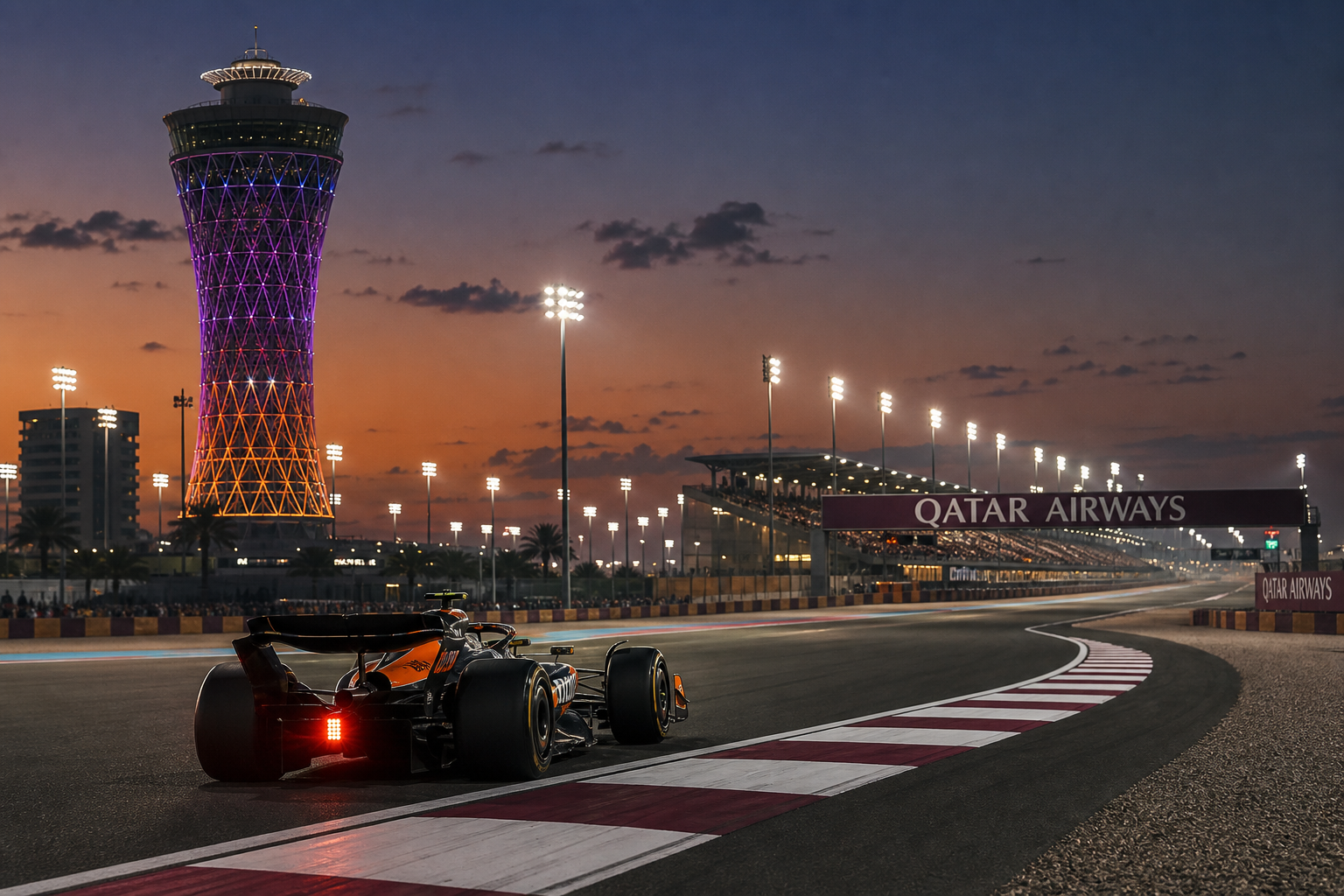

The curious part of Formula 1’s threatened Middle East finale is not that contingency plans exist. It is that the Qatar and Abu Dhabi Grands Prix are apparently still being presented as business as usual while much of the paddock has spent months treating their cancellation as the sensible outcome.
That apparent contradiction points to the awkward machinery behind a modern F1 season. A race cannot simply be removed from the calendar because the sporting mood has changed, nor can the commercial rights holder announce a cancellation without considering contracts, insurance, broadcast commitments, logistics, championship regulations, and the diplomatic consequences of doing so.
So the two races remain officially alive. Behind the scenes, however, preparations for an alternative are understood to have been under way for some time.
The Public Calendar and the Private Contingency Plan
Formula 1 has maintained that the Qatar and Abu Dhabi events are still scheduled to take place despite the ongoing conflict in the Middle East. That position is hardly unusual. Until a decision is final, the official calendar generally remains the official calendar, even when teams, organizers, and suppliers are quietly preparing for a different reality.
The commercial rights holder has reportedly been making contingency plans while continuing to support the published schedule. Those two things are not mutually exclusive. In fact, they are probably the only responsible way to manage a situation in which conditions can change quickly.
A replacement race, or a reshaped season finale, would require more than finding an available circuit and sending a few shipping containers in its direction. F1 teams carry equipment around the world by air and sea, television crews need facilities and transmission arrangements, officials need accreditation and accommodation, and local promoters need time to prepare a venue that was not necessarily expecting the championship.
The calendar may look like a neat list of dates on a screen. Operationally, it is a very large and expensive domino arrangement. Touch one piece and somebody at the other end of the paddock starts shouting about freight.
Why the Cancellation Has Been Delayed
The central difficulty is that a cancellation decision must satisfy several competing interests at once.
First, there are the commercial agreements. Formula 1’s races are tied to contracts with promoters, host governments, broadcasters, sponsors, hotels, airlines, and suppliers. Removing two Grands Prix from the schedule could trigger financial penalties, disputes over force majeure provisions, or demands for compensation. The exact terms are not public, but the existence of those relationships makes a casual announcement impossible.
Second, there is the sporting calendar. The Qatar and Abu Dhabi races are not isolated events sitting at the end of a long spreadsheet. They are part of a championship schedule that teams plan around months in advance. If both disappear, Formula 1 must decide whether to replace them, end the season earlier, or move another event into the vacant slot. Each option affects the teams differently, particularly in a championship that may still be unresolved.
A shorter season would alter the number of available points and could change the outcome of the drivers’ or constructors’ championships. A replacement event would preserve the competitive structure but create a massive logistical and financial burden. Moving an existing race could create another set of contractual problems. None of these choices is tidy.
Third, there is the question of timing. Announce too early and Formula 1 may cancel races that could, in theory, have gone ahead. Wait too long and teams, fans, and local businesses are left trying to make expensive arrangements around a calendar that no longer looks credible.
That is the sort of decision that produces careful statements, private meetings, and an impressive amount of legal paperwork. It does not produce a satisfying answer on a Tuesday afternoon.
The Imola Clue
One of the more revealing details is the reported interest in hotel capacity around Imola. That matters because the Italian circuit is an obvious candidate whenever Formula 1 needs a European fallback: it is a permanent venue, it has hosted modern F1 races, and it sits within a region with established motorsport infrastructure.
But hotel availability is not proof that Imola will replace Qatar or Abu Dhabi. It is evidence of planning, nothing more. A contingency venue can be investigated, provisionally held, or discussed without ever being added to the final calendar.
That distinction is important. Formula 1 has to examine realistic alternatives before it knows whether cancellation is necessary. Checking accommodation near a possible circuit is the mundane, unglamorous work that sits beneath a supposedly glamorous global championship. Before the cars arrive, someone has to find beds for thousands of people. The glamorous bit is usually easier.
Imola would also represent a significant change in the character of the finale. Instead of ending the season beneath the floodlights in the Gulf, teams could face a traditional European circuit and potentially very different weather, track conditions, and logistical demands. That would not merely be a change of scenery. It could affect tire behavior, car setup, freight schedules, and the atmosphere surrounding the championship’s conclusion.
Why Formula 1 Cannot Simply Say “No”
There is a temptation to view the issue as a straightforward safety decision: if the regional situation makes the races unsafe, cancel them. In principle, that is the priority. In practice, the decision involves assessments from governments, security agencies, the FIA, Formula 1, race promoters, teams, insurers, and local authorities.
The commercial rights holder also has to consider its relationship with host countries. Qatar and Abu Dhabi are not ordinary stops on a temporary sporting tour. They are important venues within F1’s current business model, and the championship has invested heavily in building a season that reaches a global audience through high-profile events in the Middle East.
That commercial reality does not override safety. It does explain why public messaging may remain cautious while contingency work continues. Formula 1 has every reason to avoid appearing to abandon a race before the relevant authorities have reached a final position, particularly when the political and security situation can develop rapidly.
There is also the matter of precedent. A cancellation based on security concerns can have consequences beyond one weekend. Promoters may ask what level of risk is considered acceptable, broadcasters may seek clarity over scheduling commitments, and teams may want to know how decisions will be made the next time a race becomes doubtful. Every statement becomes part of a much larger file.
What Teams and Fans Need to Know
For the teams, uncertainty is expensive even before a race is officially canceled. Travel, freight, hospitality, staffing, accommodation, spare parts, and event preparation all depend on knowing where the season will end. A European replacement may be geographically simpler than a trip to the Gulf, but that does not make it free or easy to arrange at short notice.
Fans face a more personal version of the same problem. Flights and hotels may already have been booked, often with limited flexibility. A late decision could leave ticket holders choosing between attending a changed event, absorbing cancellation costs, or waiting for further guidance while prices and availability move in the wrong direction.
That is why an early, clear decision would be valuable even if it is unwelcome. Uncertainty is not neutral. It shifts the cost of the delay onto everyone who has to plan around the calendar, while the official position remains unchanged.
A Season Finale Suspended in Limbo
The delay, then, is less mysterious than it first appears. Formula 1 is balancing the need to prepare for cancellation against the legal, sporting, commercial, and diplomatic consequences of announcing it. The paddock’s private assumptions may be strong, but assumptions are not the same as an approved alternative.
For now, Qatar and Abu Dhabi remain on the calendar. The reported contingency work suggests that Formula 1 does not regard the situation as routine, however. If Imola and other options are being examined, the championship is preparing for a future in which the final two rounds may not happen as currently advertised.
That leaves the season finale in an awkward holding pattern: officially intact, operationally questionable, and surrounded by the kind of careful language that usually means somebody, somewhere, is waiting for a decision with rather large consequences.

0 Comments