
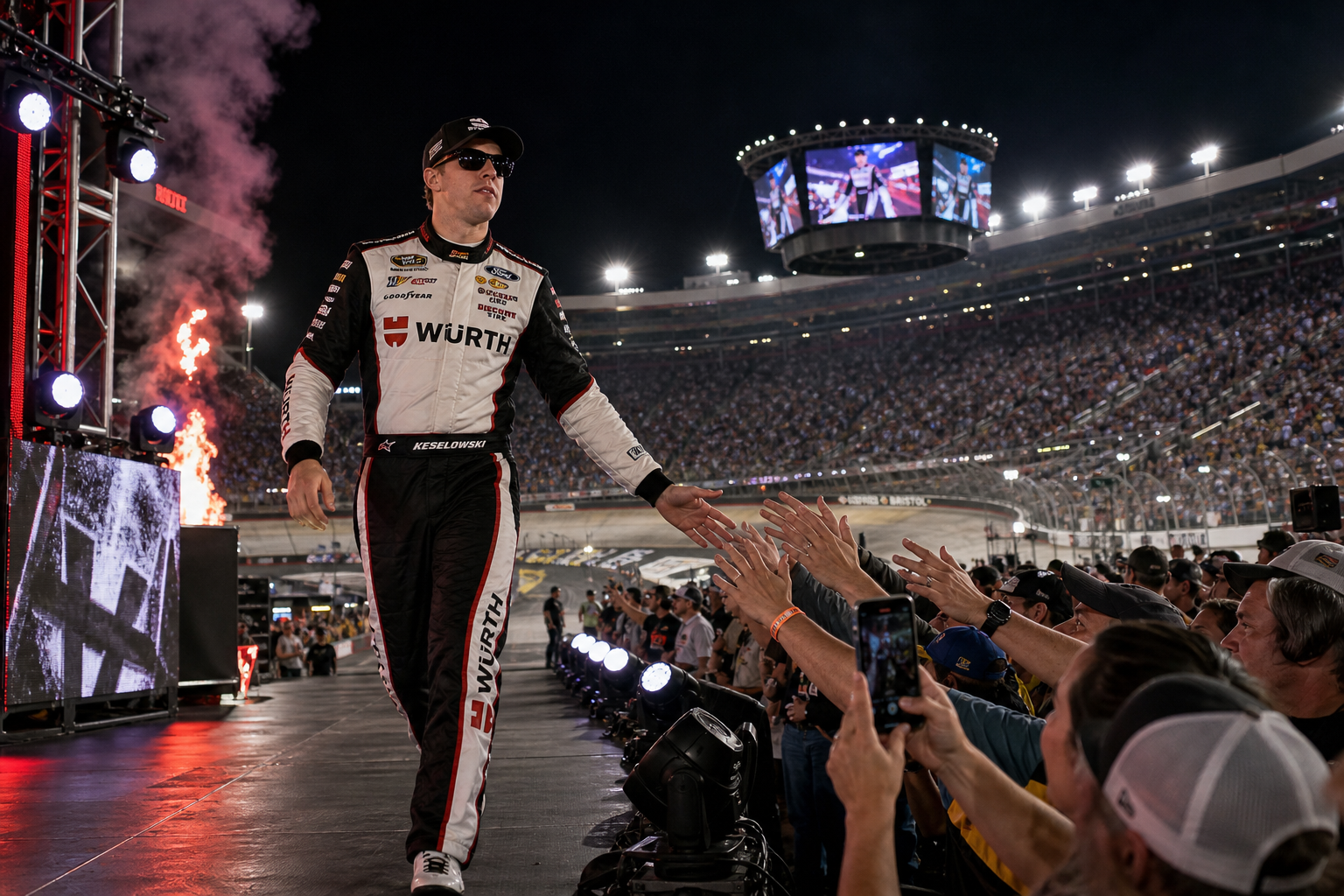

Before the engines fire and 500 laps begin, Bristol’s Cup Series drivers get a rather unusual moment of control. They choose the music that accompanies their walk onto the stage, giving each driver a few seconds to announce himself to a packed grandstand before the evening descends into short-track mayhem.
It sounds like a small pre-race detail. It isn’t. At Bristol Motor Speedway, the intro songs have become part of the event’s personality, sitting somewhere between a driver introduction, a concert entrance, and a mildly dangerous karaoke night involving several hundred million dollars of racing machinery.
The Bristol Night Race Is Built for Theater
Bristol is already one of NASCAR’s most theatrical venues. The Tennessee track is only 0.533 miles around, yet the Cup Series race runs for 500 laps. That works out to 266.5 miles of close-quarters racing, repeated braking zones, packed traffic, and very little room for anyone to have a quiet think about what went wrong.
Under the lights, the setting becomes even more distinctive. The concrete racing surface sits inside steep grandstands that make Bristol feel less like a conventional speedway and more like a sporting amphitheater. The drivers are not disappearing over distant horizons here. They are constantly visible, constantly close together, and constantly one bad decision away from turning a respectable evening into a large, expensive argument.
That atmosphere makes the driver introductions unusually important. Fans are already primed for noise, spectacle, and personality. A hand-picked song gives each driver the chance to step out of the uniform and briefly show the person behind the helmet.
A Few Seconds of Driver Identity
Most professional racing drivers spend their working lives being translated into statistics. Lap times, qualifying positions, stage points, average running position, playoff standings and finishing results are useful, but they are not especially revealing. A song choice can be.
It may point toward a driver’s taste in music, sense of humor, hometown identity, preferred image, or simple desire to make an entrance that people remember. Some choices are aggressive. Some are funny. Some are deliberately predictable. That is part of the appeal. A driver does not have to offer a profound artistic statement; he merely has to pick something that feels like him.
There is also a small but meaningful contrast between the controlled world of modern NASCAR and the looseness of the introductions. The cars are built, inspected, regulated and prepared with extraordinary precision. The walkout, by comparison, lets personality leak through the seams. For a moment, the driver is not a sponsor platform or a championship contender. He is a bloke choosing the soundtrack to his entrance.
Brad Keselowski Showed How Memorable It Can Become
One of the best-known examples came in 2010, when Brad Keselowski selected AC/DC’s “For Those About to Rock.” The song was already an obvious fit for an evening of loud engines and short-track combat, but Keselowski made the moment considerably more memorable by taking a microphone and addressing the Bristol crowd after walking out.
That is the trick with these introductions: the song provides the setup, but the driver supplies the payoff. A strong selection can earn a cheer. A driver who adds a little theater can turn it into a story fans remember years later.
Keselowski’s choice also captured something essential about Bristol. This is not a venue that demands restraint. The race itself is built around intensity, noise and spectacle, so an entrance backed by a suitably dramatic rock anthem does not feel excessive. At Bristol, excessive is often merely the starting point.
Why the Music Matters to the Fans
For spectators in the grandstands, the introductions create a personal connection before the competitive machinery takes over. The fans are not just watching cars appear on track; they are watching individual drivers emerge one by one, each with a chosen soundtrack and a few moments in the spotlight.
That distinction matters in a series with a large field and a packed schedule. Casual viewers may know the biggest names, but the introductions give every Cup driver a chance to register. A familiar song can trigger an immediate reaction. An unexpected choice can create curiosity. A particularly bold entrance can become one of the night’s talking points before the green flag even waves.
It also gives the event a sense of occasion. NASCAR has plenty of pre-race ceremonies, but a standardized announcement can feel rather sterile when repeated often enough. Letting drivers choose their own music introduces just enough unpredictability to keep the ritual alive. The format is simple, but simple is not the same as dull. Toast is simple. So is a good tire-smoking burnout.
The Song Choice Can Shape the Driver’s Image
There is a certain amount of strategy involved, even if nobody would confuse it with race engineering. A driver can reinforce an existing reputation or deliberately bend it in another direction.
A hard-driving rock track may suit a driver known for aggression on the track. A country song can lean into regional identity without requiring a speech about roots and authenticity. A humorous or deliberately odd selection can make a driver seem more approachable. The key is that the choice should feel intentional. Nobody wants an entrance that sounds as though it was assembled by a marketing department after three committee meetings and a focus group involving people who have never attended a race.
There is no correct musical genre, either. The success of the moment depends less on the song itself than on whether the driver appears comfortable owning the choice. A perfectly suitable anthem can fall flat if the entrance feels forced. An eccentric selection can work brilliantly when the driver commits to it.
At Bristol, the Introduction Is Part of the Race Weekend
The driver songs do not change tire wear, alter the concrete surface or improve a car’s long-run balance. They will not rescue a driver who misses the setup or gets caught in someone else’s wreck. Once the race begins, the soundtrack becomes the familiar mix of engines, spotter calls, scraping sheet metal and the crowd reacting to every near miss.
But that does not make the introductions disposable. Events are remembered through details, and Bristol has one of the best details in NASCAR. The track already offers a compact layout, enormous grandstands and a night-race atmosphere that few venues can match. Giving the drivers control of their entrances adds a human layer before the machinery takes over.
That is why the tradition has lasted. The songs are brief, but they give fans something beyond the usual statistics and sponsor messages. They create anticipation, reveal personality and occasionally produce a moment that survives long after the final checkered flag.
Then the engines start, the field bunches up and 500 laps of Bristol begin. The music may stop, but the drama has only changed instruments.
0 Comments