
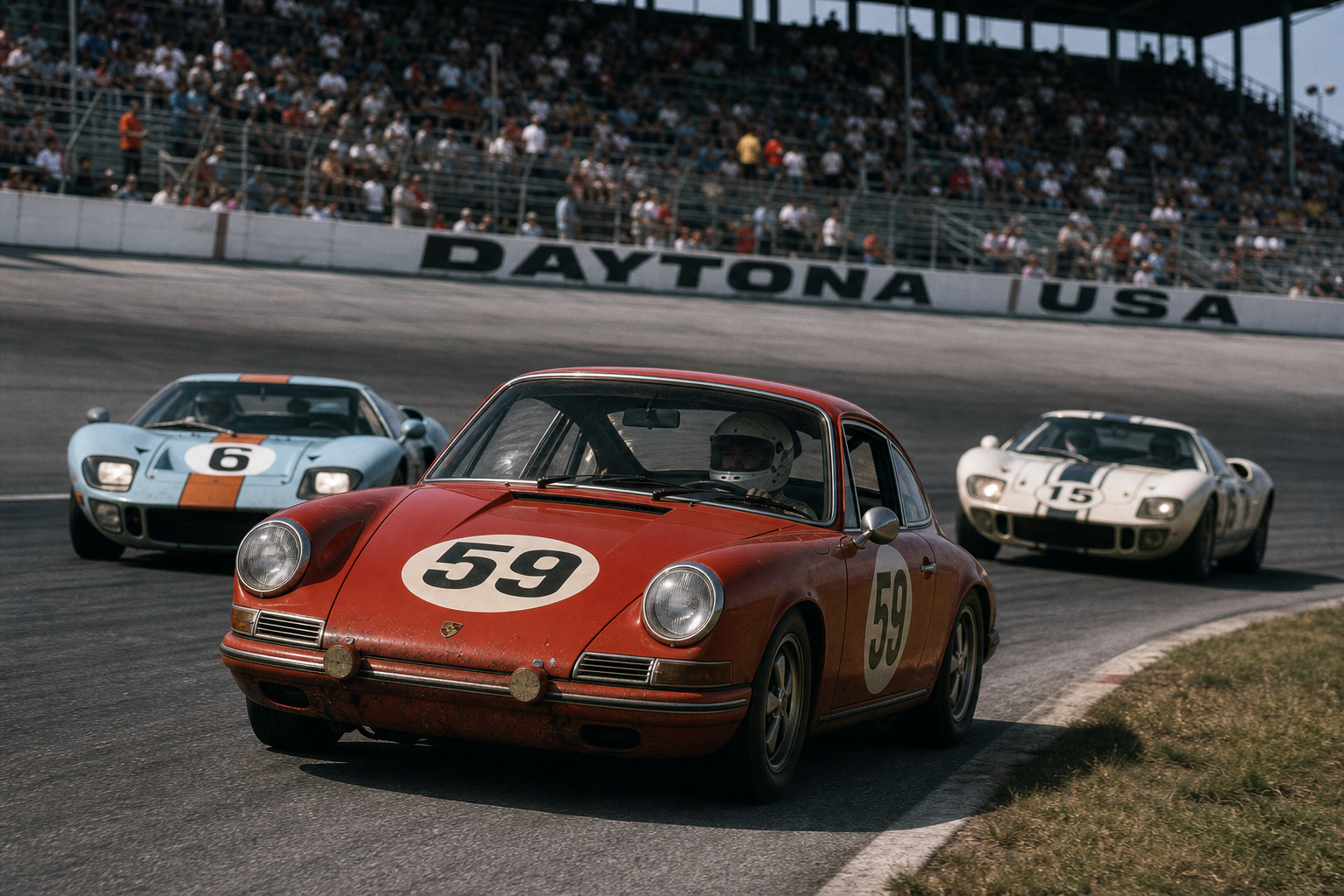

The Daytona 24 Hours is built around excess: enormous speed, brutal duration, changing weather, exhausted crews, and the peculiar spectacle of watching racing cars attack a banked oval through the small hours of the morning. In 1972, however, the famous endurance race was reduced to six hours.
It sounds like someone had accidentally booked the wrong event. In reality, the shortened race was a direct consequence of the United States fuel crisis, which forced organizers and sanctioning bodies to reconsider how much gasoline they were willing to burn for the sake of motorsport. The Daytona race survived, but for one year it became a very different contest.
Daytona Was Not Always a 24-Hour Race
The event’s identity is now inseparable from its full-day format, but it began on a much smaller scale. The first Daytona endurance race, held in 1962, lasted three hours. That was still a serious test on the newly opened Daytona International Speedway’s combination of high-banked oval and infield road course, but it was a rather more manageable proposition than keeping cars running from lunchtime through the following afternoon.
The race gradually grew in ambition. Its organizers were looking toward the 24 Hours of Le Mans, the established benchmark for long-distance sports-car racing, and Daytona eventually adopted the same twice-around-the-clock format in 1966. That first 24-hour running produced an appropriately grand result: Ken Miles and Lloyd Ruby took overall victory for Ford in a GT40 Mk II, giving the new format immediate international credibility.
From then on, the 24-hour race became the centerpiece of Daytona’s sports-car calendar. It was not merely a longer version of an ordinary race. The duration changed everything. Teams had to manage drivers, tires, brakes, lighting, traffic, pit stops, fuel strategy, and mechanical sympathy. A car that looked unbeatable at sunset could be limping around by sunrise, generally with a body panel missing and a mechanic staring into the middle distance.
The 1972 Fuel Crisis Changed the Equation
By 1972, endurance racing faced a problem that could not be solved with a clever pit-stop strategy. The United States was dealing with a fuel shortage and rising gasoline prices, while the public mood toward motorsport’s consumption was becoming increasingly uncomfortable. A 24-hour race involving a large field of high-performance cars was an easy target.
IMSA, which sanctioned the event at the time, shortened the race to six hours. The decision preserved the meeting while cutting fuel usage dramatically. It also avoided the awkward spectacle of racing organizations insisting that burning thousands of gallons of gasoline was somehow a solemn civic duty.
The change was not an insignificant adjustment to the schedule. Cutting 18 hours from an endurance race removed the very factors that usually define Daytona: overnight running, driver fatigue, long-term reliability, and the slow accumulation of damage that separates a fast car from a surviving one. Teams still had to prepare for a demanding race, but the event now rewarded a much more aggressive approach.
Why Six Hours Produced a Different Kind of Race
A six-hour event sits in an interesting middle ground. It is far too long for a driver to attack every lap without consequence, yet short enough that teams cannot rely on attrition to eliminate the opposition. Fuel strategy remains important, but there is less opportunity for a conservative car to recover from an early deficit. Mechanical durability still matters, although a marginal component has less time to reveal itself in spectacular fashion.
That altered rhythm suited the winning Porsche 911S, driven by Peter Gregg and Hurley Haywood. Their victory demonstrated that the shortened race was not simply a ceremonial version of the traditional Daytona classic. The winning crew still had to combine speed, consistency, and disciplined pit work, but the event demanded them over six hours rather than an entire day.
The choice of the 911S was significant, too. Daytona had recently been associated with spectacular prototype machinery, including Porsche’s mighty 917, but the 911 offered a different interpretation of endurance performance. It was smaller, lighter, and better suited to the production-based sports-car racing environment that was becoming increasingly important in North America. A six-hour race placed greater emphasis on maintaining a high average pace, where a well-prepared 911 could be an extremely serious weapon.
The Daytona Road Course Was Still a Proper Test
Shortened duration did not make Daytona easy. The circuit’s character has always been unusual. Cars spend significant time on the high banks, where aerodynamic stability and engine performance are exposed, before diving into the infield section, where braking, traction, and driver confidence matter more.
That combination punishes compromise. A car optimized for the oval can be awkward and nervous through the infield. A machine that behaves beautifully in the slower corners may give away too much speed on the banking. Add traffic, changing tire loads, and the need to avoid damaging the car, and even a six-hour race becomes an extensive engineering examination.
The shortened event also placed a premium on preparation. There was less time for a car to recover from a slow start and less opportunity for an underperforming machine to benefit from rivals’ failures. Every pit stop mattered more. Every lost lap hurt more. The teams could not simply settle in and wait for Daytona to grind everyone else into expensive confetti.
A One-Year Detour, Not a New Identity
The six-hour format was temporary. Daytona returned to its traditional 24-hour schedule the following year, restoring the overnight drama that had become central to the event. The 1972 race therefore stands as an unusual interruption rather than a failed attempt to redesign the classic.
That brief interruption is precisely what makes it so interesting. It shows how closely motorsport is tied to circumstances outside the circuit. Race formats can look permanent when viewed through a modern lens, but they are often shaped by economics, politics, fuel availability, regulations, and public sentiment. Daytona’s 24-hour identity was strong enough to survive a one-year reduction, but it was not immune to the realities of the era.
The episode also offers a useful reminder that endurance racing is not defined solely by the number printed beside the word “hours.” The strategy changes with the distance, but the essential challenge remains: make a fast car run quickly for a long time without allowing the drivers, machinery, or pit crew to do anything catastrophically foolish.
Why the Six-Hour Daytona Still Matters
Today, the Daytona 24 Hours is celebrated for its full-day punishment. The night stints, sunrise finishes, and battered prototypes are part of the event’s mythology. A six-hour race can seem almost tidy by comparison, like ordering a small coffee at a truck stop.
Yet the 1972 race belongs in the event’s history because it tested the resilience of the competition itself. Daytona did not disappear when the traditional format became politically and economically awkward. It adapted, ran a meaningful race, and returned to 24 hours when conditions allowed.
That is the slightly odd charm of motorsport history. The famous races are not always the ones that follow the familiar script. Sometimes the most revealing chapter is the year when a 24-hour classic lasted only six hours, a Porsche 911S took the win, and the organizers discovered that even Daytona had to keep one eye on the fuel gauge.
0 Comments