
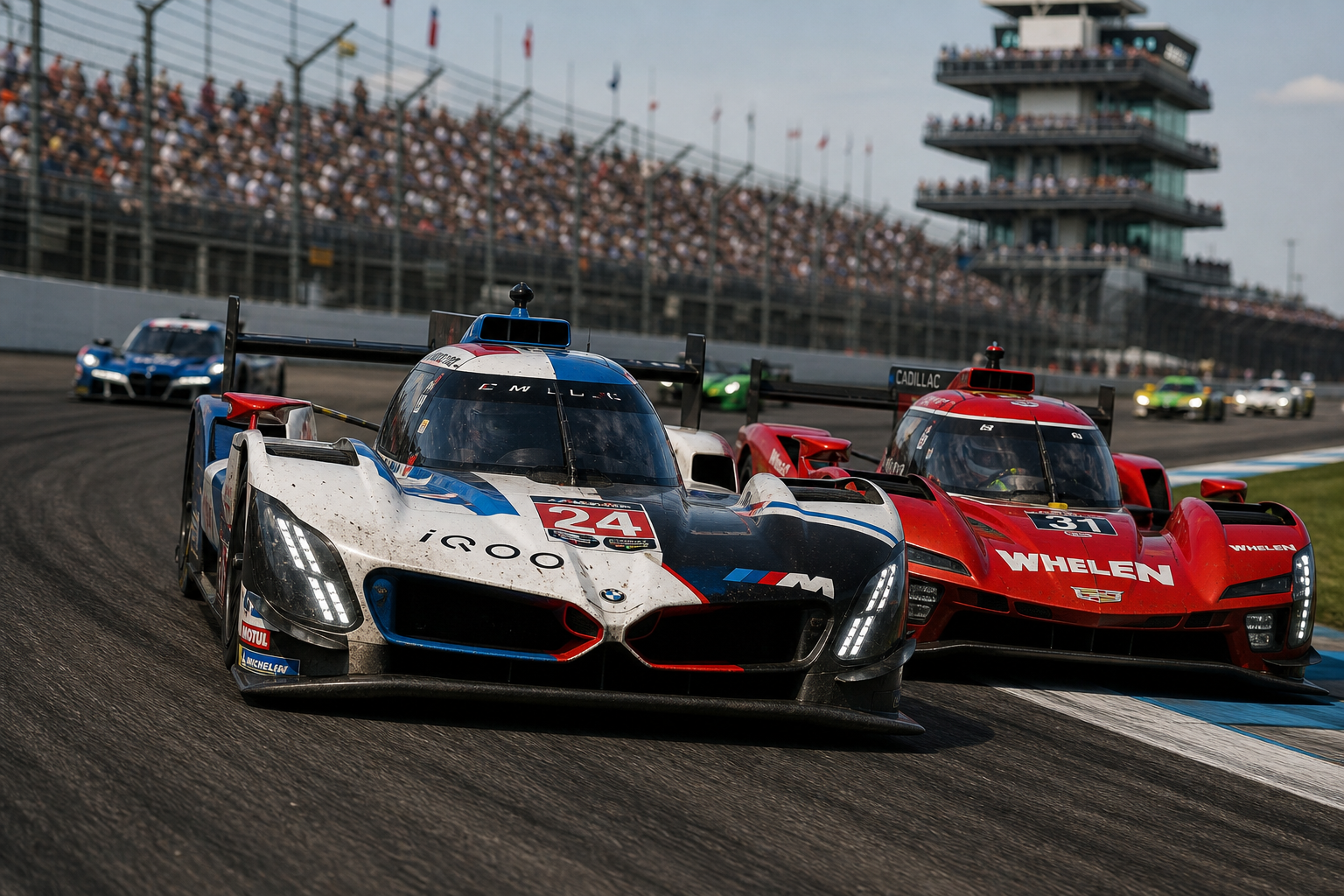

Sheldon van der Linde waited until there was barely enough race left to do it, then launched the move that decided the Battle on the Bricks. With 5 minutes and 30 seconds remaining at Indianapolis, the South African driver took his No. 24 BMW M Hybrid V8 past Earl Bamber’s No. 31 Whelen Cadillac V-Series.R into Turn 12, settling a tense late fight in the penultimate race of the IMSA WeatherTech SportsCar Championship season.
It was the sort of pass that makes endurance racing look deceptively simple. Two prototypes, traffic everywhere, tires and fuel being managed, and one braking zone in which somebody has to decide whether caution is sensible or merely another word for losing. Van der Linde chose the latter option. Sensibly, he did it without waiting for another invitation.
A Late Move With No Room for Hesitation
The duel between van der Linde and Bamber had developed into the defining contest of the closing stages. Both drivers were at the sharp end of the GTP field, piloting some of the most sophisticated machinery in North American sports-car racing. The BMW and Cadillac are hybrid-powered prototypes built for outright pace, but the machinery can only do its job if the driver finds a way through traffic without throwing away the race.
That is what made the pass into Turn 12 so important. Van der Linde had to close on Bamber while also negotiating slower cars, judging the available braking distance and committing before the opportunity disappeared. In a sprint-style IMSA finish, there is no leisurely endurance-race arithmetic left to hide behind. The checkered flag is coming, the tires are no longer theoretical, and every hesitation becomes somebody else’s advantage.
Bamber’s Cadillac had held the position until that moment, but the BMW found the opening and completed the move. Van der Linde then had the job that is often harder than making the pass itself: keeping the car clean, maintaining the lead and refusing to give the Cadillac another look at the position during the final minutes.
Why Traffic Made the Indianapolis Finish So Difficult
Multi-class sports-car racing creates a peculiar sort of chaos. The fastest prototypes are racing one another while simultaneously catching cars from other classes, each moving at a different speed and following a different line through the circuit. A driver can gain several seconds in one sector and lose the advantage at the next corner simply because a slower car arrives at the wrong moment.
That traffic was central to the van der Linde-Bamber fight. A pass between two evenly matched GTP cars is rarely just a duel between those two cars. It is a moving calculation involving closing speeds, corner exits, visibility and the position of traffic several seconds ahead. The driver who reads the situation best can create an opportunity that does not exist on an empty track.
Turn 12 became the place where van der Linde’s calculation paid off. The move also demonstrated why late-race prototype battles can be more compelling than a simple qualifying-style contest. Raw pace matters, naturally, but so do patience, positioning and the ability to make a decision while the track is changing around you. Motorsport has always rewarded bravery. Multi-class racing adds a spreadsheet to the bravery and then sets fire to the spreadsheet.
BMW and Cadillac Bring Different Flavors of Prototype Racing
The winning BMW M Hybrid V8 and the Cadillac V-Series.R represent two manufacturers’ approaches to the current top class of IMSA competition. Both are purpose-built GTP prototypes, rather than road cars with a racing body kit and a heroic marketing department. Their hybrid systems, aerodynamic efficiency and carefully managed performance are designed around long-distance competition, where speed must be extracted repeatedly and reliably rather than produced for one glamorous lap.
That technical backdrop makes a last-minute fight particularly revealing. At this level, the cars are not separated by simple differences in engine power. Drivers work with energy deployment, tire condition, traffic and the aerodynamic compromises required to run in close company. A car that looks dominant in one part of a lap may be vulnerable elsewhere, especially when its driver has to choose between defending a line and preparing an attack.
For van der Linde, the BMW’s advantage was ultimately measured in one specific moment: the approach to Turn 12 with the Cadillac ahead and the finish approaching rapidly. For Bamber, the same moment became a reminder that leading with five and a half minutes remaining is not the same as winning. Racing is occasionally rather cruel about that distinction.
Van der Linde Adds Another Major IMSA Result
The Indianapolis victory is significant for van der Linde personally as well as for BMW. The South African has built a reputation across top-level sports-car racing for speed and racecraft, and this was not a victory produced by a comfortable margin or a quiet run at the front. It required a direct pass against a rival in another factory-backed prototype during the most valuable minutes of the race.
That matters because late-race opportunities are often fleeting. A driver may spend an entire stint close enough to attack, only for traffic, tire degradation or a defensive move to close the door. Van der Linde had to recognize that the opening into Turn 12 was real, not merely tempting, and then place the BMW accurately enough to finish the maneuver without contact.
Bamber, meanwhile, leaves Indianapolis with the frustration that comes from doing nearly everything required to win and losing the lead at the last serious opportunity. The No. 31 Cadillac was still part of the story right to the flag, which is rather more useful than disappearing from contention several laps earlier, but it will not feel especially comforting when the result is recorded as second rather than first.
One Race Remains After the Indianapolis Thriller
The Battle on the Bricks was the penultimate race of the IMSA WeatherTech SportsCar Championship season and the final sprint round, leaving one event still to run. That gives the Indianapolis result added weight without requiring anyone to pretend the championship has already been decided by a single late pass.
What the race did provide was momentum for BMW and a clear demonstration of van der Linde’s ability to convert pressure into a result. The No. 24 crew did not need a dominant procession. It needed its driver to remain close, understand the traffic and act before the clock ran out.
That is the charm of a finish such as this. The BMW M Hybrid V8 did not win because the laws of physics suddenly developed a German accent. It won because, with 5 minutes and 30 seconds remaining, van der Linde saw the gap, trusted the braking zone and made Earl Bamber’s Cadillac surrender the place. At Indianapolis, that was enough to turn a tense prototype battle into a BMW victory.


0 Comments