
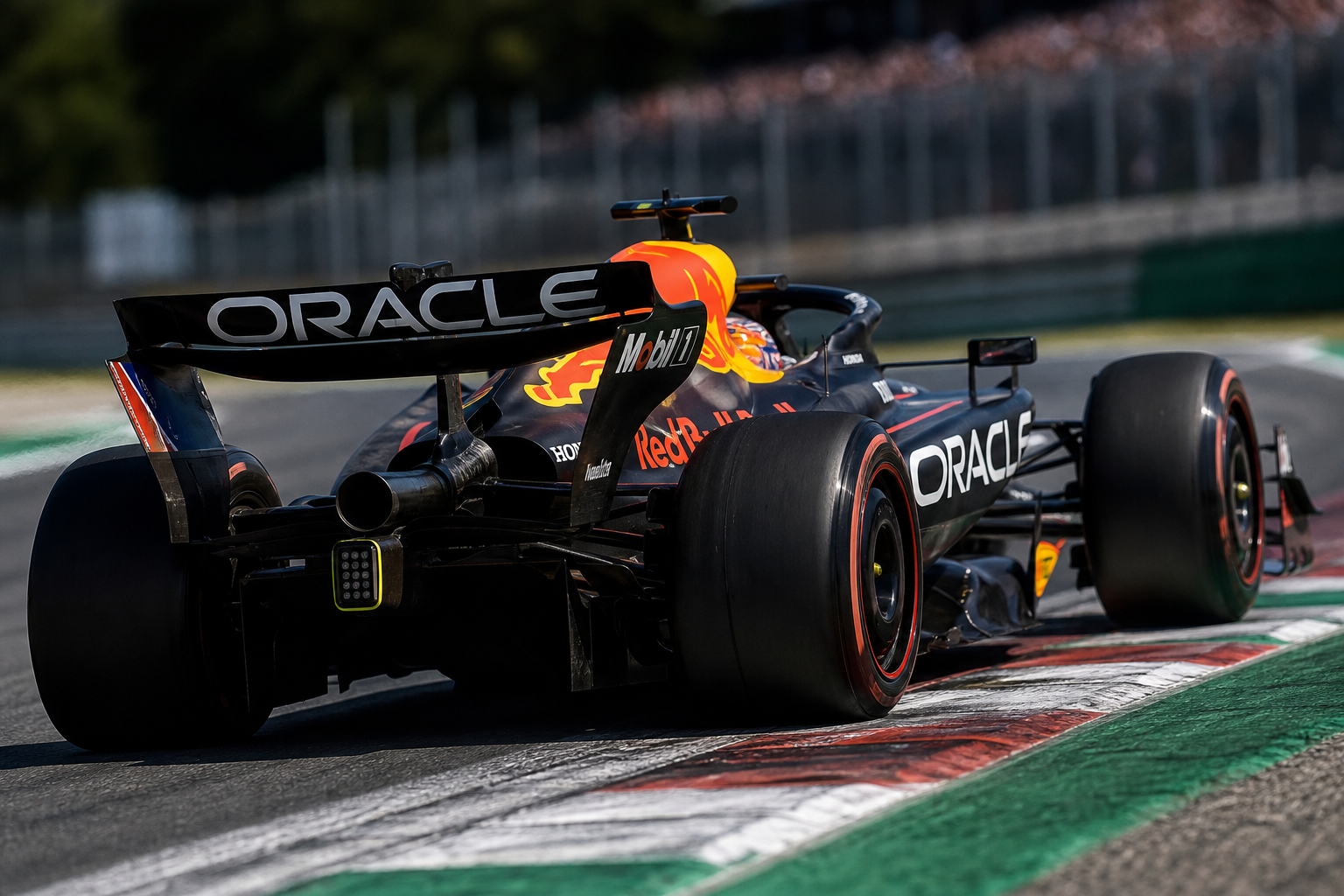

Max Verstappen has been warning Red Bull about the same unpleasant habit for years: the car can feel acceptable at the start of a session, then gradually turn sour as the laps accumulate. The problem is most obvious at the rear axle, where grip and confidence seem to disappear just when a Formula 1 driver needs them most.
Red Bull now admits that it may not be able to fully cure the underlying issue until 2027. That is a remarkably long time to live with a problem affecting a four-time world champion, particularly one who has made a career out of extracting speed from cars that occasionally behave like they have been assembled during a power cut.
A Problem That Gets Worse With Time
Verstappen’s complaints have surfaced across several weekends this season. The common thread is not necessarily a sudden mechanical failure, but a deterioration in the car’s behavior during a session or race. As the tires take more punishment, fuel load changes and the car completes more laps, the rear axle reportedly becomes increasingly difficult to manage.
That distinction matters. A car that is slow from the first corner can usually be understood, even if fixing it is expensive and deeply annoying. A car that changes character during a run is far more troublesome. Engineers can tune around a lack of outright grip, but a moving target makes setup decisions considerably more complicated.
At the rear axle, the consequences are immediate. The driver may experience oversteer on corner entry, instability under braking, a lack of traction on exit, or a general loss of confidence when the car is loaded through a fast turn. Those symptoms can overlap, and they can be amplified by tire temperature and degradation. The driver ends up managing the car rather than attacking the lap.
That is particularly damaging in qualifying, where one lap is supposed to provide a clean answer. Instead, Verstappen can find himself trying to predict what the rear of the car will do several corners ahead. It is less “precision instrument” and more “shopping trolley with a philosophical objection to straight lines.”
Monza Exposed the Frustration
The problem became especially visible during qualifying at Monza, where Verstappen described the RB22 as “a car made of paper.” It was a colorful description, but the irritation behind it was clear. The comment was not merely about a car lacking pace; it reflected the sense that the machine could lose its useful behavior as the session developed.
Monza is an unforgiving place for an unstable rear end. The circuit’s long straights reward low drag, while its heavy braking zones and fast changes of direction demand a car that remains predictable when the driver attacks the lap. There is very little room for a driver to disguise a balance problem, and even less patience available when the car becomes less cooperative with each run.
Verstappen has also indicated that he has been raising the issue internally for years. That detail makes the latest timeline more significant. This is not a complaint that appeared after one disappointing weekend, nor does it sound like a driver simply objecting to a particular setup choice. It is an issue that has survived multiple attempts to understand and improve the car.
Why a Rear-Axle Issue Can Be So Difficult to Cure
Formula 1 cars do not have isolated systems in the way a brochure might suggest. Changes made to the suspension can affect aerodynamic behavior. Altering the aerodynamic platform can change tire loads. A different setup may improve the rear axle in one phase of a lap while making the front end less effective elsewhere.
The rear tires also carry a significant share of the workload when a car accelerates out of slow corners. If the car overheats or slides the rear tires, the driver can lose performance progressively rather than all at once. That makes the car feel increasingly fragile during a longer run, even when the initial laps look promising.
There can be several possible contributors to that sort of behavior: aerodynamic sensitivity, suspension characteristics, tire usage, cooling demands, ride-height changes, or the way the car responds as fuel burns off. The important point is that the source material does not identify one faulty part, and Red Bull’s apparent conclusion suggests the problem is structural rather than a component that can simply be swapped before the next race.
That is why a full solution could take years. If the issue is connected to the car’s basic aerodynamic or mechanical architecture, engineers may be able to reduce the symptoms with setup changes and development parts without eliminating the cause. A proper fix may require a new design philosophy rather than another round of small revisions.
Why 2027 Is the Important Date
Red Bull’s suggestion that the problem cannot be fully resolved until 2027 indicates that the team may be working within the limits of its current car concept. In Formula 1, a major regulation change can provide the clean sheet that teams need when an architecture has become difficult to untangle. It can also make partial fixes less attractive if engineers know a more fundamental redesign is already approaching.
That does not mean Verstappen will be forced to endure the same behavior unchanged until then. Red Bull can still work on reducing the instability, improving tire management and making the car more predictable over a run. “Cannot be fully fixed” is a very different statement from “nothing can be done.” It does, however, suggest that the team believes some portion of the problem is built into the current package.
For a driver of Verstappen’s caliber, predictability is not a luxury. He can handle a car with an aggressive balance, and his driving style has often allowed him to find performance where others find only trouble. But even the best driver cannot consistently overcome a rear axle that changes its attitude as the session progresses. At some point, the driver is not exploiting the car’s limits; he is negotiating with them.
Red Bull’s Engineering Challenge
The awkward part for Red Bull is that the team has previously shown it can produce exceptionally fast cars. Speed, however, is not the same as usability. A car may generate impressive lap times under a narrow set of conditions yet become difficult to drive when temperatures, tire condition or track evolution move away from that sweet spot.
That distinction has become increasingly important as Verstappen’s complaints have continued. Drivers are usually happy to criticize a car after a bad result, but repeated comments about the same behavior carry more weight when they appear across different circuits and session types. The pattern suggests a limitation that cannot be explained away by one poor setup or one awkward track.
Red Bull must now improve the current car without creating new problems elsewhere. More rear stability could come at the cost of aerodynamic efficiency. Protecting the tires could reduce qualifying performance. A setup that behaves well in a long run might leave the car too slow over one lap. Formula 1 is full of compromises, although some compromises are dressed up in carbon fiber and called development direction.
Verstappen’s blunt feedback gives the team a clear target, but not necessarily an easy solution. The immediate objective will be to make the car less sensitive and more consistent. The longer-term objective, apparently, is a deeper redesign that will not arrive until 2027.
Until then, Red Bull’s fastest route may be damage limitation: keep the rear axle within a usable operating window, stop the car from deteriorating so dramatically during a run and give Verstappen something he can trust from the first lap to the last. That sounds simple. In Formula 1, it rarely is.
0 Comments