
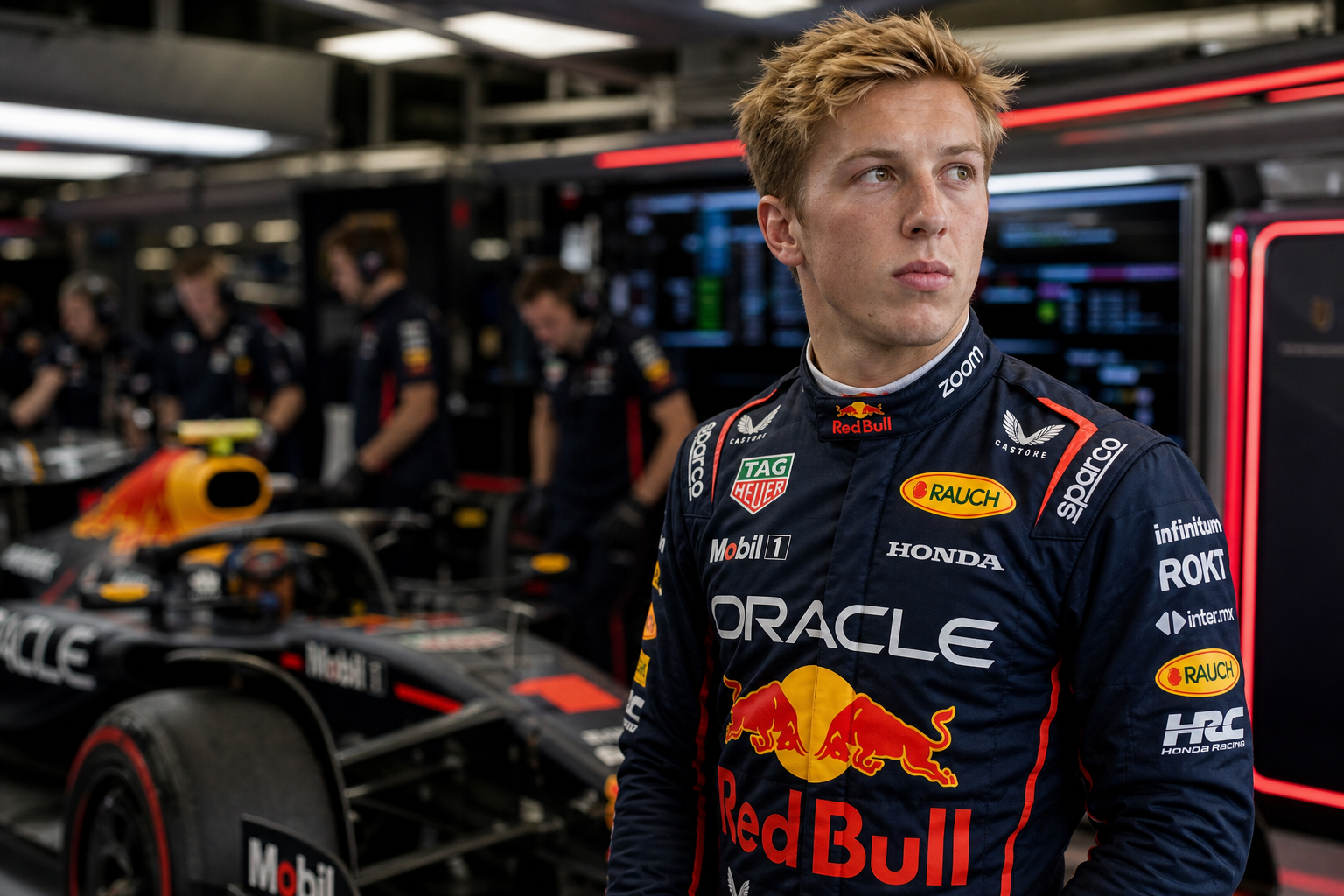

Liam Lawson’s latest stint in a Red Bull seat has done more than keep the car occupied while Isack Hadjar recovers from injury. It has, by all accounts, put Lawson squarely back into the frame for the long game — the sort of long game that makes Formula 1 driver lineups look like a chessboard after someone has kicked the table.
Red Bull has been openly complimentary about Lawson’s contribution in recent races, with the team describing his form as “very, very, very strong.” That is not the kind of line you trot out lightly, especially from a squad that tends to treat praise like a particularly rare spare part. It suggests Lawson has not merely filled a gap; he has made the gap look rather more awkward than Red Bull might have expected.
A Substitution That Became Something More
Lawson’s current spell in the car was never supposed to become a headline-grabber. He stepped in because Hadjar was injured, and the assignment was straightforward enough on paper: keep the machine running, keep the points coming if possible, and avoid making a nuisance of yourself. Naturally, Formula 1 had other ideas.
When a reserve or stand-in driver lands in a front-line seat, the temptation is always to see the situation as temporary wallpaper. Useful, necessary, and unlikely to be discussed again. But a strong substitute can change the tone of a team’s planning very quickly. That appears to be what has happened here. Lawson has given Red Bull a reminder that good drivers do not politely wait their turn and remain invisible; they arrive, get on with the job, and make the people in the back office start opening spreadsheets with suspicious enthusiasm.
The fact that Red Bull has chosen to speak so positively about his performance matters because the organization is famously unforgiving when the stopwatch disapproves. You do not survive long at the sharp end of Formula 1 by handing out compliments for good attendance. If the praise is this strong, it is because Lawson has earned it the hard way: with pace, composure, and enough value to make a future decision suddenly feel less settled than it once did.
Why 2027 Is Already Coming Into Focus
The key phrase in all of this is the one that keeps creeping toward the horizon: 2027. Driver contracts, development programs, and future lineups tend to sit in the background until someone like Lawson does something inconveniently impressive. Then they rush to the foreground, dressed in a suit and carrying a calculator.
Red Bull’s praise suggests Lawson is no longer being viewed as a temporary placeholder. Instead, he is forcing a proper discussion about what comes next. That does not guarantee him anything, because Formula 1 careers are rarely handed out like raffle prizes, but it does place him in a far healthier position than simply being the chap covering the shift.
For Red Bull, this kind of situation is familiar territory. The team’s driver pipeline has long been one of the most scrutinized in motorsport, and its decisions often have ripple effects across the wider grid. When one of its drivers performs well, the pressure to define the future arrives early and noisily. When that driver happens to be a substitute, the whole thing becomes even more interesting, because the temporary solution starts to look suspiciously like a permanent option.
What Red Bull Sees in Lawson
Although the team’s comments were concise, the meaning behind them is hard to miss. Lawson has evidently impressed not just by keeping himself out of trouble, but by contributing at a level that has caught Red Bull’s attention in a very real way. In Formula 1, that usually means he has done the unglamorous bits properly: managed the tires, kept the car in the operating window, and extracted enough speed to make the strategists feel clever rather than haunted.
That is often what separates a useful replacement from a genuinely promotable driver. Anyone can have one decent session and enjoy a flattering headline. It takes consistency to persuade a top team that the early evidence is not a fluke. Lawson appears to have crossed that threshold, or at least given Red Bull enough confidence to start speaking about him in terms that go beyond emergency cover.
There is also a neat bit of Formula 1 irony here. The sport is obsessed with preparation, simulation, and long-range planning, yet some of the most consequential decisions still come from unexpected opportunities. A driver gets a call-up because someone else is sidelined, and suddenly the future of the seat is being discussed before the injured driver is fully back on his feet. It’s hardly sentimental. It is, however, very Formula 1.
The Reality Behind the Praise
Red Bull’s public approval is useful, but it is not the same as a signed contract or a guaranteed promotion. The team still has to weigh the broader picture, including its longer-term lineup plans and the shape of the 2027 market. Drivers move, opportunities open, and team politics have a habit of making even simple decisions look like they were drafted by a committee of caffeinated accountants.
Still, Lawson’s position is plainly better now than it was before this latest run. He has not only kept himself in the conversation; he has made Red Bull talk about him in stronger terms than many stand-ins ever hear. That alone is a meaningful result in a sport where attention is precious and patience is usually in short supply.
For Lawson, the job remains the same as it ever was: keep delivering, keep the pressure on, and make it difficult for the decision-makers to look elsewhere. If he can do that, the 2027 discussion may end up being less about whether he deserves another chance and more about how Red Bull could possibly justify not giving him one.
In Formula 1, that is about as close as a driver gets to job security without actually having it. Which, given the usual chaos of the place, is still rather something.


0 Comments