
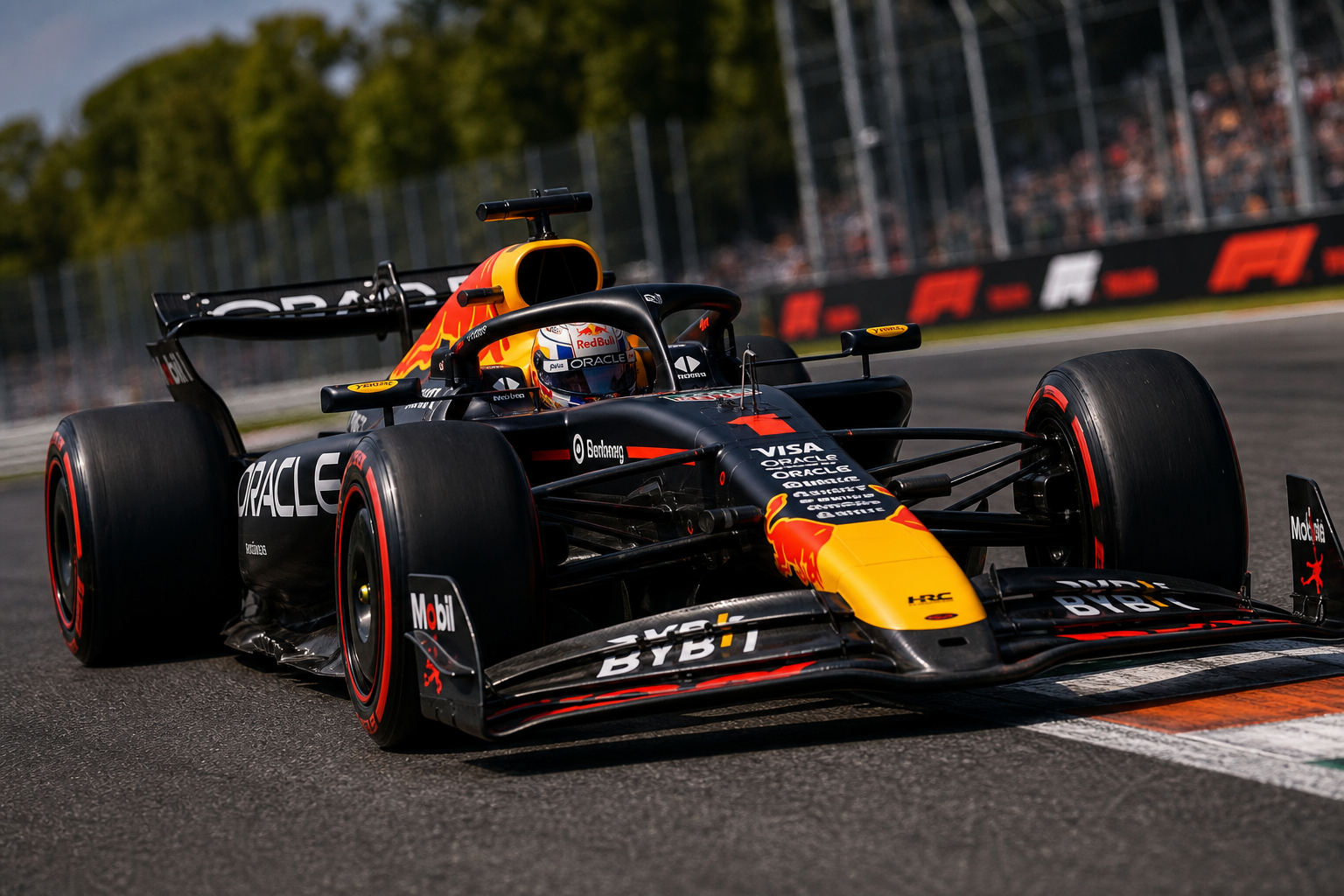

Max Verstappen’s complaints about the Red Bull Formula 1 car have stopped sounding like the usual driver grumbling about a missed apex. They now point to a problem the team openly admits it may not be able to fully solve until 2027.
The issue appears at the rear axle, where Verstappen says the car can deteriorate as a session or race progresses. That is a particularly nasty habit for a racing car. A machine that is merely difficult at the start of a run can often be tamed with setup changes. One that gradually loses its rear-end behavior is rather more like trying to balance a dinner plate on a wet dog.
Red Bull has acknowledged that Verstappen’s concern is genuine, but the team’s comments also suggest that a complete remedy is not immediately available. The four-time world champion has reportedly been raising the issue internally for years, yet it remains present in the current car. According to Red Bull, the problem cannot be fully fixed before 2027.
A Rear Axle That Gets Worse as the Run Continues
Verstappen’s complaint is not simply that the Red Bull lacks grip. Formula 1 drivers are constantly asking for more grip, usually with the solemnity of a man requesting the last biscuit. The more specific concern is that the car’s rear axle becomes progressively less dependable during a session or race.
That can manifest itself in several ways: less confidence when turning into a corner, poorer traction on exit, more sliding under power, or a balance that moves away from the driver as the tires lose performance. The exact technical cause of Verstappen’s problem has not been publicly detailed, so it would be foolish to pretend there is a neat diagnosis available from the grandstand.
What is clear is the consequence. Verstappen cannot attack the car in the same way throughout a run because the behavior he feels at the beginning may not be the behavior waiting for him several laps later. A setup that looks acceptable in a short practice stint can become a liability in qualifying or a race.
That is especially damaging for a driver whose strengths include braking late, carrying enormous confidence into corners, and placing a car precisely at the edge of its available grip. If the rear axle changes character beneath him, the margin for those famously committed inputs shrinks sharply.
Monza Exposed the Frustration
The problem was particularly visible during qualifying at Monza, where Verstappen described the RB22 as “a car made of paper.” It was a memorable line because it captured more than simple disappointment. Paper can be light and useful, but it is not what anyone wants holding together a Formula 1 car while traveling at racing speeds.
Monza is an unforgiving place for an unstable or inconsistent rear end. The circuit demands low aerodynamic drag for its long straights, but the car still needs enough stability under braking and through its faster corners. Teams trim away downforce to achieve speed between the chicanes, leaving drivers with less aerodynamic support when they need the car to remain settled.
That does not prove Monza caused the problem, nor does it explain the underlying fault. It does explain why a rear-axle weakness would become so obvious there. When the car is already operating with a relatively lean aerodynamic setup, there is less room to conceal poor balance with extra downforce. The driver gets the unedited version.
For Verstappen, that made qualifying particularly painful. A driver needs to extract everything from the tire over a single flying lap, but a rear axle that loses consistency can turn the final attempt into a negotiation rather than an attack. The steering wheel may still point in the correct direction; the car may simply decline to cooperate with the enthusiasm.
Why a Known Problem Can Survive for Years
Verstappen’s claim that he has been complaining about the behavior internally for years is significant. It suggests the issue is not a sudden defect on one unfortunate chassis or a setup mistake that can be erased by turning a few knobs in the garage.
Modern Formula 1 cars are deeply interconnected. Aerodynamic surfaces, floor behavior, suspension geometry, tire loads, ride height, and weight distribution all influence one another. Improving one area can easily create trouble somewhere else. A change intended to produce more rear stability might cost straight-line speed, upset the front axle, narrow the operating window, or make the car more sensitive to fuel load and track temperature.
The floor is particularly important on current ground-effect cars, because much of their performance comes from managing airflow beneath the chassis. When that aerodynamic platform moves away from its preferred operating range, the driver may feel a sudden change in balance. The car can appear perfectly acceptable in one corner and untrustworthy in the next, which is the sort of behavior that produces colorful radio messages.
That still does not identify Verstappen’s exact problem. Red Bull has not publicly reduced the issue to one component, one suspension setting, or one aerodynamic surface. The useful conclusion is more modest: the team appears to regard it as a deeper car-design limitation rather than a fault that can be eliminated with a quick trackside adjustment.
Why 2027 Is the Important Date
Red Bull’s suggestion that a full solution may have to wait until 2027 says something about the way Formula 1 development works. A team can bring updates to a car throughout a season, but it cannot freely redesign every underlying relationship between aerodynamics, suspension, tires, and chassis architecture whenever a driver requests a better rear end.
If the problem is tied to the basic design philosophy of the car, solving it may require a new aerodynamic concept or a substantial mechanical rethink. That takes time in the wind tunnel, on computational models, and eventually on the circuit. Even then, an improvement in one characteristic can expose another weakness. Formula 1 engineers do not get to select “maximum rear stability” from a menu and wait for the printer.
The 2027 reference therefore indicates that Red Bull believes the limitation extends beyond the sort of update that can be bolted on during the current campaign. It also suggests that the team is managing the problem rather than removing it: adjusting setup, changing run plans, and asking the driver to work around a car that does not always remain in the same operating window.
That is an uncomfortable position for a team accustomed to building cars capable of making Verstappen look almost unfairly efficient. A driver can compensate for plenty, but compensation is not the same as performance. Every correction costs time, tire life, or confidence.
The Driver Is Not the Only One Paying the Price
A rear-axle problem that develops over a run affects more than qualifying lap time. In a race, it can force a driver to protect the tires earlier than planned, alter corner-entry speeds, or sacrifice exits to avoid spinning the rear tires. That can create a chain reaction through the entire stint.
Once the driver begins managing the car, the race engineer has fewer options. A pit stop can replace worn tires, but it cannot necessarily correct a balance that is rooted in the car’s basic behavior. More rear wing might help stability, yet it also costs speed. A suspension change could improve traction in one part of the lap while compromising another. Every solution carries a bill, and Formula 1 is very good at charging interest.
The problem may also complicate development feedback. Verstappen is clear about what he dislikes, but engineers must separate the symptoms from the cause. Is the rear moving because the tire is overheating? Is the tire overheating because the car is sliding? Is the sliding caused by aerodynamic instability, mechanical grip, or a setup compromise made elsewhere? The driver feels the full mess; the engineering group has to untangle it without mistaking one effect for the original fault.
Red Bull’s Long-Term Test
Red Bull’s admission turns Verstappen’s radio complaints into a useful window on the team’s current challenge. The car may still be fast, but outright speed does not erase an inconsistent operating window. A car can set a strong lap and remain fundamentally frustrating if the driver cannot trust it to behave the same way on the next attempt.
Verstappen has been willing to describe that frustration in unusually direct terms, and the “car made of paper” remark at Monza was hardly a glowing product review. Yet the more revealing detail is the timeline. If the team has known about the rear-axle behavior for years and still expects the complete answer only in 2027, Red Bull is facing a long engineering exercise rather than a weekend nuisance.
Until then, Verstappen and Red Bull will have to keep extracting speed from a car that can apparently change its mind during the run. That is possible; elite drivers do it every weekend. It is also expensive in lap time and mental energy. A Formula 1 car should be difficult because it is fast. It should not also require the driver to wonder which version of the rear axle will turn up after the next corner.
0 Comments