
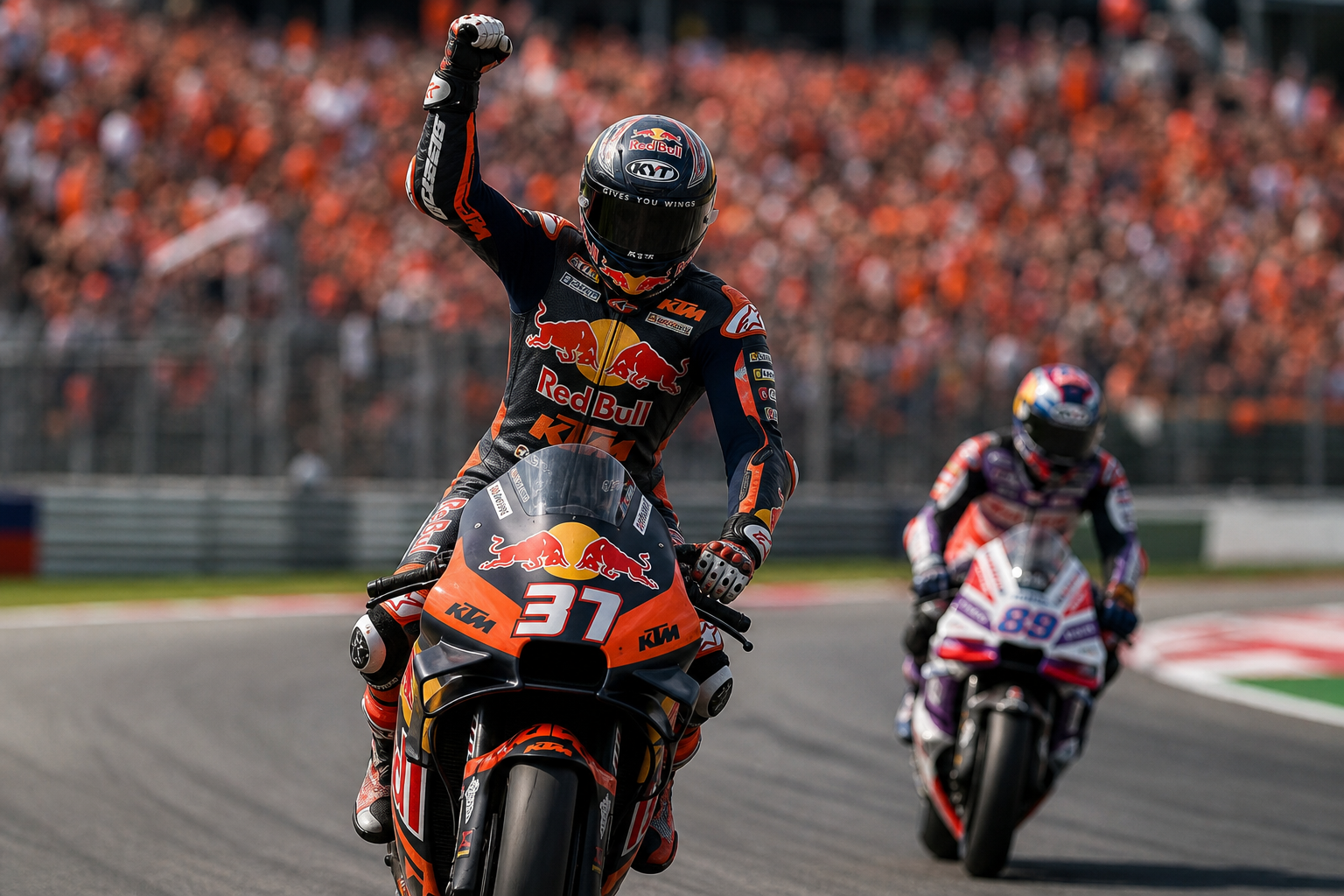

Pedro Acosta has finally got the victory everyone has been waiting for. The KTM rider converted a fierce charge through the field into his first MotoGP win at the Austrian Grand Prix, producing the sort of performance that makes a long-awaited breakthrough feel entirely deserved.
Acosta started fourth, slipped to fifth during the opening exchanges, and then set about dismantling the order in front of him. He recovered the lost position quickly, picked off his rivals with little apparent fuss, and reached the race lead by passing polesitter Jorge Martin on lap nine of 28.
From there, the factory KTM rider controlled the race and secured a dominant maiden victory. Martin finished second, extending his points advantage over Marc Marquez in the championship standings. One rider finally found the top step; the other left Austria with an even healthier title position. Motor racing occasionally manages to be generous and cruel in the same afternoon.
Acosta Turns a Bad Start Into a Statement
The most revealing part of Acosta’s race may have been the opening lap. Starting fourth should have given him a clean platform, but dropping to fifth meant he had work to do before the race had properly settled. Rather than allowing the moment to dictate the afternoon, he immediately began clawing his way back into contention.
That response matters. A first MotoGP win can become an oddly heavy object, particularly when a young rider has already built a reputation for speed and fearlessness. Every near miss adds another layer of expectation. The obvious danger is that the rider begins chasing the result instead of riding the race.
Acosta did the opposite. He recovered position, found his rhythm, and moved through the field with a calmness that belied the occasion. The source of his pace was not some last-corner miracle or desperate gamble. He simply appeared able to pick apart the riders ahead of him, one by one, aboard the factory KTM.
That is a much more convincing way to earn a first win than surviving a chaotic race and accepting the trophy when everyone else has fallen over. There is nothing wrong with a lucky victory, naturally, but Acosta’s Austrian performance had the shape of a rider taking command.
The Pass That Changed the Race
Martin began the race from pole and finished second, but Acosta’s move on lap nine was the pivotal moment. Passing the polesitter before the halfway point of the 28-lap contest showed that Acosta was not merely hanging onto the leaders or waiting for the race to come to him.
He was coming for it.
The significance of the pass goes beyond the change in running order. Martin was already carrying the authority that comes with starting at the front, while Acosta had begun the race by losing ground. By the time the KTM rider reached him, the early disadvantage had been erased and the initiative had changed hands.
Once Acosta moved ahead, the race became a test of whether he could maintain the advantage rather than whether he could find it. According to the available race report, he did exactly that, turning a recovery drive into a commanding result.
A Major Result for KTM
Acosta’s win also gives the factory KTM operation a result to savor. The victory came on a KTM rather than a satellite machine, placing the manufacturer’s own effort at the center of the Austrian Grand Prix story.
That distinction is important in MotoGP. A rider’s talent can transform a package, but a factory team still needs a motorcycle capable of allowing that talent to become a race win. Acosta’s performance does not, by itself, answer every question about KTM’s overall competitiveness. It does, however, provide a very clear demonstration that the combination of rider and machine could control a Grand Prix when the opportunity arrived.
There is also a pleasing neatness to the result. Acosta’s first MotoGP victory came in a factory KTM, and it followed a race in which he had to make the result rather than simply inherit it. The motorcycle was not dragged over the line by circumstance. Acosta used it to work through the field, pass the polesitter, and stay in front.
Martin Loses the Win but Strengthens His Championship Position
For Martin, second place was not the result he would have wanted after starting from pole, but it was still valuable in the championship fight. His runner-up finish extended his points lead over Marc Marquez, preserving momentum even as Acosta took the biggest prize of the afternoon.
That is the slightly strange arithmetic of a long MotoGP season. A rider can lose a race and still leave in a stronger position than when he arrived. Martin’s result meant that Acosta’s breakthrough did not become a damaging day for the championship leader. He surrendered the win, but he limited the cost.
Starting first and finishing second also tells its own story. Martin had the pace to claim pole and remain at the sharp end, but Acosta’s charge altered the order before the race reached its midpoint. The result was not a collapse from the leader; it was a controlled second place behind a rider who had found another level on the day.
Marc Marquez Loses Ground to Martin
The championship consequences are less cheerful for Marquez. With Martin finishing ahead and extending his lead, Marquez leaves the Austrian Grand Prix needing to recover points rather than celebrate a gain.
The report does not provide the final points gap, so the important fact is the direction of travel: Martin increased his advantage. In a season where every podium has strategic value, even a relatively small swing can become significant once the calendar begins to tighten and riders are forced to measure risk against reward.
That makes Martin’s second place more useful than it may first appear. Acosta gets the headlines, quite rightly, while Martin quietly improves his championship position. Marquez, meanwhile, has to watch a rival strengthen his lead without the consolation of victory.
Why Acosta’s First Win Matters
Maiden victories are often treated as if they are merely overdue appointments with destiny. In reality, they can change the atmosphere around a rider. Before this race, Acosta was a fast young talent still waiting to convert his potential into a MotoGP win. After it, he is a Grand Prix winner with proof that he can manage the full burden of leading a race.
That final point is crucial. Speed over one lap is one thing. Passing established rivals is another. Holding the advantage once the target is painted on your back is something else entirely.
Acosta managed all three elements in Austria. He started near the front, survived an early setback, recovered positions, passed Martin on lap nine, and remained in control through the rest of the 28-lap race. It was not a scrappy first win assembled from other people’s misfortune. It was a proper piece of work.
The next challenge is less glamorous but far more revealing: doing it again. One victory proves that the door is open. Repeated victories prove that the rider can keep walking through it. Acosta has now removed the most obvious question hanging over his MotoGP career. The interesting questions start here.
0 Comments