
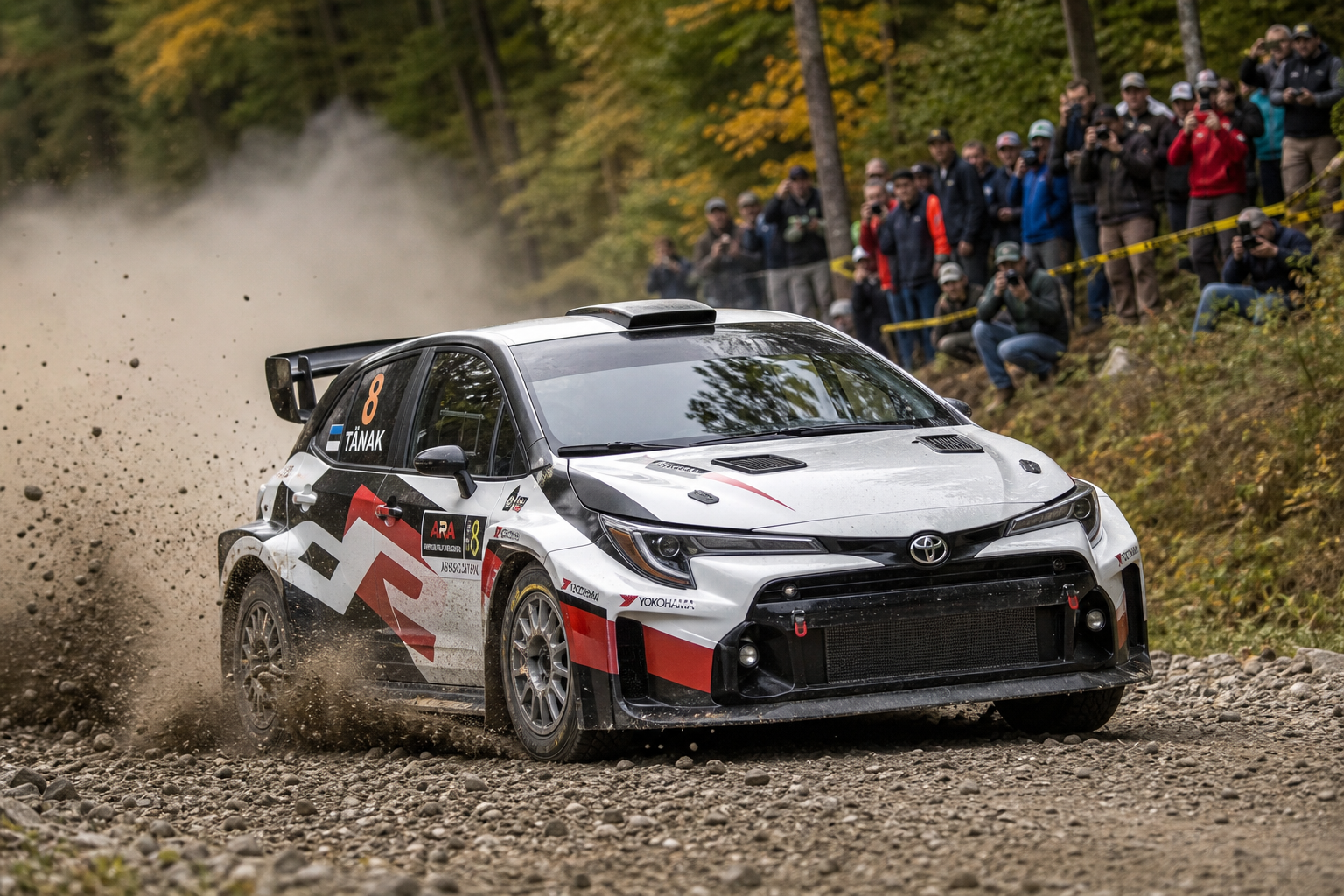

Ott Tänak has returned to competitive rallying in the least subtle way possible: by winning. The 2019 World Rally Champion took victory at the Overmountain Rally Tennessee, making a successful debut in the American Rally Association National Championship with a factory-supported Toyota GR Corolla Rally RC2.
For a driver who has spent much of his career fighting at the sharp end of the World Rally Championship, this was a different sort of assignment. The roads were American rather than European, the championship was new territory, and the car was a rally-prepared GR Corolla rather than the machinery Tänak had driven during his recent WRC campaigns.
He still did what front-line rally drivers tend to do when handed a steering wheel and a selection of loose-surface roads: he went very quickly and made the result look rather straightforward.
A Winning Return After a Rallying Absence
The Overmountain Rally Tennessee marked Tänak’s first competitive rally since the previous year’s World Rally Championship finale. That gap is meaningful in a sport where rhythm matters enormously. Rally drivers spend thousands of miles learning how a car reacts to changing grip, how aggressively they can attack a corner, and how much information they can process from pace notes arriving at speed.
Rallying does not offer much time to ease back into the job. A driver can be perfectly fit and technically sharp, yet still need to rebuild the instinctive connection between the notes, the road, the tires, and the car. Gravel makes that process even less forgiving. Grip changes from one corner to the next, surfaces move beneath the tires, and a small mistake can turn an impressive run into a very expensive forestry lesson.
Tänak’s victory therefore says more than simply “former world champion wins rally.” It shows that the Estonian was able to transfer his experience to a new championship, a different event environment, and a different rally car without requiring a lengthy period of reacclimation.
The Toyota GR Corolla Rally RC2
The car beneath Tänak was a factory-supported Toyota GR Corolla Rally RC2. That description is important because it places the machine in a category built around serious four-wheel-drive rally performance without being the same thing as Toyota’s top-level World Rally Championship car.
RC2 machinery is designed to deliver accessible, competitive performance for teams and drivers operating below the highest factory category. These cars are still purpose-built rally weapons, with the suspension travel, underbody protection, roll cage, competition transmission, and gravel setup required to survive a hard charge over rough roads. They are not showroom cars with a few stickers and a louder exhaust, despite what the marketing department might occasionally wish us to believe.
The GR Corolla provides an obvious production-car connection, but the rally version is engineered around competition first. A road-going hot hatch must cope with commuting, speed bumps, passengers, and the occasional supermarket parking-lot disaster. A rally car has rather different priorities. It needs to absorb impacts, maintain traction on constantly changing surfaces, communicate what the tires are doing, and remain reliable while being driven at an intensity that would make most road cars begin composing their own wills.
That makes the car an interesting tool for Tänak’s return. The result cannot be separated entirely from the driver, but neither should the engineering be ignored. A factory-supported effort gives Toyota a chance to demonstrate the GR Corolla’s competition potential while giving Tänak a platform capable of exploiting his experience.
Why the American Rally Association Debut Matters
Tänak’s appearance was not merely a guest drive at an unfamiliar event. It was his debut in the American Rally Association National Championship, placing an established international star into a championship with its own drivers, roads, rhythms, and competitive culture.
American rallying can look quite different from the WRC environment. The calendar, event formats, road characteristics, and level of factory involvement all create their own demands. A driver cannot assume that experience in one championship automatically produces an effortless advantage in another. The roads still need to be read. The car still needs to be set up. The weather still has the capacity to ruin everyone’s carefully considered plan within about seven minutes.
That is why a victory on debut carries genuine weight. Tänak was not simply returning to a familiar championship in a familiar car. He was operating in a new competitive setting and did so successfully in Toyota’s GR Corolla Rally RC2.
More Than a Publicity Exercise
High-profile guest appearances can sometimes feel like elaborate marketing exercises: a famous driver arrives, the cameras gather, and everyone politely agrees that the weekend was tremendously exciting. This result has more substance than that.
A rally victory provides useful evidence about the competitiveness of the car, the preparation of the team, and the driver’s ability to adapt. It also gives Toyota a prominent result for its rally program in the United States. The GR Corolla is already one of the company’s most enthusiast-focused road cars, and seeing its name attached to a successful competition effort strengthens the connection between Toyota’s performance image and its grassroots motorsport activities.
That connection matters because rallying remains one of the clearest ways for a manufacturer to demonstrate that performance technology has been developed for more than a brochure photo. Four-wheel drive, durable suspension, chassis control, and a responsive turbocharged powertrain are not theoretical qualities when they are being asked to survive a gravel rally at speed.
Tänak’s Reputation Still Travels Well
Tänak’s 2019 WRC title established him as one of the defining rally drivers of his generation. His reputation was built not only on outright speed but also on his ability to commit when the road demanded it, manage difficult conditions, and extract performance from highly technical machinery.
Those qualities do not disappear when a driver changes series. They need to be adjusted to the car and the event, certainly, but the underlying skills remain valuable. Rally drivers do not get to rely on a permanent racing line or a perfectly predictable surface. They work from information, anticipation, and feel. A driver with world championship experience brings a considerable amount of all three.
The Overmountain result offered a neat demonstration of that adaptability. After stepping away from competition following the previous WRC season, Tänak returned in a new environment and immediately delivered the result every factory-supported team wants from a headline appearance: victory.
A Strong Result With Plenty Still Unknown
The available result establishes the essential facts: Tänak won, the event formed part of the American Rally Association National Championship, and he drove a factory-supported Toyota GR Corolla Rally RC2 in his first competitive outing since the previous WRC season finale.
It does not, however, turn the weekend into proof that every future American rally event will belong to Toyota or Tänak. One rally is one rally. Different roads, conditions, entries, and mechanical demands can rearrange the order quickly. Motorsport has a habit of punishing anyone who mistakes a good result for a permanent law of nature.
Still, this was an impressive return. Tänak arrived without a recent competitive outing, changed championships, drove a different rally car, and left Tennessee with the win. That is a much cleaner comeback than most drivers receive—and a rather effective way to remind everyone that the Estonian remains very handy when the road turns loose.


0 Comments