
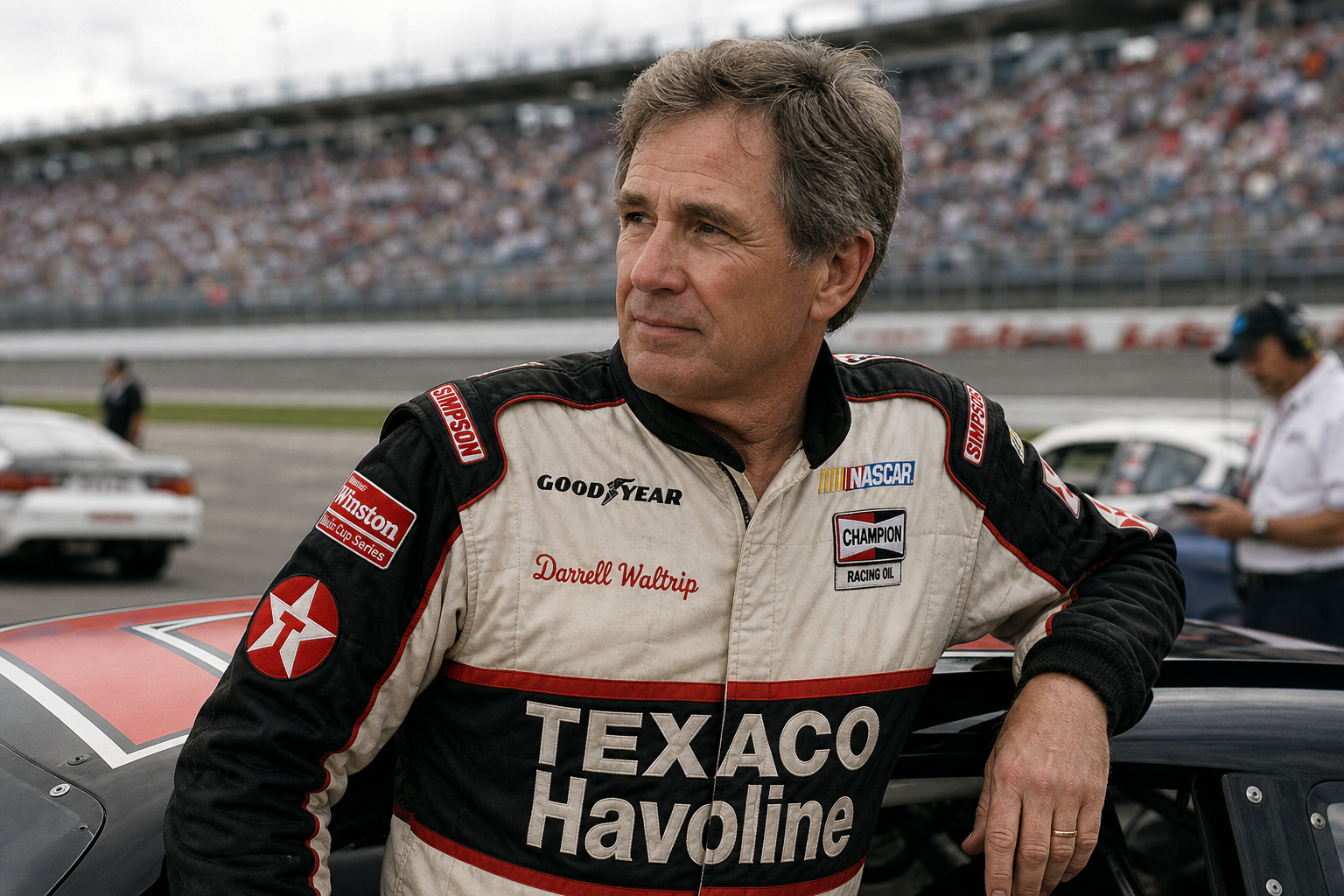

Darrell Waltrip has spent much of his life in front of a crowd: first with a helmet on, then with a microphone in hand. Now the three-time NASCAR Cup Series champion is stepping further away from public life after being diagnosed with frontotemporal degeneration, or FTD.
Waltrip’s family shared the news with his friends and fans, saying the 79-year-old former driver’s condition may also have been complicated by injuries associated with chronic traumatic encephalopathy, commonly known as CTE. The announcement brings a deeply personal dimension to the long-running conversation about the physical cost of professional racing.
A Racing Career Built on Speed and Staying Power
Waltrip was one of NASCAR’s defining figures during the sport’s most competitive decades. His career included three Cup Series championships, won in 1981, 1982, and 1985, along with 84 points-paying Cup victories. He also claimed 59 pole positions and won the Daytona 500 in 1989, a victory that had eluded him through much of his earlier career.
Those numbers explain why Waltrip is remembered as far more than a popular television personality. He was a formidable stock-car racer who could qualify quickly, manage a long race intelligently, and turn a difficult afternoon into a result through sheer persistence. His driving style was aggressive without being careless, and his willingness to speak his mind made him one of the sport’s most recognizable characters.
Waltrip’s career also coincided with a period when NASCAR’s cars were physically demanding and safety standards were still developing. Drivers endured heavy impacts, punishing vibration, heat, noise, and long races in machines that offered considerably less protection than modern stock cars. A crash did not need to produce an obvious catastrophic injury to leave a lasting mark.
What FTD Means
Frontotemporal degeneration is a group of progressive brain disorders that primarily affect the frontal and temporal lobes. Those regions are involved in behavior, personality, language, judgment, and executive function. FTD can therefore look different from the memory-centered symptoms many people associate with other forms of dementia.
Some people experience major changes in behavior or decision-making. Others develop language difficulties, trouble expressing themselves, or problems understanding speech. The condition can affect a person’s ability to navigate ordinary routines even when certain memories remain relatively intact.
FTD is not a normal part of aging, and its progression can be especially difficult for families because the early changes may appear behavioral rather than purely physical. The family’s announcement did not provide further clinical details, and there is no responsible way to infer how the diagnosis is affecting Waltrip personally beyond what has been made public.
The Family Also Raised the Issue of CTE
In explaining the diagnosis, Waltrip’s family said the condition was likely complicated by CTE-related injuries from his racing career. CTE is associated with repeated head impacts, including impacts that may not produce a concussion diagnosis at the time. Researchers have linked the disease with changes in mood, behavior, thinking, and memory, although diagnosis during life remains complicated and the relationship between repeated impacts and individual symptoms is not straightforward.
That distinction matters. A racing career alone does not establish that a particular person has CTE, nor does it explain every neurological symptom. The family’s statement presents it as a factor they believe may be involved, rather than offering a complete medical account.
Still, the concern is understandable. Stock-car drivers have faced repeated impacts for generations, often at high speed and in cars that could transmit enormous loads through the chassis. Safety improvements such as stronger driver compartments, head-and-neck restraints, better seats, energy-absorbing barriers, improved medical response, and more sophisticated impact analysis have changed the sport considerably. They cannot erase the exposure endured by earlier generations.
From Driver to Broadcaster
Waltrip’s second act made him just as familiar to many fans as his racing career. After leaving full-time driving, he became a prominent television analyst and broadcaster, bringing the same directness and enthusiasm to the booth that he had shown from behind the wheel.
He had a useful broadcasting instinct: Waltrip could explain what a driver was attempting without draining the drama from it. He understood tire management, traffic, pit strategy, and the peculiar psychology of a driver trying to survive a long event while everyone around him was making questionable decisions at 190 mph. That combination of technical understanding and personality made him a natural bridge between the competitors and the audience.
For years, he remained one of the voices most closely associated with NASCAR coverage. Fans who never watched him race still knew the laugh, the opinions, and the unmistakable racing vocabulary. His move away from public life will therefore be felt not only as the retirement of a former champion, but as the quiet disappearance of one of the sport’s most recognizable storytellers.
A Difficult Announcement for NASCAR Fans
The family’s message was aimed at the supporters who have followed Waltrip through several distinct eras of NASCAR. That history includes his championship battles, his rivalry with other major stars of the period, his Daytona 500 breakthrough, and his later work explaining the sport to a broader audience.
There is a temptation, whenever a famous driver faces a serious neurological illness, to reduce the person to a warning about motorsports. That would be unfair to Waltrip and too simple for the medical facts. His career was not merely a list of impacts, and his diagnosis cannot be turned into a neat conclusion about racing without evidence.
But the announcement does underline why driver safety remains a permanent engineering and medical challenge. Racing is safer than it was during Waltrip’s prime in many measurable ways. The cars are stronger, the restraints are better, and track safety has improved dramatically. The body, however, is not impressed by marketing language or a shiny new roll cage. Repeated trauma can remain a concern long after the checkered flag.
For now, Waltrip’s family is asking for privacy as he steps further back from public appearances and professional commitments. The appropriate response from fans is a simple one: remember the driver, respect the family’s wishes, and allow the man who spent decades entertaining NASCAR audiences to face this chapter away from the noise of the grandstands.
Waltrip’s legacy is secure in the record books, but statistics only tell part of the story. He helped define an era on the track and then spent years helping viewers understand it from the booth. That is a substantial body of work by any measure, and one that deserves to be remembered with more than a passing glance.


0 Comments