
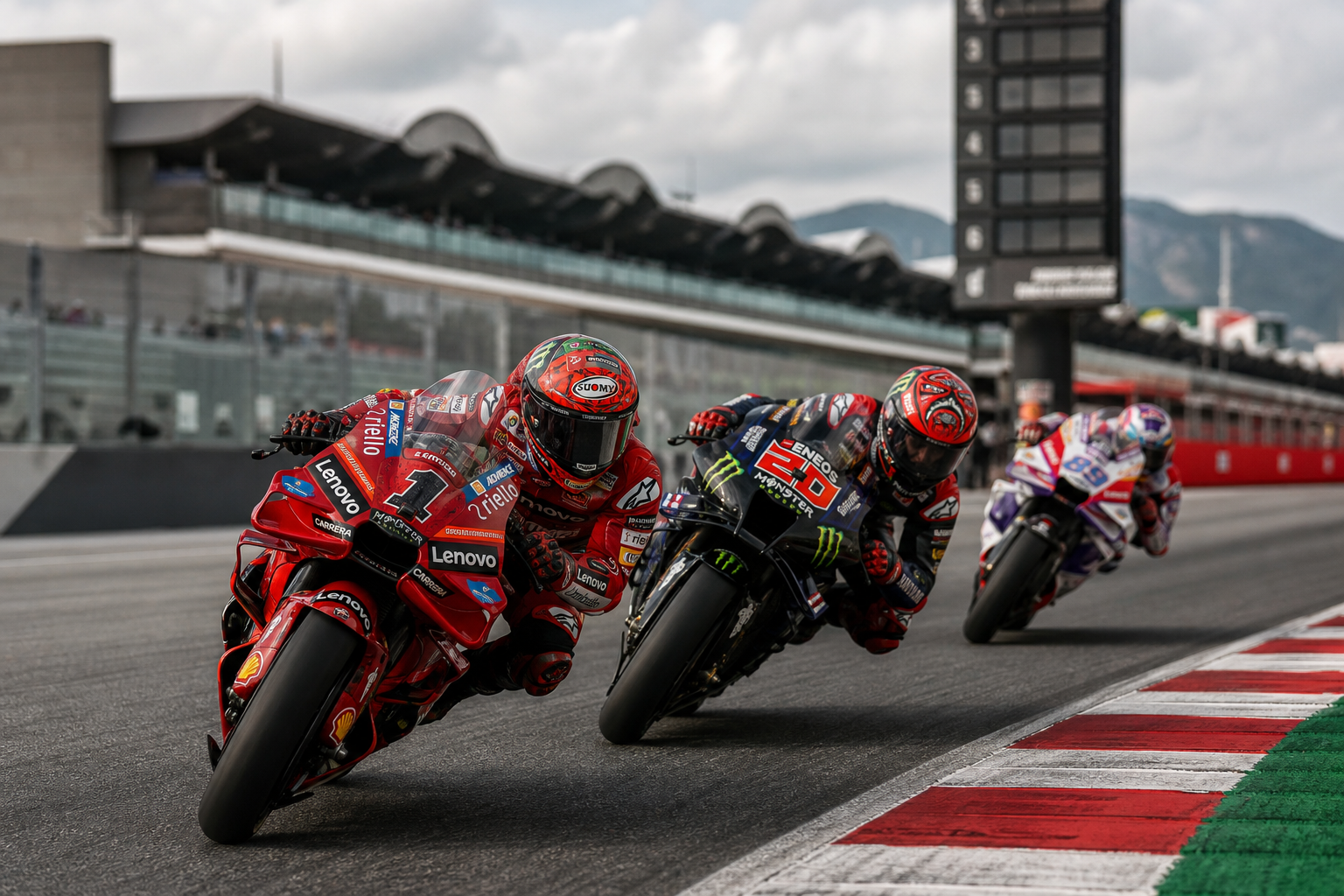

MotoGP is preparing for one of the most consequential technical resets in its modern history, yet the argument surrounding a Pirelli test has exposed something less mechanical and rather more political: the riders still don’t appear to have a sufficiently powerful voice when decisions are made about the equipment they depend on.
That is the uncomfortable thread running through the latest dispute. With eight races still scheduled for the 2026 season—and uncertainty hanging over the Qatar round—teams and riders are already looking toward 2027. Several competitors will change teams, while the championship itself prepares to move into a new technical era.
The tire situation should have been one of the clearest parts of that preparation. Instead, it has become a reminder that MotoGP can be extraordinarily sophisticated in engineering terms while remaining surprisingly old-fashioned in the way it handles the people actually riding the machines.
Why the 2027 Tire Change Is So Important
Pirelli will become MotoGP’s tire supplier for the 2027 season, replacing Michelin. That change arrives alongside a substantial overhaul of the technical regulations, so this is not a routine supplier swap involving a different logo on the sidewall.
The motorcycles will be shaped by a new set of constraints. Engine capacity will fall from the current 1000cc formula to 850cc, aerodynamic freedom will be reduced, and some of the electronic and chassis devices that have become part of modern MotoGP’s performance arms race will be restricted or removed. The championship is also committed to fuel made entirely from non-fossil sources.
Every one of those changes affects tire behavior. Reduce engine capacity and the demand for acceleration changes. Cut aerodynamic load and the way a bike transfers weight under braking and through corners changes with it. Alter ride-height and launch systems and you alter how the rear tire is loaded during the most violent parts of a lap.
Tires are not an isolated component in this equation. They influence braking stability, corner entry, edge grip, rear traction, race strategy, warm-up behavior and rider confidence. A rider can adapt to a different engine character. Adapting to a tire that gives its information through a different physical language is another matter entirely.
That is why tire testing has become such a sensitive subject. A test rider can record lap times, collect data and report back to engineers, but the riders competing for the world championship are the people who must understand the tire at the limit, in traffic, over race distance and while fighting another rider who is trying to place a motorcycle in the least convenient possible location.
A Test Is Not Just a Test
Manufacturers naturally want as much testing information as possible. They need to understand how the new tire interacts with their chassis, electronics, aerodynamics and engine characteristics. The supplier needs feedback on construction, compounds, carcass behavior and operating windows. Teams need time to build an entirely new performance model.
But testing also creates questions about who gets to shape the direction of development and how the information is distributed. Factory riders may have more influence than satellite riders. Test riders may be deeply experienced but removed from the pressure of a championship weekend. Teams may interpret feedback through their own technical priorities, while the riders are left to live with the consequences.
That is the core of the Pirelli row. The argument is not merely about whether a particular test was useful, fair or properly organized. It is about whether riders have a meaningful role in decisions that directly affect safety and performance.
MotoGP riders are not passive passengers. They are the final measurement instrument in the development process, albeit one with a pulse and a fairly strong opinion about front-end feel. Their feedback can identify behavior that a data channel cannot fully explain: a vague warning before a slide, a change in support as the tire overheats, or a loss of confidence that forces a rider to brake earlier even when the stopwatch insists the bike is theoretically capable of more.
Those details are not cosmetic. A tire that produces a clear, predictable warning gives a rider room to recover. A tire that suddenly crosses from confidence to disaster leaves very little room at all. The distinction may be difficult to summarize in a spreadsheet, but it is perfectly obvious to the person who has just asked a motorcycle to turn at more than 200 mph.
The Riders’ Problem Is Bigger Than One Supplier
The concern raised by the Pirelli test does not necessarily amount to an indictment of Pirelli. Any new supplier needs testing time, and the company arrives with considerable experience in high-level motorcycle racing. The issue is the structure around the change: how riders are consulted, how their feedback reaches the people making decisions and whether they can challenge a process before a problem becomes embedded in the regulations.
That matters because MotoGP has spent years adding layers of technical complexity. Aerodynamics, ride-height devices, increasingly sophisticated electronics and relentless development have moved more of the performance conversation away from the rider. The rider remains the most visible person on the grid, but not always the most influential one.
That imbalance is especially awkward in a championship that sells the idea of human bravery and physical skill. The rider is still the person taking the risk, yet technical decisions can be negotiated among manufacturers, suppliers, officials and engineers with only limited direct rider involvement.
There are already formal channels for rider feedback, of course. Team meetings, safety commissions and private discussions all have their place. The question is whether those channels provide enough leverage. Being heard is not the same as having the power to stop, delay or reshape a decision.
Why 2027 Makes the Timing Crucial
A normal tire change would be difficult enough. A tire change combined with a new engine formula, reduced aerodynamic performance and revised device regulations creates a much larger development puzzle.
Teams will have to learn whether a design that works well with the new engine also protects the tire over race distance. Engineers will be balancing acceleration against tire wear, downforce against agility and setup stability against the need to keep the tire inside its operating range. The first version of a 2027 motorcycle will be an educated guess. The riders’ feedback is what turns that guess into a usable race bike.
There is also a practical sporting issue. The riders entering the 2027 season may not all have the same amount of experience with the final tire specification. Some will have been involved in development work, while others may inherit a finished product after much of the important direction has already been set. That creates the possibility of an uneven transition, particularly if teams receive different testing opportunities.
MotoGP must therefore avoid treating the tire as a supplier’s private engineering project. It is a championship-wide performance and safety issue. If the tire changes the character of the motorcycles, the riders should be involved early enough to influence that character—not merely invited to complain once the contracts are signed and the shipping crates are already on their way.
A Stronger Rider Voice Would Improve the Championship
Giving riders more influence would not mean handing them control of every technical decision. Riders understandably favor equipment that suits their strengths, and one competitor’s ideal front tire may be another’s personal nightmare. The sport still needs engineers, manufacturers and a regulator capable of making decisions for the entire grid.
But there is a difference between allowing riders to dictate the rules and ensuring that their collective safety and usability concerns carry real weight. MotoGP could strengthen that process by giving the riders’ safety commission a clearer role in equipment decisions, publishing more information about how test feedback is assessed and creating a formal mechanism for escalating unresolved concerns.
That would also help the championship’s credibility. MotoGP fans understand that racing involves compromise. They will accept technical change, even unpopular technical change, if the reasoning is clear and the people carrying the risk have been properly included.
The Pirelli test dispute has arrived at an awkward moment for MotoGP. The sport is trying to make its motorcycles more relevant, more sustainable and potentially more entertaining under the 2027 rules. Those ambitions are perfectly reasonable. What is less reasonable is expecting riders to adapt to major changes while treating their feedback as a final-stage consultation exercise.
A championship built around riders should not make them fight for a seat at the table. The 2027 regulations may change the engines, aerodynamics and tires, but the basic principle should remain simple: the people riding the motorcycles must have a strong enough voice to influence how those motorcycles are made safe and competitive.

0 Comments