
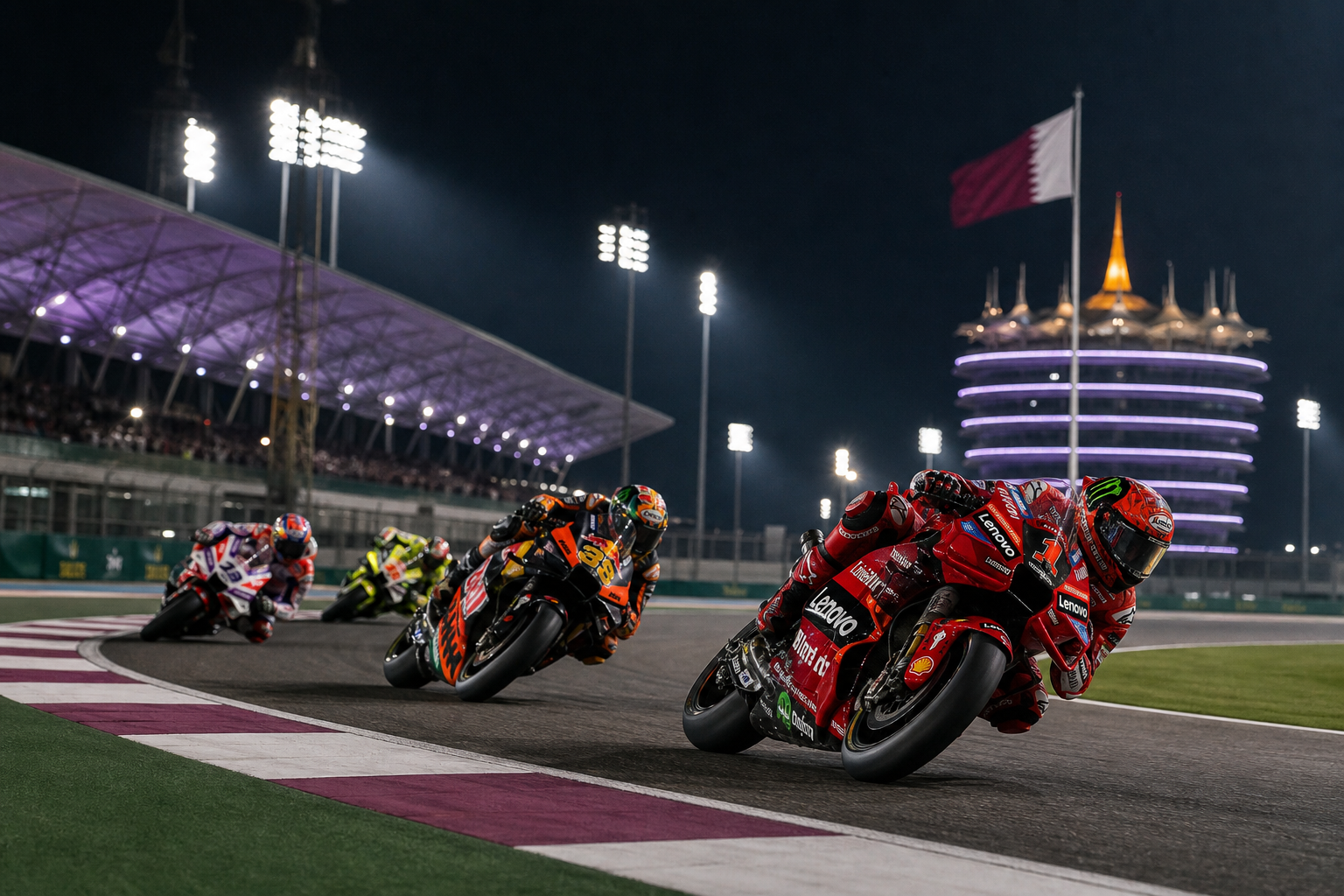

MotoGP is still planning to race in Qatar on November 8, despite a regional conflict that has already disrupted other major motorsport events in the Middle East.
Carmelo Ezpeleta, chief executive of MotoGP promoter Dorna Sports, says the current intention is straightforward: “The idea is to go” to Qatar as scheduled. That is not quite the same thing as an unconditional guarantee, but it is the clearest indication so far that the Qatar Grand Prix remains on the calendar.
The distinction matters. Motorsport calendars are usually presented as immovable objects, printed months in advance and surrounded by the reassuring machinery of contracts, freight schedules, television commitments and hospitality bookings. In practice, they are rather more like a very expensive house of cards. A serious security problem in one region can cause races, equipment and personnel to be rerouted with startling speed.
Qatar Remains the Intended Destination
Ezpeleta’s comments keep the Qatar round in its planned position, with the race scheduled for November 8. No alternative venue or replacement date has been announced, and there is no indication from the available information that MotoGP has formally canceled or moved the event.
That is the important point for now. The championship’s position is still to proceed rather than to withdraw, even as the wider situation remains unsettled.
MotoGP has not treated the Qatar Grand Prix as a routine event in recent years. The race is a major logistical undertaking, requiring teams to move motorcycles, spare engines, tires, tools, hospitality equipment and personnel across international borders. A modern Grand Prix is not merely a collection of racing machines arriving at a circuit on Thursday morning. It is a traveling industrial village, complete with enough freight to make an airport baggage carousel look positively civilized.
Any change to the Qatar round would therefore affect far more than the riders’ weekend schedules. Teams would need to revise freight movements, accommodation, staff travel and technical preparation. Broadcasters and commercial partners would also face difficult decisions, particularly if a replacement race had to be arranged at short notice.
Why the Regional Situation Has Raised the Stakes
The conflict has already had visible consequences for motorsport in the region. The Formula 1 race in Saudi Arabia was canceled, while the Bahrain Grand Prix was moved to Malaysia. Those decisions provide a clear warning that established events are not immune when security conditions deteriorate.
They also explain why Ezpeleta’s wording is measured. Saying that the “idea is to go” signals the championship’s current plan without pretending that organizers control every factor surrounding the event. Security assessments, travel conditions and official guidance can all change between now and November.
That uncertainty affects MotoGP in a particularly direct way. The championship brings together riders and team members from numerous countries, meaning any decision must account for the safety and movement of a large international workforce. The sport may be built around carbon fiber, electronics and spectacularly fast motorcycles, but nobody can outbrake a government travel warning.
The Qatar round also occupies a strategically important place on the calendar. A race held late in the season can carry championship consequences, with teams needing to protect points, manage machinery and avoid unnecessary risks. If the event were moved, postponed or replaced, the sporting implications could be considerable even before anyone considered the logistical bill.
A Plan Is Not Yet a Final Confirmation
It would be easy to read Ezpeleta’s statement as a full confirmation that the race will definitely happen. That would be overconfident.
The wording indicates intent. It does not remove the need for further monitoring or final approval as the date approaches. Motorsport organizers routinely keep contingency plans private until they are necessary, especially when public discussion of possible alternatives could create confusion for teams, fans and commercial partners.
There is also a practical reason to avoid premature announcements. Canceling or moving a Grand Prix involves multiple organizations, and each one has its own timetable. Teams need clarity for travel and freight. Local organizers need to understand whether the event will proceed. Broadcasters need to protect programming commitments. Fans may already have booked flights and hotels. A rushed announcement can leave everyone with answers in the press conference and questions in their inbox.
For the moment, then, the responsible reading is that MotoGP intends to hold the Qatar Grand Prix as scheduled, but that the plan remains subject to the circumstances surrounding the event.
What Happens Next
The next stage will be continued assessment rather than dramatic calendar theater. MotoGP and the relevant authorities will need to determine whether the conditions allow teams, riders and fans to travel and operate safely. If those conditions remain acceptable, the event should continue toward its November 8 date.
If they do not, the championship would face the same unpleasant choices already encountered by other series: cancellation, postponement, relocation or a replacement event. None is simple. A new venue would need to be available, properly licensed and capable of meeting MotoGP’s technical and operational requirements. A postponed race would have to fit into a calendar already packed with transport movements and commercial obligations. Cancellation would reduce the season and create its own sporting and financial consequences.
That is why Ezpeleta’s brief comment carries more weight than its casual phrasing might suggest. MotoGP is not announcing a new circuit or presenting a fresh technical regulation. It is confirming that, for now, the championship still expects to travel to Qatar while the region faces a difficult and rapidly changing situation.
The race remains scheduled. The intention remains to hold it. But until the security picture becomes clearer, the Qatar Grand Prix should be regarded as planned rather than beyond question. In motorsport, even a calendar date printed in bold can turn out to be written in pencil.
0 Comments