
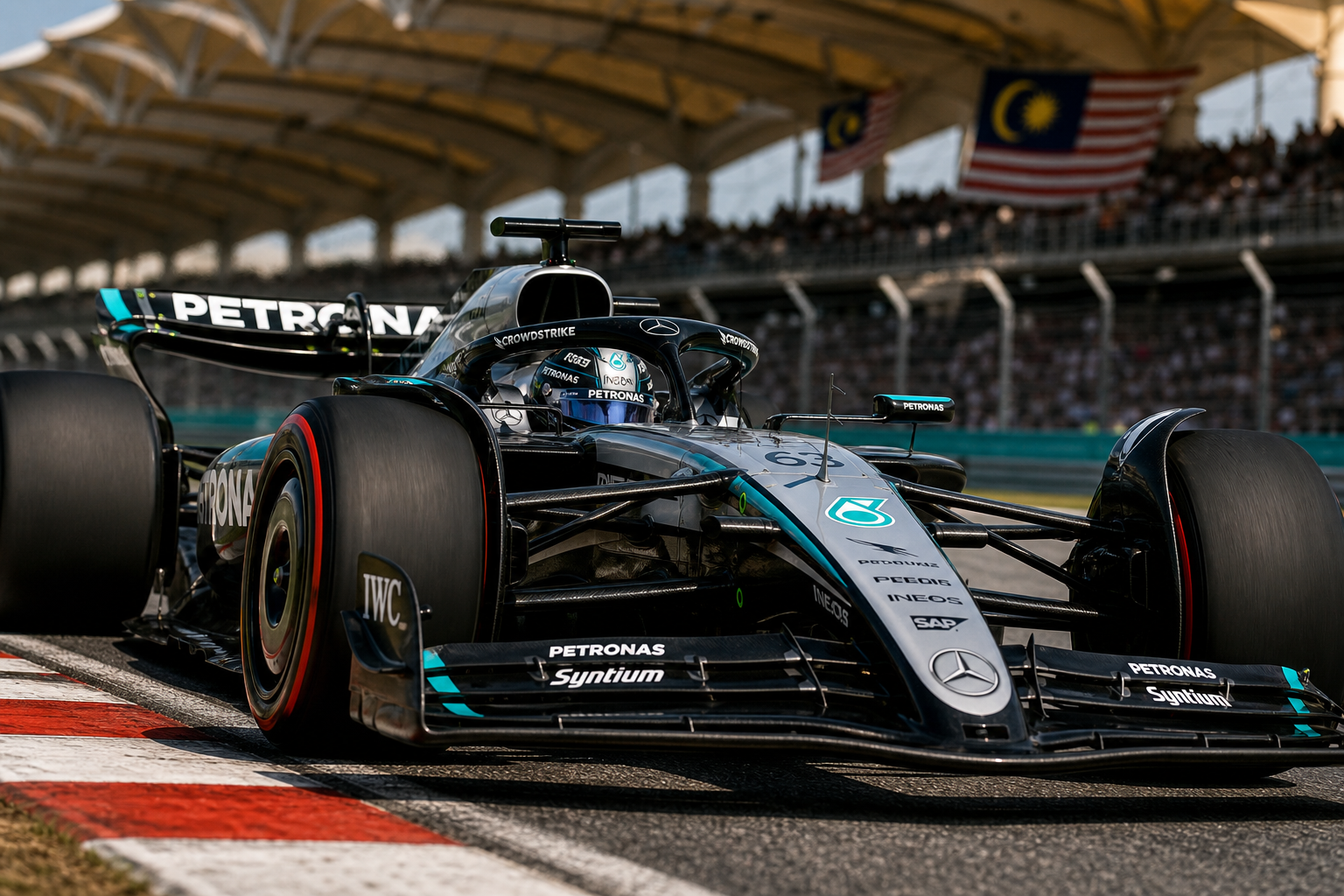

Mercedes has been winning the championship without consistently owning the most important piece of qualifying real estate: the front of the grid. That awkward contradiction is now heading toward a possible resolution, with the team confirming that its next major Formula 1 upgrade will debut at the upcoming Malaysian Grand Prix.
The Silver Arrows leads the 2026 championship by 145 points over Ferrari, despite not introducing a substantial development package since Montreal in May. Mercedes has instead relied on a sequence of smaller revisions, a strategy that has apparently been enough to keep its race results ticking over while rivals chase performance through more visible technical changes.
But a championship lead can disguise a problem. If Mercedes has been collecting points without regularly taking pole position, its advantage may owe as much to consistency and execution as outright one-lap speed. The Malaysia upgrade is therefore about more than adding a few tenths to the timing screens. It is an attempt to close the gap between being the most effective team across a season and being the fastest team on Saturday afternoon.
A Championship Leader Still Chasing Qualifying Speed
Mercedes’ 145-point cushion gives it breathing room, but it does not make the pole-position drought irrelevant. Formula 1 rewards race-day efficiency, tire management and strategic discipline, yet starting at the front remains one of the cleanest ways to control all three.
A car that begins from pole avoids much of the traffic and uncertainty that can turn a straightforward race into a tactical nuisance. It can dictate the pace, protect its tires in clean air and force opponents to respond rather than attack. Even in an era when overtaking is possible, qualifying performance still shapes the race in ways that no clever pit-wall spreadsheet can completely erase.
That is why Mercedes’ decision to hold its larger package for Malaysia deserves attention. The team has not been forced into emergency development mode by a collapsing season. Quite the opposite: it has enough of a points advantage to introduce a more ambitious update on its own timetable. The interesting question is whether the delay reflects confidence in its current car or a recognition that the remaining performance target requires a coordinated change rather than a series of small adjustments.
Why the Malaysia Package Matters
The available information does not reveal exactly what Mercedes is changing. There is no confirmed list of revised aerodynamic surfaces, suspension components, cooling parts or floor modifications, and it would be foolish to fill that silence with the usual paddock fan fiction dressed up as engineering certainty.
What is clear is that Mercedes considers the package significant enough to identify it as the next major step. In Formula 1, that usually means the team expects a measurable improvement in the car’s overall performance rather than a cosmetic collection of detail changes. The target could be outright downforce, a broader operating window, better tire preparation in qualifying or a combination of all three. The team’s pole drought suggests that one-lap performance is a particular priority.
Qualifying pace is rarely controlled by a single component. A car must generate enough grip as the tires reach their narrow peak, give the driver confidence through high-speed corners and avoid sliding the surface into oblivion before the lap is complete. A package that produces more theoretical downforce but makes the car difficult to balance may look impressive in a wind tunnel and rather less impressive when a driver is wrestling it through the final sector.
That is where a major upgrade can either justify the wait or make the wait look rather optimistic. Mercedes will want more speed, but it will also need the new parts to behave consistently across different track conditions. A qualifying-specialist improvement would be useful. A step that helps both qualifying and race pace would be considerably more valuable.
Small Steps Have Kept Mercedes Ahead
Mercedes’ development approach since Montreal has been deliberately restrained. Rather than rolling out one large package, the team has preferred minor updates. That strategy can look conservative, but it has practical advantages.
Smaller changes are easier to evaluate. Engineers can isolate their effects, drivers can compare the car’s behavior with fewer variables in play, and the team is less likely to spend several races trying to understand why a complicated package has produced confusing results. Formula 1 teams have occasionally arrived at a race with a glamorous new collection of parts only to discover that the car has become faster in the simulator and more bewildering on the circuit. The wind tunnel, at least, does not complain about balance.
Mercedes’ championship position suggests its measured approach has worked well enough. The team has continued to score at a rate that Ferrari has not matched, even without the sort of major upgrade activity that often dominates technical coverage. That points to strengths beyond peak qualifying speed, whether in race execution, reliability, tire usage, driver performance or the car’s ability to remain competitive across different conditions.
Still, a development plan built around incremental gains can eventually reach a limit. If the remaining weakness is linked to the interaction between several parts of the car, changing one small area at a time may not unlock the desired result. Malaysia, then, becomes a test of whether Mercedes has found a more complete answer.
The Risk of Chasing Pole When the Championship Is Comfortable
There is a natural temptation for a championship leader to avoid unnecessary risk. Mercedes could simply continue collecting strong finishes, protect its points advantage and bring the title home without taking a large technical gamble. That would be perfectly rational.
But Formula 1 teams do not operate solely on the logic of banking points. Pole positions matter to drivers, engineers and manufacturers because they provide a clear measure of speed. They also offer useful evidence that a car’s underlying concept is working at the sharp end of the performance envelope.
For Mercedes, ending the drought would carry a psychological benefit as well. A team can lead a championship while still feeling that another competitor has the faster car over one lap. Repeatedly starting behind rivals forces drivers to recover ground, exposes the car to traffic and leaves less margin for a poor launch or an untimely safety car. A front-row car makes the entire weekend less of a faff.
The danger is that the upgrade may disturb the qualities that have made Mercedes so effective over a full season. A small increase in qualifying speed would not be much use if it came at the expense of tire life or race consistency. The ideal result is not merely a car capable of one brilliant lap, but a car that can start near the front and remain strong when the race settles into its long, punishing middle phase.
Ferrari Has a Clearer Target
Ferrari’s position as the second-placed team gives the Malaysia weekend an obvious competitive angle. Mercedes holds a 145-point advantage, but Ferrari does not need to overturn that deficit in one stroke to put pressure on the leader. It only needs to keep reducing the gap while Mercedes works out whether its latest package has delivered what the numbers promised.
That creates a neat strategic contrast. Mercedes can afford to develop from a position of strength, while Ferrari has every reason to treat any Mercedes hesitation as an opportunity. If the new parts immediately deliver stronger qualifying performance, the championship leader will have reinforced its advantage. If the package needs more refinement, Ferrari may be able to turn Mercedes’ cautious progress into a more competitive fight.
The Malaysia Grand Prix should therefore reveal more than the identity of the fastest car on Saturday. It should show whether Mercedes’ season-long consistency is supported by a genuine performance margin or whether the team has been managing a championship lead while waiting for its car to take another step.
What to Watch When the Upgrade Appears
The obvious metric will be qualifying position, particularly the gap to pole. But the more revealing evidence may come from the comparison between qualifying and race pace.
- One-lap performance: Can Mercedes convert its championship-leading form into a front-row start?
- Consistency across the weekend: Does the new package work immediately, or does the team need extensive setup work to unlock it?
- Race behavior: Has Mercedes gained qualifying speed without sacrificing tire life and long-run stability?
- Ferrari’s response: Does the upgrade widen the gap, or does Ferrari remain close enough to exploit any weakness?
A pole position would provide the headline Mercedes wants, but one qualifying result will not settle the technical argument. The real verdict will come from whether the car remains competitive once fuel loads change, tires wear and the pristine conditions of a single qualifying lap disappear.
Mercedes has already proved that it can lead the 2026 championship without a constant stream of major upgrades. Malaysia will show whether the team can add the missing ingredient: the kind of outright qualifying speed that makes a dominant points advantage feel every bit as convincing as it looks on paper.


0 Comments