
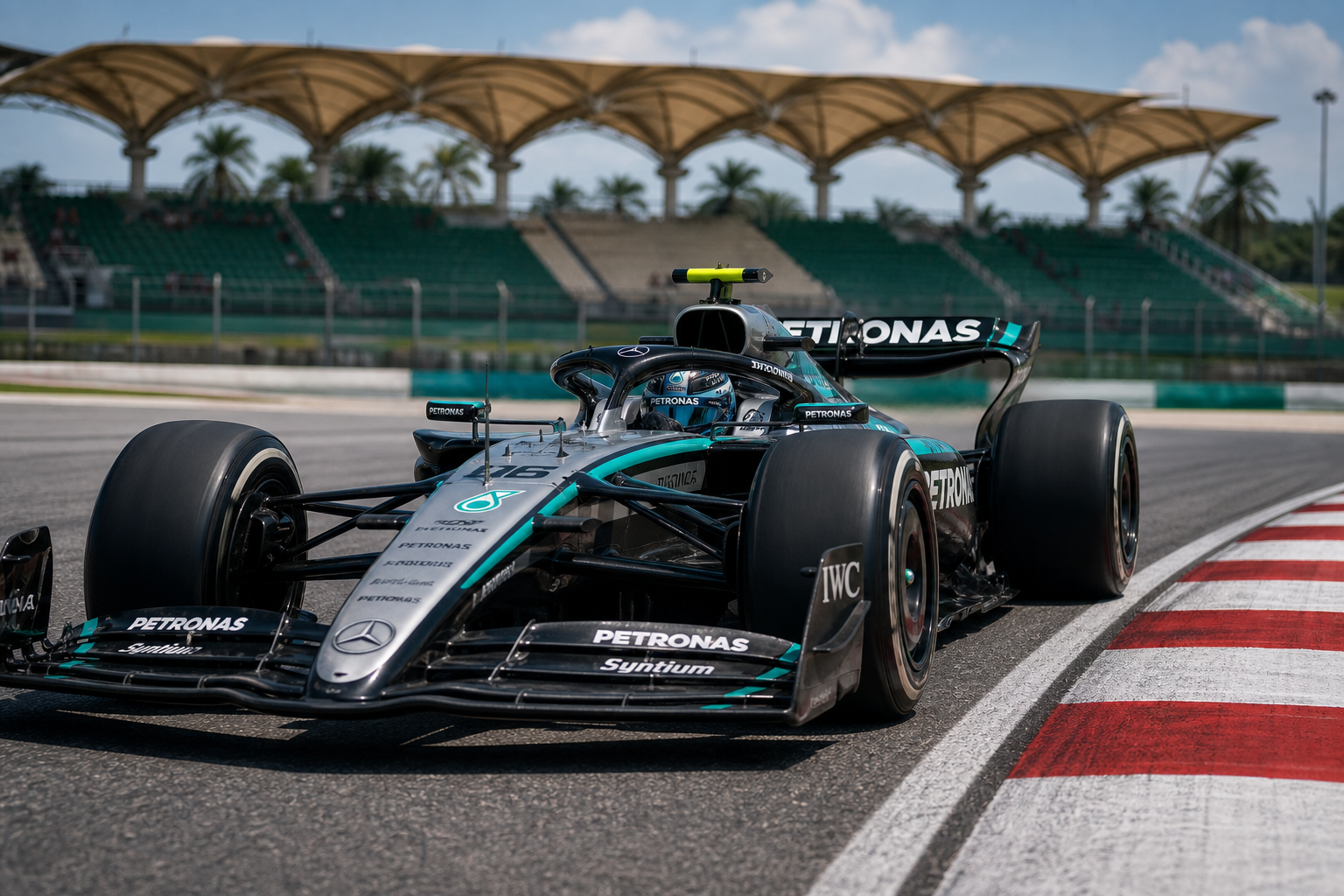

Mercedes has chosen the upcoming Malaysian Grand Prix as the moment to stop nibbling at its Formula 1 car and bring out the toolbox. The team’s next major upgrade package is scheduled to arrive there, with the clear ambition of ending its drought at the front of qualifying and putting the Silver Arrows back in the conversation for pole position.
That is a slightly awkward problem for Mercedes to have. The team leads the 2026 championship by 145 points over Ferrari, making it the runaway force in the standings, yet it has not produced a major development package since the Canadian Grand Prix in Montreal in May. Championship control, in other words, has not translated into regular domination on Saturday afternoon.
Formula 1 is full of such peculiar contradictions. A team can be the class of the season over the length of a championship while still finding that another car is occasionally quicker over a single qualifying lap. Mercedes appears to have been managing that gap with smaller updates rather than rushing a large package into service.
Mercedes Has Led the Championship Without Constant Major Upgrades
The 145-point margin over Ferrari is the most important fact surrounding this development. Mercedes is not bringing the package to Malaysia because its season has collapsed or because it suddenly needs rescuing. It is leading comfortably.
The more interesting question is why a team in such a strong position has waited since Montreal for its next substantial step. The source information does not detail the individual components involved, so there is no basis for claiming that the package targets a specific aerodynamic weakness, suspension issue, floor problem, or power-unit shortfall. What is clear is the development rhythm: major work arrived in Canada, smaller changes followed, and Mercedes now considers Malaysia the right place for another meaningful intervention.
That approach has an obvious advantage. A championship leader does not need to gamble with every race weekend. Smaller revisions can preserve a known quantity while engineers continue working on a broader package away from the circuit. In a sport where one badly behaved floor can turn a promising Friday into a weekend spent interrogating data like a detective with a grudge, patience has some appeal.
There is a cost, though. Every race without a substantial improvement gives rivals more time to close the gap, particularly in qualifying. A car that is consistently strong over race distance can still be vulnerable if it starts behind a competitor with better one-lap performance. That forces drivers to overtake, manage traffic, and protect tire life rather than simply controlling the race from the front.
The Malaysian Grand Prix Becomes a Qualifying Test
Mercedes’ stated target is not vague. The team wants to get back into contention for pole, which makes Malaysia more than a convenient delivery point for new parts. It becomes an immediate examination of whether the upgrade has produced the kind of performance gain that matters on Saturday.
Qualifying exposes a Formula 1 car’s weaknesses mercilessly. There is no long first stint in which strategy can disguise a shortfall, no tire offset to explain away a lost tenth, and very little room for a driver to compensate for a car that refuses to produce confidence in fast corners. A package that works well in race trim but fails to improve peak performance would leave Mercedes with a familiar-looking problem wearing newer bodywork.
That does not mean pole position is the only useful measure. New parts can improve consistency, tire management, operating range, or the car’s behavior across different track conditions. Those gains may not immediately appear as a dramatic qualifying headline. However, Mercedes has specifically connected this package with its desire to challenge for pole, so qualifying will be the most obvious public verdict.
The timing also gives the team an opportunity to learn quickly. If the package behaves as expected, Mercedes can build on the data through the remainder of the season. If it does not, the team will have discovered that before the championship reaches its most consequential phase. Motorsport engineers, like the rest of us, prefer their expensive lessons to arrive while there is still time to do something about them.
Why the Upgrade Matters Despite Mercedes’ Big Lead
A 145-point advantage creates breathing room, but it does not eliminate the need for development. Formula 1 championships are long engineering contests, and the team that starts strongly is not automatically the team that finishes with the fastest car. Rivals can recover performance through upgrades, while a leader that stands still gradually becomes a target.
Mercedes therefore has two jobs. It must protect its championship lead, and it must prove that the car can continue to improve rather than merely relying on an early-season advantage. The Malaysian package is an important test of the second task.
There is also a psychological element, although that should not be confused with measurable lap time. Pole positions shape the tone of a paddock. They demonstrate that a car can extract its maximum performance when every team is chasing the same single-lap prize. A championship leader that repeatedly misses out on the front row can begin to look less inevitable than its points total suggests.
Mercedes will not need to win every qualifying session to validate its season. But returning to genuine pole contention would send a useful message to Ferrari and the rest of the field: the championship leader is still developing, and its advantage is not merely leftover credit from the opening part of the year.
What We Still Do Not Know About the Package
Mercedes has confirmed the timing and the objective, but the available information does not reveal the upgrade’s design or the performance target attached to it. That means any confident claim about a revised floor, new wings, altered suspension geometry, or changes to cooling would be guesswork dressed up in a team shirt.
That restraint matters. Formula 1 upgrade stories often become crowded with grand predictions before the cars even leave the garage, despite the fact that a development package can produce a gain in one area while creating a new compromise in another. The only reliable judgment will come from the car’s behavior on track and, ultimately, its qualifying and race results.
Mercedes has at least made its intention clear. After relying on smaller developments since its Montreal package, it is bringing a larger step to Malaysia and aiming directly at the performance metric that has eluded it: pole position.
The team can afford a calculated risk because of its championship cushion. But the rest of the field will be watching closely. If the upgrade works, Mercedes could turn a comfortable points lead into a more complete advantage. If it does not, the numbers may still look healthy, but the absence of qualifying pace will remain an irritating loose thread—rather like a warning light that has not yet become expensive.


0 Comments