
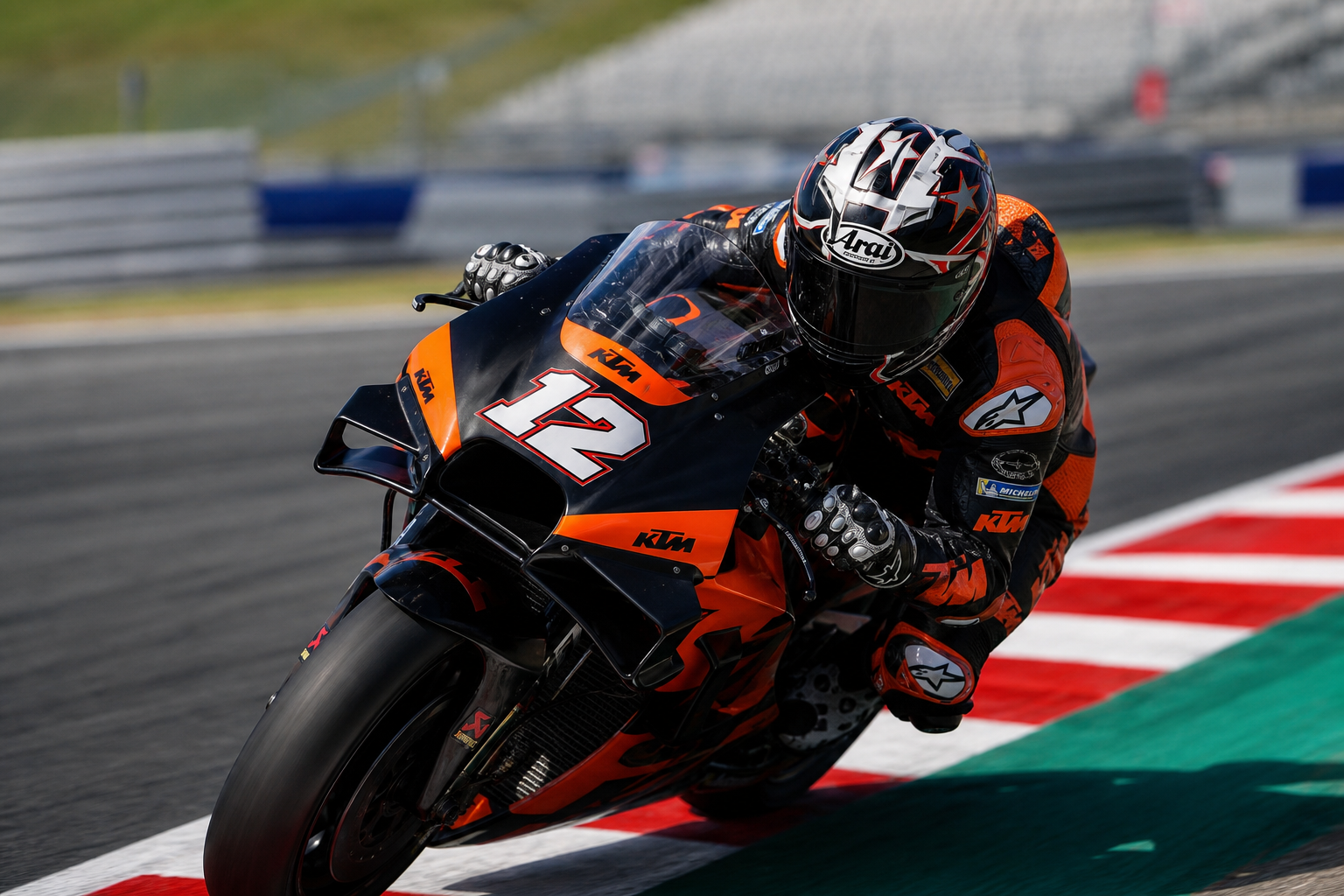

Maverick Viñales is about to find out whether his injured left shoulder is ready for the only test that really counts: riding a MotoGP bike properly, at speed, while braking, turning and wrestling with several hundred pounds of angry machinery.
The Tech3 rider will take part in Monday’s post-Austrian Grand Prix Pirelli test at the Red Bull Ring, using the session to assess whether he can return to competition at next month’s Japanese Grand Prix. The test is not a formal announcement that Viñales is fit to race. It is a much more useful and rather less glamorous reality check.
Can the shoulder tolerate a full day of prototype-racing abuse? Can Viñales ride at a competitive pace without protecting the injured side? Can he repeatedly brake hard, change direction and manage the physical demands of a MotoGP race without the arm fading? Those are the questions the KTM-mounted rider needs to answer.
A Practical Fitness Test, Not a Grand Comeback Ceremony
Viñales has been absent while recovering from the shoulder injury, but his preparation has intensified in recent weeks. On Friday, he rode a road-going sports bike at the Circuit d’Alcarràs near Lleida, building strength and reacquainting himself with the physical movements required on a motorcycle.
That step matters, although a road bike is a gentler laboratory than a MotoGP machine. A production sports bike can provide valuable work for the shoulder, arms and upper body, but it does not reproduce the same level of braking force, acceleration, corner-entry aggression or sustained concentration. MotoGP riders are not merely sitting on motorcycles and turning handlebars. They are hanging off, supporting their bodies under braking, loading the front end and repeatedly absorbing forces through their shoulders and arms.
The difference is rather like checking whether a footballer can jog around the block and then assuming he is ready for 90 minutes in a cup final. Useful? Certainly. Conclusive? Not remotely.
The Red Bull Ring will provide a sharper test. Its compact layout features heavy braking zones, rapid changes of direction and high-speed sections that place considerable physical demands on a rider. Even without a race start or a championship at stake, the circuit will expose any weakness in Viñales’ shoulder quickly.
Why the Shoulder Matters So Much in MotoGP
A shoulder injury is particularly awkward for a MotoGP rider because it affects nearly every phase of a lap. Braking requires the rider to brace against deceleration while controlling the bike with precision. Corner entry demands constant movement across the seat and tank. Mid-corner corrections may be small, but they arrive at speed and often while the rider is supporting much of his body weight with one arm.
Then there are the less obvious demands. Riders must react to tire movement, manage steering inputs and keep the motorcycle stable when the front or rear begins to slide. A shoulder that feels acceptable during a handful of laps may become painful or weak after repeated runs, precisely when fatigue starts to affect concentration and technique.
That is why Viñales’ test will have to be judged on more than lap time. His ability to complete consistent runs, maintain normal riding movements and recover between outings could be more important than a single quick lap. A rider can sometimes produce a heroic burst while compensating for an injury. A race requires something much less theatrical: repeatable performance.
The Japanese Grand Prix Is the Target, Not a Guarantee
Viñales is targeting a return at next month’s Japanese Grand Prix, but Monday’s running will determine how realistic that plan is. The Austrian test gives him an opportunity that gym work and road-bike laps cannot provide: direct feedback from a MotoGP motorcycle, with its higher speeds, stronger braking and more demanding riding position.
If the shoulder responds well, Viñales can continue preparing with a clearer idea of the work still required. He will know whether he needs to focus on strength, endurance, mobility or simply more time on the bike. If the shoulder does not cope, discovering that at a controlled test is considerably better than finding out during a race weekend, when practice, qualifying and a Grand Prix leave little room for experimentation.
There is also a practical difference between being medically cleared and being genuinely ready. Medical clearance means a rider can compete. It does not guarantee that he can ride at his normal level, fight for position or survive the physical toll of a full race distance. MotoGP is not especially interested in good intentions. The stopwatch and the final laps tend to be rather more opinionated.
What the Test Means for Tech3
For Tech3, Viñales’ return would restore continuity after an injury-enforced interruption and give the team a clearer picture of its competitive plans for the next round of the championship. A rider returning from injury can also provide valuable technical feedback, but only if he is physically capable of riding normally.
If Viñales is compensating for the shoulder, his comments about the motorcycle may be colored by the injury rather than the machine’s actual behavior. That makes the Austrian test useful for the team as well as the rider. Engineers need to know whether a problem comes from the bike, the tires, the setup or a rider who cannot yet move as he usually would.
The Pirelli test adds another layer to the session. Tire testing is normally about evaluating behavior, consistency and construction across different loads and conditions, but the rider’s physical condition remains part of that process. A rider who cannot complete runs consistently cannot provide a clean comparison. Viñales therefore has two jobs: assess his own shoulder and deliver meaningful feedback to the team.
The Smart Approach Is the Unexciting One
There will be understandable pressure around Viñales’ return. Riders want to race, teams want their regular lineup back and fans would rather see a familiar name on the grid than another injury update. But the sensible approach is not to treat Monday as a dramatic all-or-nothing comeback attempt.
The useful outcome may be a quiet one: Viñales completes the planned runs, avoids aggravating the injury and leaves the Red Bull Ring with a realistic training schedule for Japan. That may sound less thrilling than an instant return to full pace, but racing motorcycles while one shoulder is still objecting is a poor area in which to seek cinematic glory.
The Austrian test will give Viñales something far more valuable than optimism. It will give him evidence. Until he rides the KTM at proper speed and over repeated runs, the Japanese Grand Prix remains an objective rather than a confirmed entry.
For now, the next stage of his comeback is straightforward: get on the bike, see how the shoulder behaves and find out whether the body is ready to do the job the calendar is asking of it.
0 Comments