
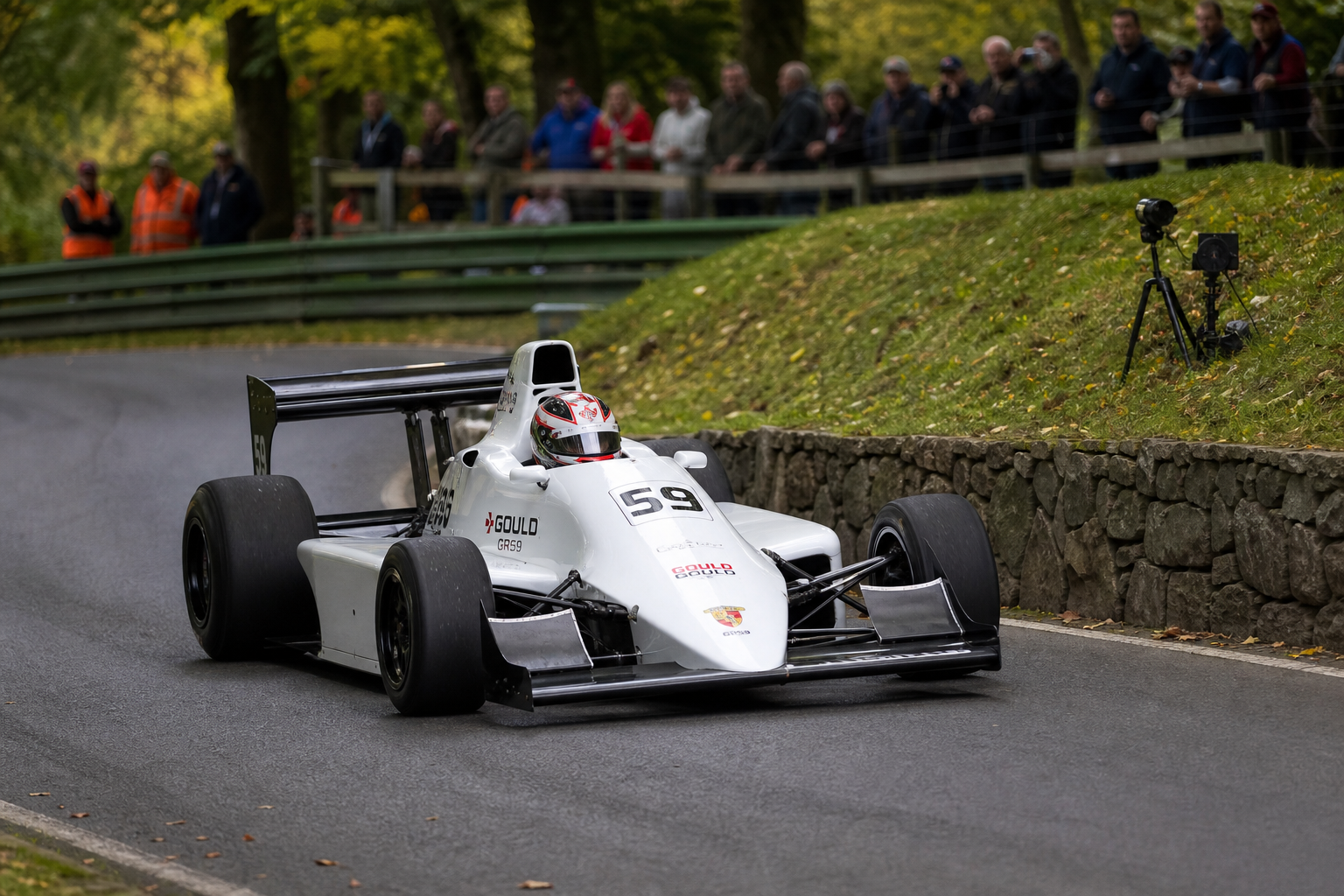

Matthew Ryder’s third British Hillclimb Championship title came down to the sort of final-run drama that makes motorsport look like it was scripted by someone with a fondness for unnecessary stress.
Driving his Gould GR59, Ryder secured the 2026 crown by a single point at Prescott after archrival Wallace Menzies crashed out of the final top-12 run-off. Will Hall finished only one point behind Menzies, leaving the championship separated by the narrowest of margins and turning the season finale into a remarkably tense way to settle the standings.
A Title Decided by One Point
Ryder entered the final contest with the championship still hanging in the balance. Menzies was his closest rival, while Hall remained close enough to make the outcome anything but a two-driver affair. In a championship decided across a season of short, intense runs, there was no room for a quiet afternoon or a convenient mathematical cushion.
The decisive moment arrived in the final top-12 run-off. Menzies crashed out, removing the driver who had been pushing Ryder hardest for the title and changing the championship picture in an instant. Hall’s position in the standings meant the result still required careful calculation, but Ryder emerged with the crown by one point.
That margin tells the story rather neatly. Ryder did not cruise to the title with a round to spare, nor did a dominant points lead make the final event a formality. The championship reached its last major run with the leading contenders still close enough for one incident to reshape the outcome. Motorsport occasionally offers grand strategy and long-term planning. Hillclimbing, rather wonderfully, can also reduce everything to one corner, one mistake, or one untidy landing.
Why the Prescott Run-Off Mattered
The British Hillclimb Championship is built around speed over a single course rather than the wheel-to-wheel race format familiar from circuit competition. Drivers are judged by the clock, with the smallest differences carrying enormous weight. There is nowhere to hide in a timed ascent: a slow launch, a missed apex, or a moment of over-commitment can consume the advantage built over an entire weekend.
The final top-12 run-off adds another layer of pressure. Reaching that group is one task; producing the decisive run when the championship is on the line is another entirely. Menzies’ crash underlined the unforgiving nature of the format. A driver can spend a season close enough to challenge for the title, only for the final run to end before the stopwatch can provide an answer.
That is not a criticism of Menzies. It is the central cruelty of hillclimbing. The cars are built to attack a short course with extreme commitment, and the drivers have very little time to correct an error once it begins. The margin between an outstanding run and an accident can be almost offensively small.
Ryder’s Gould GR59 Completes the Job
Ryder’s title came in the Gould GR59, the car that carried him to his third championship. The result confirms the effectiveness of the combination without requiring any marketing department to sprinkle the word “ultimate” over it. The car and driver simply delivered when the points mattered most.
Hillclimb machinery is not designed around the compromises required by a road car, or even the long-distance demands of a conventional circuit racer. Its purpose is much narrower and rather more intense: generate as much performance as possible over a short uphill course, where acceleration, traction, braking stability, aerodynamic grip, and driver commitment all have to arrive at precisely the right moment.
That makes a championship title especially dependent on repeatability. A single spectacular run is useful, but a season is built on consistently reaching the sharp end of the field and converting opportunities into points. Ryder’s final margin suggests that his campaign survived the inevitable chaos and accumulated just enough advantage to remain standing when the last serious challenge disappeared.
Menzies and Hall Leave Prescott With Plenty of What-Ifs
Menzies will understandably look back at the final run-off as the moment the title escaped. His crash gave Ryder the opening, but the narrow championship margin also shows how competitive the season had been before Prescott. One point separated the champion from Menzies, while Hall ended only one point behind Menzies.
That effectively leaves all three drivers packed together at the top of the final story. Ryder gets the trophy, Menzies retains the consolation of having pushed the champion to the limit, and Hall can point to a campaign that placed him within striking distance of both. It is a brutal way to finish second or third, but it is also the clearest evidence that the championship was not a procession.
For Hall in particular, the one-point deficit to Menzies will be difficult to ignore. Championships are rarely lost through one isolated moment, of course, but a gap that small invites a long list of alternative outcomes: a better qualifying effort, a cleaner run, or a different result in one of the season’s earlier contests. Motorsport is full of those calculations, most of them performed after the opportunity has gone.
A Hat-Trick Earned the Hard Way
Ryder’s third British Hillclimb Championship title is impressive on its own. Winning once can be the product of a perfect season; winning three times demands sustained speed, discipline, preparation, and the ability to deal with rivals who know exactly how valuable every fraction of a second can be.
This one, however, carries its own character. The title was not sealed by a comfortable advantage or a final weekend devoid of tension. It was decided by a single point, with the closest challenger crashing out in the final top-12 run-off and another rival finishing close enough to keep the arithmetic uncomfortable.
That is a suitably dramatic way for Ryder to complete his hat-trick. The Gould GR59 gets another championship to its name, Menzies and Hall leave Prescott wondering what might have been, and the 2026 British Hillclimb season finishes with the scoreboard doing what it does best: reducing months of speed, risk, and effort to one tiny number.
0 Comments