
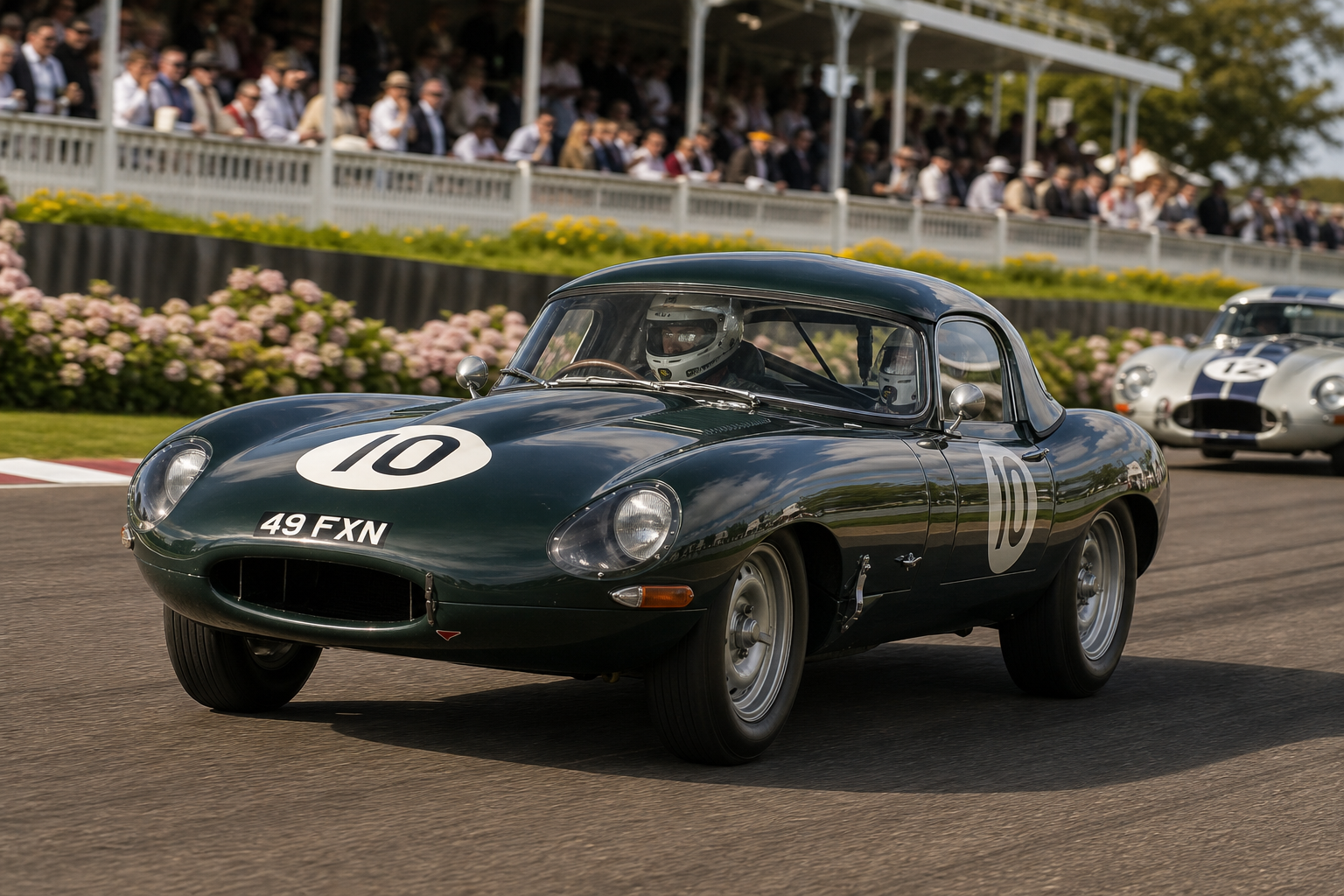

A one-second winning margin is barely enough time to finish saying “that was close,” which made Lukas Halusa and Andre Lotterer’s victory in the Royal Automobile Club TT Celebration a suitably tense way to finish the 28th Goodwood Revival.
The pair shared the Halusa family’s Jaguar E-type lightweight low-drag coupe, chassis 49 FXN, bringing the distinctive machine across the line just ahead of its nearest rival on a sunny Sunday afternoon at Goodwood. It was the sort of finish historic racing does particularly well: fast, loud, beautifully engineered and sufficiently close to make everyone involved briefly reconsider the wisdom of driving a priceless old Jaguar at serious speed.
A Jaguar With Serious Racing History
49 FXN is not an ordinary classic E-type wearing a few competition stickers. The car is the former Peter Lumsden and Peter Sargent machine, and its low-drag coupe body gives it a very different character from the more familiar open-top E-types that have become staples of historic racing.
The car was designed by Sami Klat and bodied by Playfords, a combination that produced one of the most visually purposeful versions of the E-type racing concept. The long, smoothly tapered roof and enclosed rear bodywork reduce the visual fuss of the standard road car, but they also reveal the aerodynamic thinking behind the project. This is an E-type shaped by speed rather than showroom theater.
That distinction matters. The original E-type was already an unusually aerodynamic sports car for its era, but racing exposed the limitations of any road-going compromise. A low-drag coupe could offer cleaner airflow and greater stability at speed, while the lightweight construction helped preserve the Jaguar’s most important weapon: its ability to carry speed without relying solely on brute force.
There is nothing delicate about the way 49 FXN looks, either. It has the familiar E-type nose, but the enclosed cabin and extended rear profile give it the purposeful appearance of a machine designed by someone who had no interest in making it convenient for the weekly grocery run. Quite right, too.
Lotterer Brings Modern Race Experience to a Historic Jaguar
Sharing the car with Halusa was Andre Lotterer, a driver whose career has included major success at the 24 Hours of Le Mans and extensive experience in high-level prototype and single-seater racing. That background is especially relevant in a race such as the RAC TT Celebration, where the driver must manage a historic car quickly without treating it like a modern machine with every electronic safety net imaginable.
Historic racing rewards speed, but it punishes carelessness. Older cars demand greater mechanical sympathy, and their brakes, tires, suspension systems and power delivery cannot simply be bullied into behaving like those of a current GT3 car. A driver has to understand how the car moves beneath them, how much grip remains and where the machinery’s limits really are. The consequences of getting that calculation wrong are rather more expensive than a bruised ego.
Lotterer’s modern racing experience and Halusa’s familiarity with the family’s Jaguar made for an effective combination. The final margin suggests that the result was not secured by cruising around while everyone else took the afternoon off. A one-second victory at the end of a historic race is a proper contest, not a ceremonial procession.
Why the RAC TT Celebration Remains a Goodwood Highlight
The Royal Automobile Club TT Celebration occupies a special place in the Goodwood Revival program because it brings together the kind of machinery that made international sports-car racing so compelling in the first place. These are not museum pieces being rolled carefully from one display stand to another. They are competition cars being driven in anger, often by drivers with serious contemporary racing credentials.
That combination gives the event its particular tension. The cars are old, but the racing is not meant to be slow. Their value and historical importance may encourage caution away from the circuit, yet the whole point of entering them at Goodwood is to let them perform the job for which they were built. A Jaguar such as 49 FXN looks magnificent parked beside a paddock lawn, but it makes far more sense when its engine is working hard and its body is slicing through the Sussex air.
Goodwood also provides an unusually fitting setting. The Revival’s period atmosphere can sometimes tempt visitors to focus on clothing, signage and polished nostalgia, but the circuit itself remains the real argument for the event. Its narrow, fast and unforgiving layout places genuine demands on both car and driver. Historic machinery cannot hide behind modern track width or acres of runoff, and close finishes become all the more meaningful when every lap requires commitment.
49 FXN Shows Why Low-Drag E-Types Still Fascinate
The standard E-type has never struggled to attract attention. Its proportions are among the most recognizable in automotive history, and its reputation was established almost immediately after its 1961 debut. The low-drag coupe, however, appeals to a slightly different instinct. It is less about effortless glamour and more about what happens when Jaguar’s elegant sports car is sharpened for competition.
That makes 49 FXN particularly satisfying to see at a circuit like Goodwood. The car retains the visual DNA that made the E-type famous, yet the special bodywork tells the reader that this is not merely a restored road car. It is a focused racing interpretation, developed around the practical realities of speed, airflow and weight.
There is also a pleasing contradiction in the design. The car is undeniably beautiful, but its beauty comes from function rather than decoration. The low roof, enclosed rear section and clean surfaces do not appear to have been added to create a fashion statement. They look as though someone asked a simple question: how can an E-type be made faster? The answer happened to be rather lovely.
A Fitting Finish for the 28th Goodwood Revival
Halusa and Lotterer’s result gave the 28th Goodwood Revival a finale with exactly the right ingredients: a historically important Jaguar, a famous driver, a family-owned competition car and a winning margin small enough to keep the tension alive until the checkered flag.
The victory also illustrates why Goodwood’s historic meetings remain more than static celebrations of old racing machinery. Cars such as 49 FXN are valuable because of their past, but their character becomes clearest when they are asked to race. The noise, the movement and the uncertainty restore the purpose that can be lost when a competition car spends too long behind a rope.
One second separated the Jaguar from defeat. For a car with this much history, that is a suitably dramatic way to add another chapter.


0 Comments