
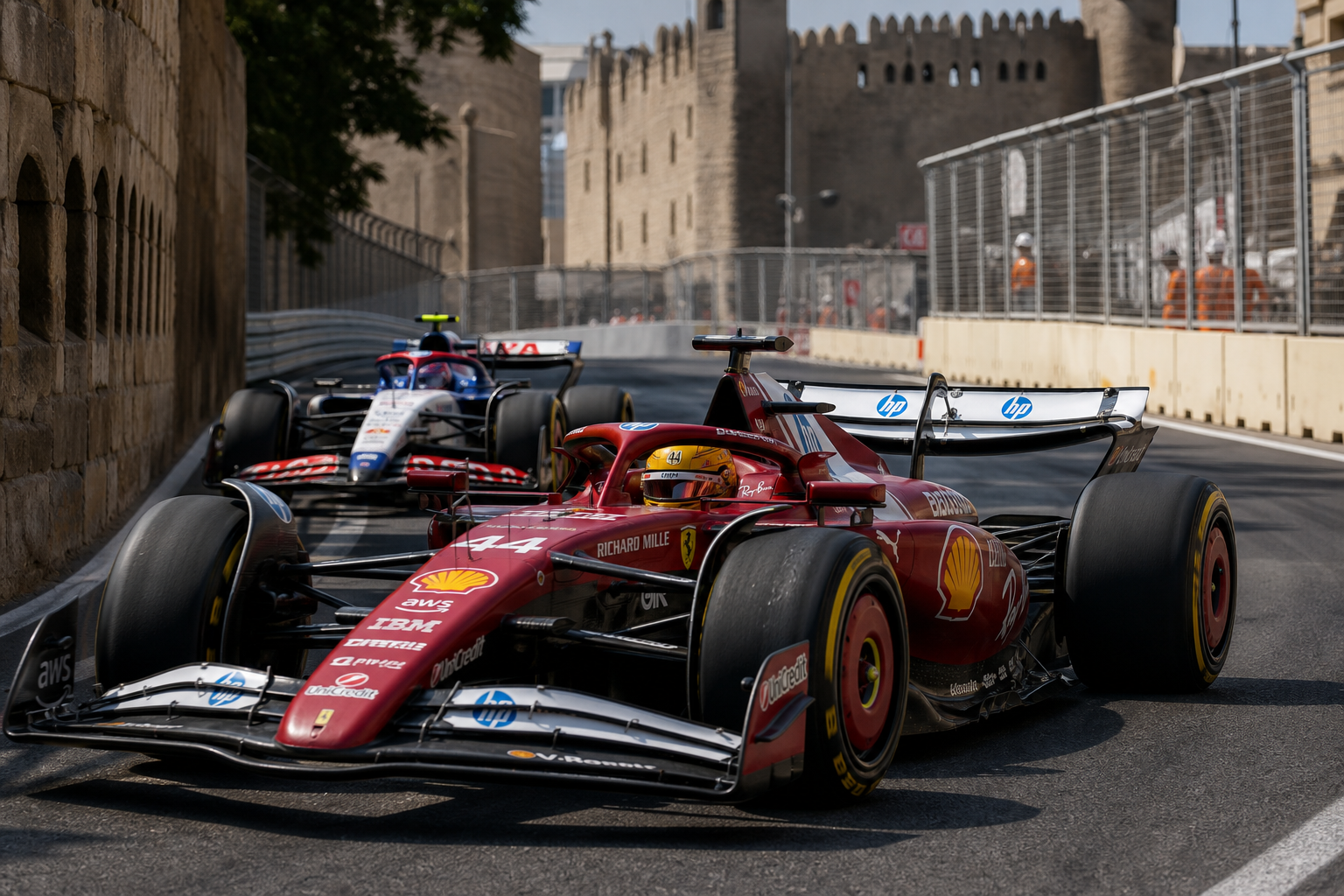

Lewis Hamilton has been called before the Formula 1 stewards after an alleged impeding incident involving Liam Lawson during second practice for the Azerbaijan Grand Prix in Baku.
The Ferrari driver was harvesting energy through the final sector when Lawson arrived on a qualifying-style lap in his Racing Bulls. The closing speed caught Hamilton’s car at an awkward moment, leaving Lawson to take avoiding action at the penultimate corner.
That is the sort of incident that can look harmless from a television camera and rather less harmless from the cockpit. In Baku, where the final sector funnels cars toward a tight sequence of corners after a very fast lap, a driver who suddenly encounters a slower car has precious little time to decide whether to lift, move off-line, or commit to the corner and hope everyone behaves sensibly. Motorsport’s favorite plan, naturally.
Why Hamilton Was Summoned
Being summoned to the stewards does not mean Hamilton has been found guilty. It means the officials want to hear from the relevant parties, examine the available video and timing data, and establish whether the Ferrari driver impeded Lawson in a way that breached the sporting regulations.
Stewards will typically consider several details in an incident like this. They can look at how quickly the cars were approaching one another, whether Hamilton had received a warning from his team, where Lawson was positioned on the circuit, and whether Hamilton made a reasonable effort to stay clear of a car on a fast lap.
The distinction between deliberate blocking and an unavoidable encounter matters. A driver managing tire temperatures or harvesting electrical energy is not automatically required to drive at full speed through every part of a lap. At the same time, a car moving significantly more slowly on the racing line can create a serious hazard when another driver is committed to a qualifying run.
That is why F1 treats impeding complaints seriously, even during practice. A driver may lose a lap, damage a tire, or be forced into a sudden change of direction. At Baku, the consequences can be more severe because the circuit combines long, fast sections with narrow corners and limited room for improvisation.
The Technical Problem Behind the Close Call
The phrase “harvesting energy” sounds rather wholesome, as if Hamilton had been out collecting apples for the winter. In reality, it refers to the hybrid system recovering electrical energy, usually during braking and other phases when the car is not being driven at maximum attack. That energy is stored in the battery and can later be deployed for additional power.
Energy management is a routine part of an F1 lap. Drivers and engineers constantly decide when to deploy electrical power, when to recover it, and when to save fuel or tires. The fastest possible lap is not always the best use of the car in every session, particularly in practice, when teams may be gathering data rather than chasing a headline time.
The difficulty comes when two drivers are operating on completely different programs. Hamilton was apparently completing a slower energy-management phase, while Lawson was on a hot lap and therefore expecting the track ahead to remain clear. Both cars could be following perfectly normal instructions for their respective programs, yet the timing of their laps produced a dangerous conflict.
That is where communication from the pit wall becomes crucial. Teams use radio warnings and GPS-based traffic systems to tell drivers when another car is approaching quickly. Those systems are useful, but they are not magic. Cars can close at extraordinary speeds, and a warning that arrives a few seconds late is not much more valuable than being told about a piano falling from the sky after it has landed.
Why Baku Makes Impeding Incidents Especially Awkward
The Baku City Circuit is an unusually difficult place to manage traffic. Its lap includes a long full-throttle run, tight braking zones, and a narrow section through the old city. Drivers can be at full commitment one moment and negotiating a low-speed corner the next.
The final sector is particularly important because mistakes there can compromise the approach to the long straight. A car on a hot lap wants clean air and a predictable line. A car harvesting energy may be slowing earlier, positioning itself differently, or avoiding unnecessary acceleration. When those two plans collide near the penultimate corner, the following driver may have to abandon the ideal line in an instant.
Lawson’s avoiding action is therefore central to the stewards’ investigation. The officials will need to determine whether Hamilton’s presence materially affected the Racing Bulls driver’s lap and whether the Ferrari was in a position to move out of the way safely. It is not enough to establish that Lawson had to react; the question is whether Hamilton could reasonably have prevented the situation.
What Could Happen Next?
The possible outcome depends on the stewards’ assessment of the evidence and the severity of the incident. If they decide Hamilton impeded Lawson unnecessarily, the usual sporting response could involve a grid penalty for the race. In less serious cases, officials may issue a warning or take no further action if they conclude that the incident was unavoidable.
Practice incidents are judged in context. A driver who blocks a car during qualifying faces a different set of circumstances from one who encounters traffic during a Friday practice session. Even so, the basic safety concern remains the same: a slower car must not create an unreasonable obstacle for a driver approaching at speed.
The hearing will also matter to Ferrari because the team is still adapting its procedures around Hamilton, who joined the organization after his long Mercedes career. Traffic management, radio timing, and energy strategy are all small pieces of the wider operation, but small pieces have a habit of becoming rather large when one car arrives at a corner unexpectedly.
For Lawson, the incident is frustrating because a disrupted practice lap can affect more than a single time on the timing screens. A hot lap provides information about tire grip, car balance, and setup direction. Being forced to alter the line at speed can spoil that data and introduce an element of risk that the driver never asked for.
Hamilton’s appearance before the stewards is therefore less about drama than precision. F1 cars rarely need much help creating drama, particularly in Baku. The officials must establish whether this was a normal consequence of two conflicting practice programs or an avoidable failure to clear the track.
Until the stewards issue their decision, Hamilton remains only an alleged offender in the matter. The incident may eventually amount to little more than a reprimand, or it may affect Ferrari’s race preparation through a sporting penalty. Either way, it is a neat reminder that in Formula 1, even the supposedly quiet business of saving electrical energy can become complicated when another car is arriving at speed.


0 Comments