
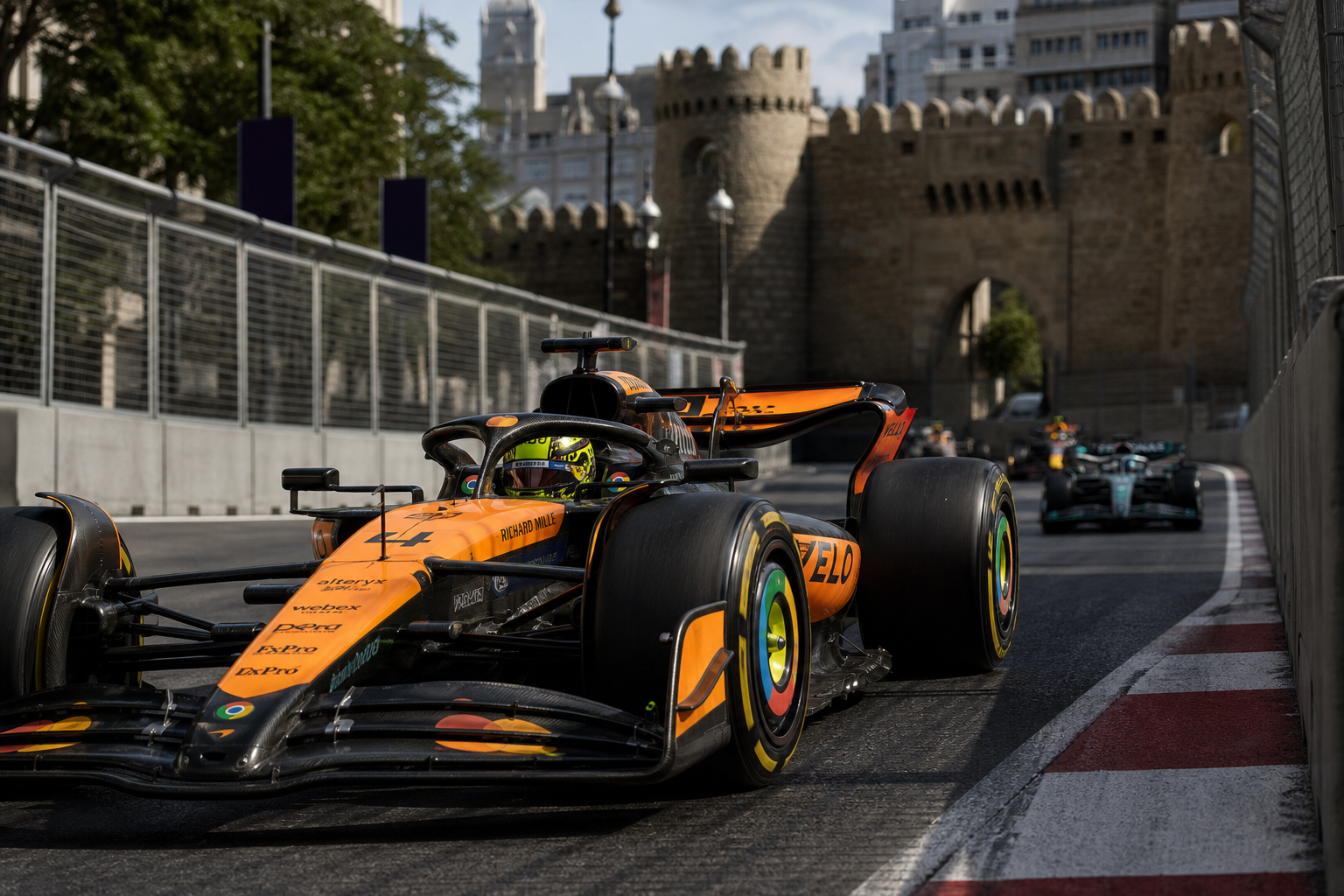

Lando Norris didn’t need a thesaurus to describe McLaren’s opening day in Baku. The British driver called the team’s lack of pace “a little knife in the heart” after ending the first Formula 1 practice session 14th and finishing second practice only sixth, still 1.5 seconds away from George Russell’s benchmark.
That is an uncomfortable amount of time to lose in modern Formula 1, where the field is often separated by tenths rather than entire seconds. It is also a particularly awkward problem to discover at the Azerbaijan Grand Prix, a circuit that gives teams relatively little room to hide behind a mediocre setup. Baku has long straights, tight corners, concrete walls and a notoriously awkward compromise between straight-line speed and low-speed grip. Get one part of the lap wrong and the timing screen becomes brutally honest.
A Difficult Start for McLaren in Baku
Norris’s first-session deficit was 1.6 seconds to Russell, who set the benchmark. That put the McLaren driver down in 14th position, hardly the sort of opening a team wants when every practice lap is being used to understand tire behavior, aerodynamic balance and the demands of a street circuit that punishes mistakes.
Oscar Piastri was closer, but not close enough to make the situation comfortable. The second McLaren was approximately one second off the pace in the opening session. That gap suggested the problem was not limited to one driver’s run plan or one scruffy lap. Both cars were lacking performance, although Piastri’s position relative to Norris offered at least a small indication that the team had room to improve.
It did improve on the timing sheet in FP2. Norris climbed to sixth, which sounds considerably healthier until the gap is examined properly. He was still 1.5 seconds away from the leading benchmark, with Red Bull and Ferrari also ahead of McLaren’s leading car.
That is the irritating part of a result that looks better at first glance. Sixth place is not a disaster. A 1.5-second deficit in practice is.
Why Baku Exposes Weaknesses So Quickly
The Baku City Circuit is an odd beast even by Formula 1 standards. One section is fast and open, with a long full-throttle run that places a premium on aerodynamic efficiency and low drag. Elsewhere, the lap tightens dramatically, particularly through the narrow old-city section, where a car needs confidence, traction and enough mechanical grip to change direction without wandering toward the walls.
Those demands pull the setup in opposite directions. Trim too much rear wing from the car and it may fly down the straight but become unpleasantly nervous in the slower corners. Add downforce for stability and the car can lose valuable speed over the long run. The correct answer is rarely obvious, and the wrong answer tends to appear on the stopwatch before the engineers have finished discussing it.
That compromise makes Baku a particularly poor place for a car with an unresolved balance problem. A driver cannot simply rely on one dominant strength. The lap demands a car that can brake cleanly, rotate at low speed, put power down without drama and remain efficient on the straight. If it does none of those things especially well, the deficit accumulates corner by corner.
Street circuits also leave teams with less margin for experimentation. Drivers need to build confidence close to the walls, but confidence is difficult to manufacture when the car is not behaving consistently. A driver who does not trust the front end will leave time in the entry phase. A driver managing rear instability will compromise the exit. At Baku, those small compromises can continue all the way down the next straight.
Norris’s “Knife in the Heart” Comment
Norris’s description was unusually vivid because the situation was not merely a matter of missing a tenth or two. The gap was large enough to make McLaren’s afternoon feel like a direct rebuke from the circuit.
“A little knife in the heart” is also a revealing choice of words from a driver who knows that practice performance can change quickly, but cannot be dismissed entirely. The team had made progress from 14th to sixth, yet the underlying gap remained substantial. That is the sort of improvement that lifts the mood in the garage without solving the problem on paper.
Formula 1 practice results are full of traps. Fuel loads differ. Tire programs differ. Some drivers complete qualifying simulations while others concentrate on longer runs. Traffic can ruin a lap, particularly on a street circuit. A red flag or a yellow flag in the wrong place can distort the order. None of those variables should be ignored.
But they do not automatically explain away a 1.5-second deficit. The sensible reading is that McLaren had not yet found the right operating window, while the more worrying possibility is that the car simply lacked the efficiency required by Baku’s unusual layout. The available practice data could not yet distinguish between those explanations.
Why the FP2 Recovery Wasn’t Enough
Norris’s rise to sixth showed that McLaren could unlock more speed as the day progressed. That matters. A car stuck at the bottom of the order in both sessions would point toward a much deeper issue. The move forward also indicated that the team was learning something from the first session rather than merely waiting for circumstances to improve.
Still, position can flatter a car when the gaps are not shown alongside it. Sixth sounds close to the front in a short headline. The stopwatch told a harsher story. Norris remained 1.5 seconds behind Russell, and the presence of Red Bull and Ferrari ahead meant McLaren was not merely chasing one unusually quick Mercedes. Several leading teams appeared to have found more pace in the same conditions.
That leaves McLaren with the classic practice-session task: identify where the time is being lost before the car is committed to a race weekend setup. The answer could involve aerodynamic drag, cornering balance, tire preparation or a combination of all three. Baku is perfectly capable of turning a small issue into a large-looking number, particularly when a car sacrifices speed at both the slow corners and the main straight.
The engineers would also need to compare Norris and Piastri’s data carefully. Piastri’s smaller FP1 deficit might suggest a difference in driving style or setup preference rather than a simple car-wide weakness. If one driver can extract more from the package, the team may be able to move toward a compromise that gives both cars greater confidence. If neither can find a consistent balance, the problem is harder to disguise.
A Warning, Not Yet a Verdict
There is a temptation to treat a poor practice session as a forecast for qualifying and the race. That is usually unwise, and Baku is especially good at making early predictions look foolish. Teams arrive with limited understanding of how the track will evolve, drivers build up gradually around unforgiving barriers, and setup changes can produce substantial gains.
McLaren’s second-session improvement is therefore important context. Norris was not trapped in 14th all day. He found enough pace to reach sixth, even if the gap to the front remained alarming. The data pointed to progress, just not enough progress.
That distinction matters. A bad lap can be repaired. A car that is fundamentally inefficient around the circuit requires a much larger response. The subsequent sessions would reveal whether McLaren’s engineers could close the gap through setup changes or whether the team had arrived with a package poorly suited to Baku’s long straights and tight corners.
For Norris, though, the emotional reaction was understandable. Drivers can tolerate being beaten by a faster car. It is harder to accept losing a second and a half when the reason is not yet obvious, particularly after the team has spent the session trying to unlock performance and still finds the timing screens refusing to cooperate.
McLaren had not lost the Azerbaijan Grand Prix in practice. It had, however, been handed a fairly direct warning. The car was moving in the right direction between sessions, but the stopwatch was still holding the knife.

0 Comments