
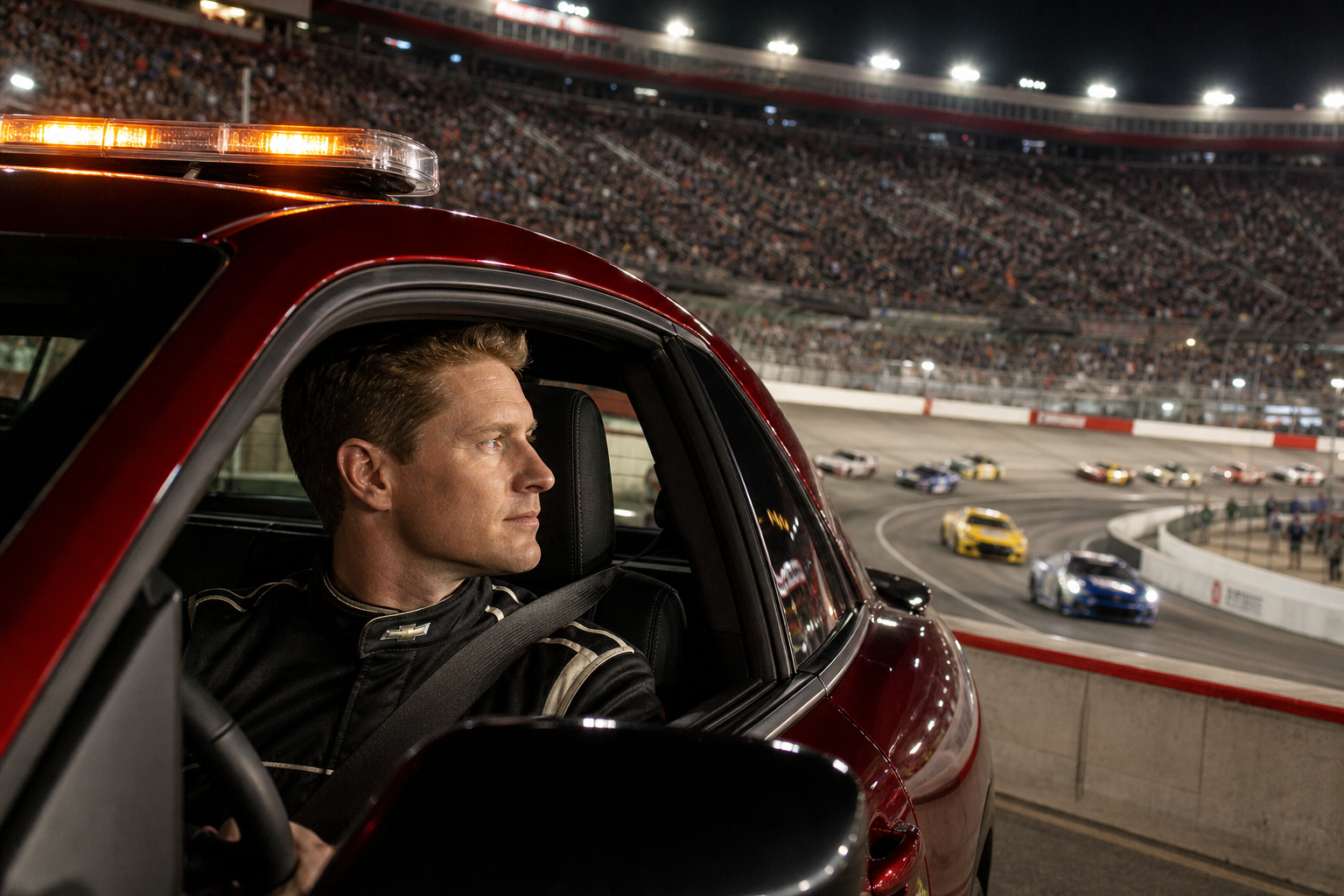

Josef Newgarden will spend Saturday night at Bristol Motor Speedway doing something every racing driver understands immediately: sitting in a car at a famous track while wishing he were in the other one.
The two-time IndyCar Series champion and two-time Indianapolis 500 winner is serving as the pace-car driver for the Bristol Night Race, returning to his native Tennessee for one of NASCAR’s most distinctive events. It is a fitting role for a driver whose career has been built on speed, oval racing and an appetite for difficult challenges. It is also rather close to the action without actually being in it, which is the sort of arrangement that can make a professional racer unusually thoughtful about life choices.
Newgarden has made it clear that he would like to race at Bristol someday. He also understands that the opportunity is unlikely to arrive easily. His primary career remains firmly rooted in IndyCar, where he is an established championship contender, but NASCAR retains a few specific ambitions that he would still like to pursue even if the practical route looks more like a mountain trail than a well-marked freeway.
Bristol Is Exactly the Sort of Place Newgarden Would Want
Bristol is not merely another oval waiting to be ticked off a driver’s résumé. The Tennessee short track is less than a mile around, yet it produces the sort of racing that makes much larger circuits feel almost leisurely. Cars run close together, traffic arrives quickly, and the concrete surface leaves very little room for a driver to be vague about his intentions.
The track’s steep banking helps NASCAR’s heavy stock cars maintain serious speed around the tight layout, but it does not make the place easy. Bristol demands confidence on corner entry, patience in traffic and a reliable sense of where the grip is moving as the race develops. A driver can be fast there and still spend the evening trying not to become part of somebody else’s caution period.
That combination would naturally appeal to Newgarden. His IndyCar record includes major success on ovals, including two Indianapolis 500 victories, and he has spent much of his career proving that he is comfortable when a race becomes a high-speed exercise in precision and nerve. Bristol is a different proposition, however. It rewards many of the same instincts while punishing anyone who assumes that oval experience is a universal passport.
IndyCar Oval Skill Would Help—But It Would Not Solve Everything
An IndyCar and a NASCAR Cup Series car may both turn left for much of a lap, but the similarities become less useful once the details start arriving. An IndyCar is lighter, more aerodynamically sensitive and built around a very different balance of mechanical grip and downforce. A Cup car is heavier, physically larger and designed to tolerate the close-quarters shoving that is part of stock-car racing’s grammar.
At Bristol, the differences would become obvious almost immediately. Newgarden would need to adapt to a car with a different braking feel, different throttle behavior and a different response to traffic. The steering inputs would not tell the same story. Neither would the tires. Even the rhythm of the race would change, because a Bristol driver is constantly managing the car’s position relative to rivals who may be inches away and moving at a slightly different pace.
That does not mean an accomplished IndyCar driver would be starting from scratch. Newgarden’s oval background would give him a useful foundation, particularly in reading a changing surface and managing speed over a long run. But it would be foolish to treat a pace-car appearance as an unofficial test session or assume that success in one form of oval racing automatically translates to another. Racing cars are annoyingly specific creatures. They remember every difference.
The Pace Car Role Is Close to the Dream, But Still Separate From It
Driving the pace car at Bristol gives Newgarden a front-row view of the event’s atmosphere and a chance to experience the track in a role that carries real responsibility. He will be part of the show, but he will not be fighting for position, managing tire wear or trying to keep a faster car from taking the preferred lane.
That distinction matters. A pace car allows a driver to sample the circuit and understand its shape, but racing speed is only one piece of Bristol’s puzzle. The track changes as rubber builds on the surface, the field creates turbulence and the tires lose performance. The driver’s workload rises as the race progresses, even though the lap itself is short enough to make every mistake arrive with remarkable efficiency.
For Newgarden, the weekend therefore carries a slightly peculiar quality. He is not an outsider being handed a ceremonial steering wheel for a publicity lap. He is one of the most accomplished active American open-wheel drivers, a man entirely capable of understanding what the cars are doing and why the competitors are working so hard. He is also not entered in the race. The invitation places him beside the opportunity rather than inside it.
Why a NASCAR Start Is Such a Difficult Thing to Arrange
Newgarden’s age—35 in the source context—does not make a NASCAR attempt impossible. Drivers regularly move between racing disciplines, and elite competitors often bring enough adaptability to make the transition worthwhile. The difficulty is finding the right circumstances rather than finding the courage to try.
A credible Cup Series start requires a team willing to provide a car, preparation time, technical support and a competitive plan. The driver must also fit the schedule around an IndyCar championship campaign, testing, sponsor obligations and the physical demands of two very different racing calendars. A one-off appearance can sound simple when discussed over a microphone. In practice, it involves a considerable number of people, budgets and calendars all agreeing at once—an achievement nearly as rare as an empty Bristol grandstand.
There is also the question of preparation. Bristol is not a forgiving venue for a driver learning a new car in public. A competitive appearance would demand more than a famous name and a strong oval résumé. Newgarden would need seat time, simulator work, technical collaboration and a team prepared to treat the entry as a serious racing project rather than an elaborate autograph opportunity.
That is likely why he can both want the chance and recognize that it may never happen. The ambition is genuine; the timetable is not entirely his to control.
Newgarden’s IndyCar Career Gives the Idea Some Weight
Newgarden is not approaching NASCAR as a driver searching for relevance. He has already built one of the strongest American open-wheel careers of his generation. His two IndyCar championships established long-term consistency, while his Indianapolis 500 victories confirmed that he can deliver under the most unforgiving pressure the series offers.
That background makes his interest in Bristol more intriguing than a celebrity appearance. He knows what a serious racing program requires. He understands the difference between being quick for a few laps and being genuinely competitive over a full event. He also knows that motorsport disciplines have their own languages, even when the cars share broad similarities.
There is a healthy humility in admitting that a desired opportunity is unlikely. Drivers at Newgarden’s level are used to controlling plenty of variables: preparation, fitness, engineering feedback and racecraft. They cannot control whether the right NASCAR seat becomes available at the right time, particularly when their existing career already demands a full commitment.
A Bristol Dream Worth Keeping
Newgarden’s presence at the Bristol Night Race may not lead directly to a Cup Series start, but it keeps the idea visible. Racing ambitions do not always disappear simply because the logistics are awkward. Sometimes they sit quietly in the background, waiting for a team, a sponsor and a calendar to behave themselves for once.
Until then, Newgarden will experience Bristol from the pace car, surrounded by the noise and compressed intensity of a track that has made a virtue of being gloriously unreasonable. He will see exactly why he wants to race there.
And if the opportunity never comes, at least he will have had the best possible reminder of what he is missing: a very fast lap, a very short track and an entire field of stock cars waiting to turn every inch of concrete into an argument.


0 Comments