
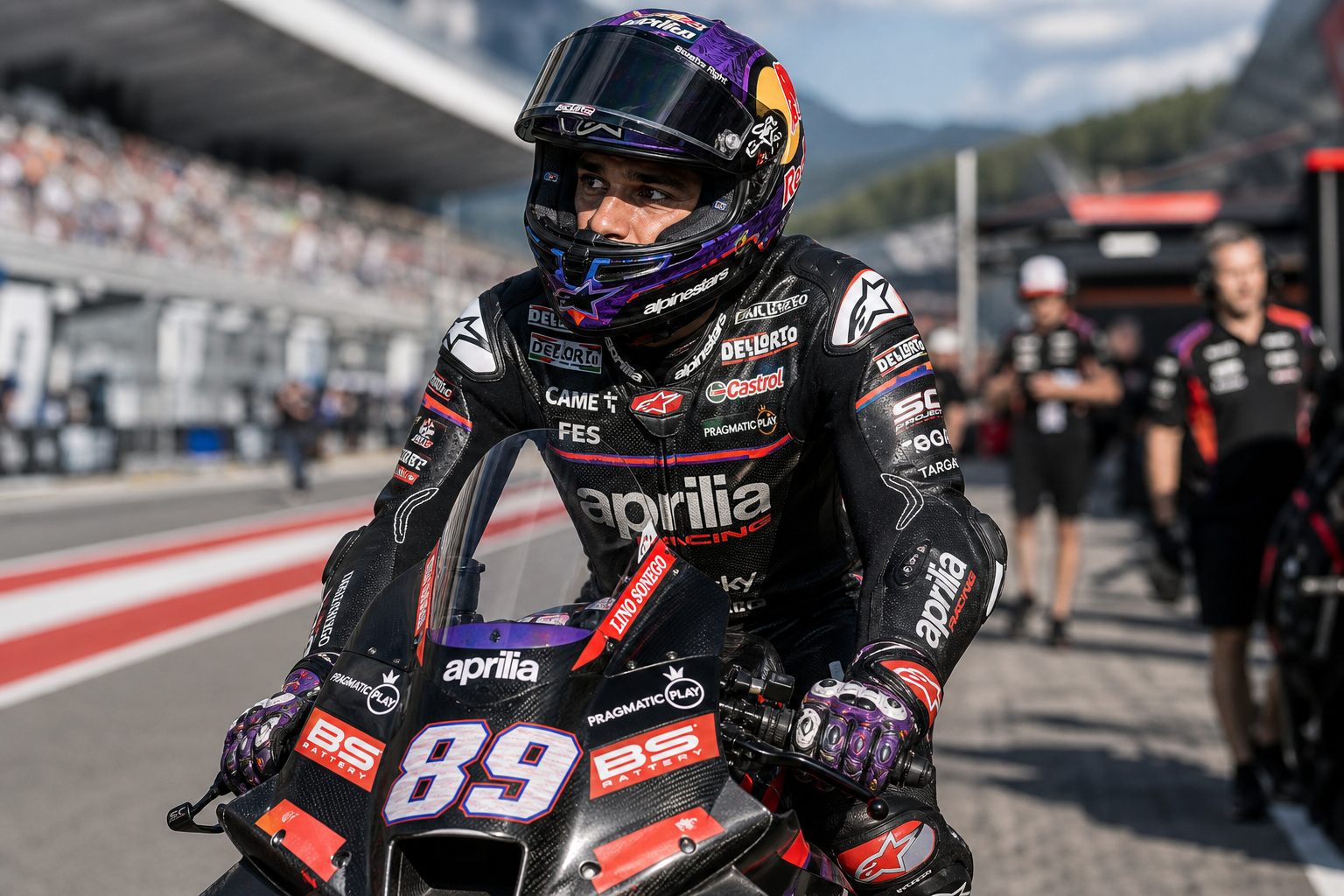

Jorge Martin has put the idea of surgery for arm pump back in the drawer after surviving a physically demanding Austrian Grand Prix without the kind of dramatic recurrence that wrecked his race at Misano the previous week.
The Aprilia rider, who leads the world championship, had been left facing an awkward decision. Arm pump is hardly a glamorous ailment, but in MotoGP it can turn a potential podium into a mechanical-looking disaster in a matter of laps. When the forearms tighten and lose strength, a rider can struggle to brake properly, operate the clutch, and hold the bars with the precision required at speeds that make sensible people reach for a bus pass.
After Austria, Martin confirmed that he would not undergo surgery in the foreseeable future. The immediate result is a welcome reprieve for the championship leader, although it does not mean the problem has been permanently solved.
Misano Made Surgery Look Like a Real Possibility
Martin’s arm-pump concerns became particularly serious at Misano, where the issue was severe enough to limit his performance and effectively destroy his race. That kind of episode is not something a rider can simply shrug off as an inconvenient ache. A MotoGP race demands repeated, heavy braking, constant changes of direction, and sustained pressure through the handlebars. Any loss of forearm strength quickly becomes a performance problem and, more importantly, a safety concern.
The timing was especially unwelcome. Martin entered this part of the season as the championship leader, meaning every race carries consequences beyond one afternoon’s result. A physical problem that prevents a rider from using the brakes or controlling the motorcycle properly can cost points in a hurry. It can also force a team and rider to consider whether a surgical fix is preferable to repeatedly managing the symptoms.
That was the calculation hanging over Martin after Misano. Surgery for arm pump typically involves releasing pressure in the affected forearm compartments, giving muscles and nerves more room to function during intense exertion. It is a familiar procedure in motorcycle racing and other sports where the arms are subjected to repeated strain, but “familiar” does not mean trivial. Any operation brings recovery time, rehabilitation, and the risk of interrupting a rider’s season at precisely the wrong moment.
Austria Changed the Conversation
The Austrian Grand Prix provided Martin with the most useful evidence available: he could complete a tough race without the problem returning in a major way. That does not offer the certainty of a medical test, but for a rider trying to decide whether to interrupt a championship campaign, it is rather important evidence.
Martin suggested that tension may have played a role in what happened at Misano, while also making clear that something had genuinely restricted him. That distinction matters. Arm pump is a physical condition, but racing stress, grip pressure, fatigue, and the way a rider responds to a problem can all affect how quickly symptoms become debilitating. The forearm does not care much about the elegance of the explanation; once it tightens, the rider still has to get the motorcycle stopped for Turn 3.
A strong showing in Austria therefore did not erase the Misano episode. It showed that Martin’s condition may be manageable without immediate surgery, at least for now. That is a very different claim from saying the issue has disappeared.
Why MotoGP Arm Pump Is Such a Serious Problem
Modern MotoGP motorcycles place considerable physical demand on a rider’s upper body. Braking zones generate huge loads, while the rider must stabilize the machine through corner entry and direction changes. The arms are not doing all the work—core and leg strength are crucial—but the forearms remain central to maintaining control and feel at the bars.
When arm pump develops, the symptoms can include pain, swelling, numbness, tingling, and a loss of grip strength. For a road rider, that would be unpleasant. For a MotoGP rider, it can compromise the basic sequence of every corner: brake hard, release the brake with control, turn the motorcycle, manage the throttle, and repeat approximately 70 times while traveling at an indecent pace.
The problem can also create a vicious circle. A rider who feels the forearms tightening may grip the bars harder, increasing the strain and accelerating the loss of function. That is why a rider’s report after one race can change dramatically from the report after another. Circuit layout, temperature, setup, physical condition, race pressure, and riding style all influence the load placed on the arms.
For Martin, the Championship Comes First
Martin’s decision to postpone surgery is understandable given his position in the standings. Missing races or returning before full strength would carry its own risks, particularly during a championship fight in which every point matters. If the symptoms remain controllable, continuing to race allows him to protect his lead while monitoring the situation from one event to the next.
That approach is not without danger. A recurrence could arrive at a circuit that demands more from the forearms than Austria did, or it could appear after several consecutive races when fatigue has accumulated. A single successful weekend is encouraging, but it is not a lifetime warranty. Motorcycle racing has never been especially generous with those.
Aprilia will also be watching the issue closely. The team can adjust the motorcycle and rider workload around comfort and consistency, but no suspension setting can cure a physical condition. Ergonomics, handlebar position, lever setup, riding posture, and overall machine behavior may help reduce unnecessary strain, yet the final decision remains a medical and sporting one for Martin.
A Pause, Not a Permanent Rejection
The important wording from Martin is that he will not have surgery “in the foreseeable future.” That leaves the door open if arm pump returns or begins to threaten his ability to race. It is a sensible position rather than a dramatic declaration that the problem is finished.
For now, Austria has bought him time. He has avoided an immediate operation, kept himself in the championship fight, and gained a race-distance demonstration that the Misano failure was not necessarily the beginning of a season-ending pattern. The next races will provide the harder test: not whether he can survive one demanding weekend, but whether his forearms can cope with the repeated pressure of a championship campaign.
That is the slightly unromantic reality behind MotoGP’s spectacular images. The championship may be decided by tire choices, race pace, and last-corner bravery, but it can also turn on whether a rider’s hands still work properly after half an hour of violent braking. Martin has chosen to keep racing and postpone the operating room. For the moment, Austria has given him every reason to believe that is the right call.
0 Comments