
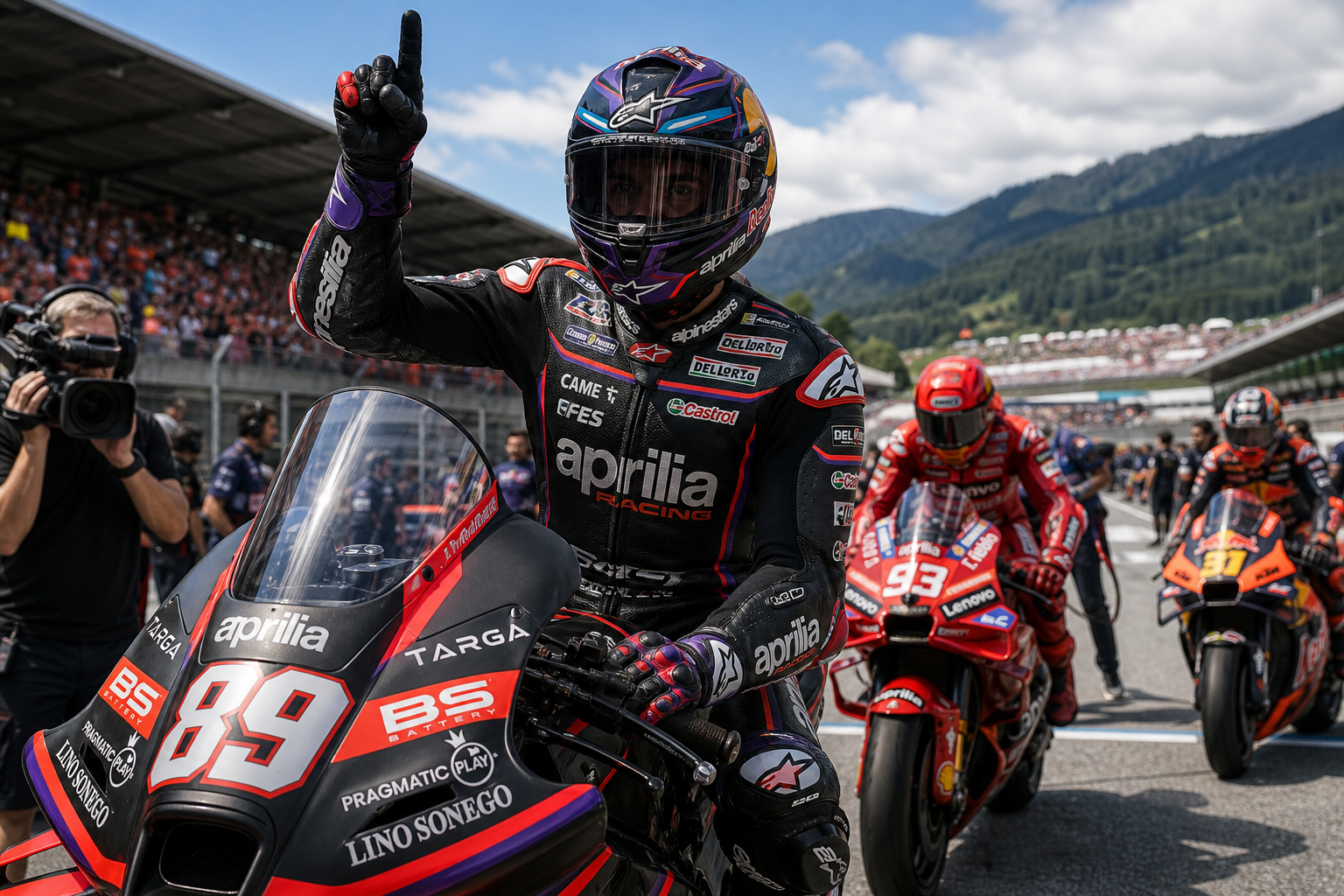

Pedro Acosta arrived at the Austrian Grand Prix carrying the sort of expectation that can make a home race feel less like a celebration and more like a job interview. KTM wanted its young star fighting for his first MotoGP victory on home ground. Instead, it was Aprilia’s Jorge Martin who seized pole position after a qualifying session so tight that the smallest mistake threatened to reshuffle the front row.
Marc Marquez edged ahead of Acosta on the factory Ducati, leaving the KTM rider to start third. That result is hardly a disaster—third on the grid is an excellent launch point—but it changes the shape of the race. Acosta will not have the cleanest possible escape at the front, while Martin and Marquez have the advantage of occupying the two positions immediately ahead of him.
Martin Finds the Lap When It Counts
Qualifying at this level is not merely a question of having a fast motorcycle. The rider needs a clear track, the correct tire temperature, a well-timed tow when one is available, and enough confidence to attack the lap without overcooking the first corner. The margins are particularly cruel when the field is closely matched. A few hundredths of a second can turn pole position into the second row.
Martin managed to put all of it together for Aprilia. The result gives him the most valuable piece of real estate on the grid and, just as importantly, denies KTM the celebratory headline it appeared to be building toward. That is the slightly rude charm of motorcycle racing: the host manufacturer may own the banners, the grandstands, and much of the crowd’s emotional investment, but pole position remains available to anyone quick enough to take it.
The Aprilia rider’s performance also gives the Italian manufacturer an important opportunity to dictate the opening phase of the race. From pole, Martin can choose the first braking point rather than reacting to somebody else’s launch. That does not guarantee the lead into the first corner, but it gives him the best possible starting position for controlling the early rhythm.
Why the Austrian Grid Is Such a Useful Clue
The Red Bull Ring is not a circuit that allows a rider to hide a weakness for very long. Its layout places considerable emphasis on acceleration, hard braking, and the ability to get the motorcycle settled quickly before turning. The long straights make the slipstream useful, while the relatively compact lap means the field can remain bunched together for much of the race.
That combination creates a qualifying session in which outright speed matters, but so does the way a motorcycle deploys its performance. A rider can gain time on the brakes and lose it on corner exit, or arrive at the final sector with a strong lap only to discover that another machine has better traction. The stopwatch is merciless and, unlike a marketing department, has no interest in describing a mediocre sector as “character-building.”
Martin’s pole therefore matters beyond the ceremonial value of standing first on the grid. It suggests that the Aprilia package was able to deliver a properly competitive single-lap performance at a track where acceleration and braking stability are central to lap time. The race will ask different questions, particularly over tire life and consistency, but qualifying has at least placed Martin in the best position to answer them.
Acosta Still Has a Strong Platform
Third place is a frustrating result only because Acosta was expected to challenge for more. In practical terms, it leaves him close enough to attack immediately and avoids the traffic that can complicate a race from the middle of the grid. His bigger task will be turning the emotional importance of KTM’s home event into a calm, repeatable race performance.
Acosta’s position also creates an intriguing tactical problem. Martin starts ahead of him, while Marquez occupies the other place on the front row. If the KTM rider makes a strong launch, he could be involved in the fight for the lead before the race has settled. If he loses ground, however, he may have to spend the opening laps managing pressure from behind rather than pursuing the victory that so many people around the team want to see.
That is the difference between a good grid position and a good race result. The former lasts until the lights go out. The latter requires tire management, clean exits, and the discipline to avoid turning the first lap into an expensive demonstration of optimism.
Marquez Adds Another Layer of Pressure
Marquez starting ahead of Acosta gives the factory Ducati a powerful presence at the front of the field. His ability to place himself between Martin and the KTM rider could prove significant during the opening laps, when a rider’s priority is often to establish a rhythm before the race becomes a matter of tire preservation.
For Martin, the ideal scenario is obvious: get away cleanly, prevent the Ducati from settling into the race, and force Acosta to spend time working past Marquez. For Acosta, the calculation is less comfortable. Passing Marquez may be necessary to keep contact with Martin, but an aggressive move early in the race can compromise tires and corner exits long before the checkered flag becomes relevant.
The presence of two championship leaders near the front only increases the strategic tension. Riders fighting for a title cannot treat every lap as an isolated drag race. Points, risk, and the championship situation all sit in the background, even when the rider is trying to outbrake somebody into a corner at racing speed. That tension is invisible from the grandstand, but it often decides whether a bold move becomes a brilliant pass or a very expensive piece of carbon fiber.
Aprilia Has the Advantage, but Not the Answer Yet
Aprilia can take considerable satisfaction from qualifying, but pole position is not a guarantee of race-day superiority. The conditions change, the fuel load is higher, and the tire behaves differently once the field settles into a long-distance rhythm. A motorcycle that feels sharp for one qualifying lap must also remain manageable when the rider is defending, following another bike, and asking for performance from worn rubber.
Martin’s immediate challenge will be turning clean air into a useful advantage. If he can maintain the lead through the early laps, he may be able to make the riders behind spend their tires trying to stay attached. If the Ducati has the stronger race pace, or if Acosta can attack quickly, pole may become little more than a pleasant memory by the time the race reaches its first major sequence of battles.
Still, Aprilia has done the important part first. It arrived at a KTM home race, faced a grid crowded with serious opposition, and produced the fastest qualifying lap. That is not a championship result, but it is exactly the sort of statement a factory team wants before a race in which every major rival has a reason to believe it can win.
A Front Row Built for Drama
Martin on pole, Marquez alongside him, and Acosta directly behind creates a compact front group with three very different pressures attached to it. Martin must convert speed into control. Marquez has the Ducati underneath him and the experience to exploit any hesitation. Acosta has the crowd, the KTM machinery, and the expectation of a breakthrough all pressing in the same direction.
That makes the Austrian Grand Prix more interesting than a simple home-race story. KTM may still have the strongest emotional connection to the weekend, but Aprilia has the strategically superior starting position, while Ducati remains close enough to spoil both plans. The winner will not be decided by qualifying alone, yet Martin has ensured that everyone else must now come through him.
For one Saturday afternoon, at least, the home crowd’s script has been rewritten. Martin supplied the correction in a motorcycle, a helmet, and a qualifying lap with no interest in sentimental narratives.


0 Comments