
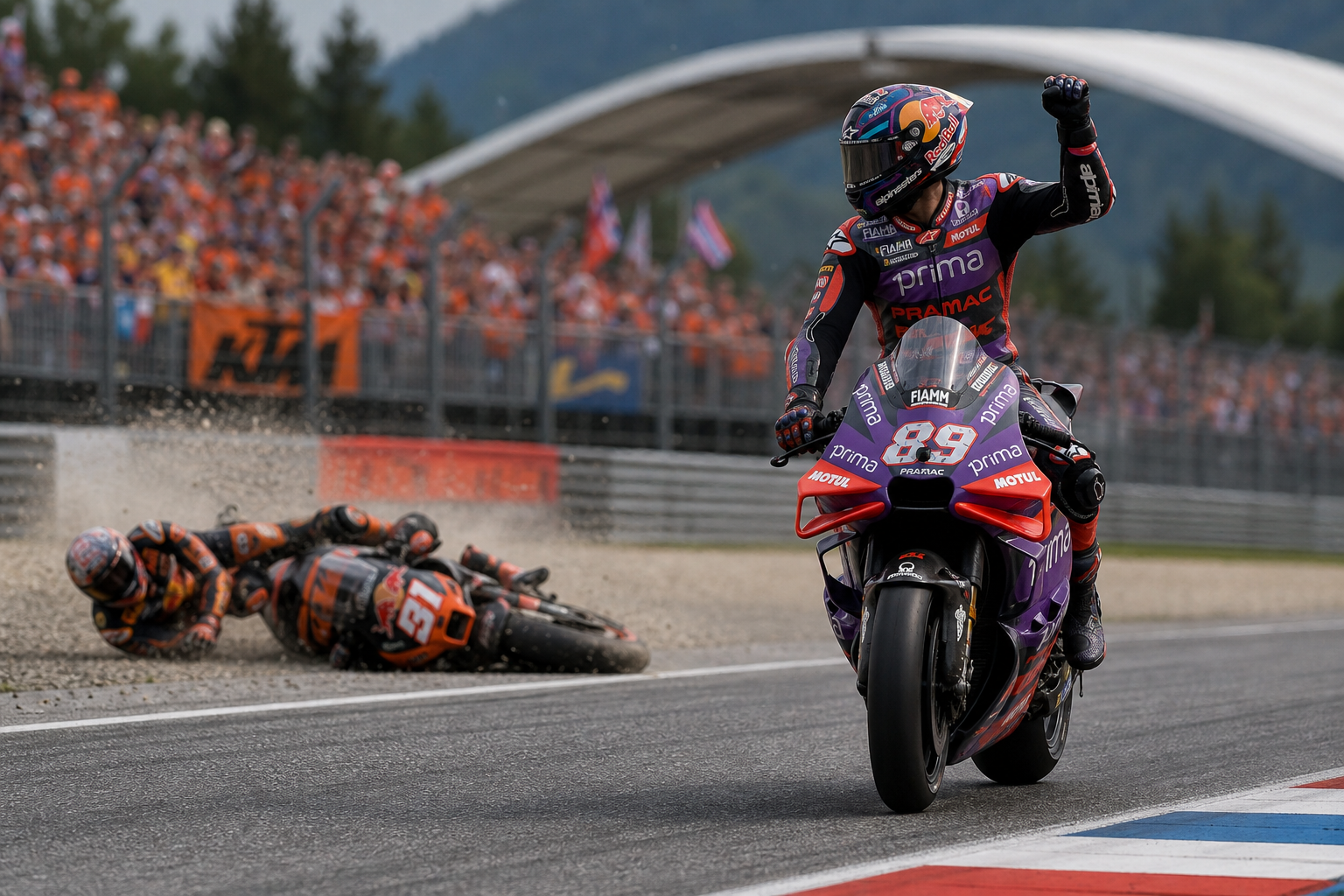

Pedro Acosta had the Austrian MotoGP sprint neatly folded into his pocket. He had escaped to a lead of nearly three seconds, the KTM crowd was enjoying the prospect of a home-venue celebration, and Jorge Martin’s race appeared to be slipping away after an early fight with Marc Marquez.
Then Acosta crashed with three laps remaining.
Martin suddenly found himself in front and converted the gift into an unlikely sprint victory, turning a race that had seemed to be running away from him into one of the more dramatic short-format finishes of the season.
Acosta Seizes Control on the Opening Lap
The defining move came almost immediately. Martin and Marquez became locked in an early battle, costing both riders momentum while Acosta took advantage of the hesitation ahead. The 22-year-old KTM rider moved into the lead on the opening lap and quickly began stretching the gap.
That was the sort of start KTM would have wanted at its home Austrian event. Acosta was not merely hanging on to the leaders; he was building a substantial advantage. By the time the race settled into its middle phase, he was almost three seconds clear.
In a full-length Grand Prix, that kind of margin can give a rider room to manage tire wear, traffic, and the inevitable late-race complications. In a sprint, however, the pressure is concentrated into a much shorter distance. There is less time to recover from a mistake, and riders tend to operate closer to the limit from the moment the lights go out. Acosta had created the perfect situation, but the job was not finished.
One Mistake Changes the Entire Race
Acosta’s crash came with only three laps left, abruptly removing the rider who had looked most likely to win. The available information does not identify the precise cause of the fall, so there is no need to dress it up as a tire gamble, a mechanical problem, or some grand strategic failure. Sometimes a MotoGP race reaches the part where the margins become tiny, and the margin disappears.
That timing made the incident especially painful. Acosta had already done the difficult work: he had profited from the opening-lap fight, taken command, and built a lead large enough to make the chasing group look rather distant. A crash at that stage is not a minor interruption. It wipes out the entire afternoon’s work in a sport where a few centimeters of available grip can decide everything.
It also transformed the character of the sprint. Instead of a controlled victory for Acosta, the finish became a race for whoever could remain composed after the leader’s departure. Martin was the beneficiary, but calling it a routine win would miss the point. His victory came from surviving the opening fight and being ready when the race changed shape.
Martin’s Win Was Earned the Hard Way
Martin did not have the cleanest opening to the sprint. His battle with Marquez allowed Acosta to escape, leaving Martin with the uncomfortable task of chasing a rider who was already several seconds up the road. The early deficit made a victory look improbable, particularly with the race distance compressed by the sprint format.
Acosta’s crash altered the arithmetic, but Martin still had to bring the result home. Sprint races punish overreaction. A rider who sees the leader fall can become too eager, make a mistake of his own, or spend precious time fighting the wrong battle. Martin instead took advantage of the opportunity placed in front of him.
That is the less glamorous but important side of an inherited win. Luck may open the door, but the rider still has to avoid walking into the furniture. Martin managed that final task and claimed the victory.
Why the Sprint Format Made the Drama Sharper
Saturday sprints are built around compressed aggression. Riders have fewer laps to settle into a rhythm, fewer opportunities to make up lost ground, and much less incentive to preserve equipment for a distant finish. The opening lap tends to carry an outsized influence, which is exactly what happened here.
Martin and Marquez’s early contest was not merely a bit of wheel-to-wheel entertainment before the proper race began. It created the opening Acosta needed. Once the KTM rider got clear, the battle behind him became a strategic problem: continue fighting and risk losing touch, or concede the position and try to chase the leader? In a sprint, neither option is particularly comfortable.
Acosta’s crash then exposed the other defining feature of the format: a large lead is valuable, but it does not make a rider immune to the consequences of one mistake. The shorter race gives every incident greater weight. There is no long second half in which to rebuild confidence or recover positions. One moment can decide the whole result, which is thrilling for spectators and probably rather less thrilling for the rider involved.
A Bitter Result for KTM at Its Home Event
Acosta’s position at the front had obvious significance for KTM. A strong performance at the Austrian Grand Prix carries an extra layer of attention for the manufacturer, its staff, and the fans filling the venue. Seeing Acosta lead by nearly three seconds offered the prospect of a particularly satisfying home celebration.
Instead, the crowd watched the race’s apparent winner disappear from contention in the closing stages. That is motorsport’s cruel little trick: a home advantage can produce more pressure as well as more support. Every promising lap raises expectations, and every mistake becomes louder.
Acosta’s speed remains the most encouraging part of the weekend from KTM’s point of view. The crash erased the result, but it did not erase the fact that he was able to seize the lead immediately and build a substantial advantage. Pace and execution are separate problems. On this occasion, the first was plainly present; the second failed at the worst possible moment.
Marquez’s Early Fight Adds Another Layer
Marquez’s involvement in the opening battle helped shape the race even though Acosta’s crash became the headline. The contest between Martin and Marquez was close enough to affect the order behind them, and Acosta read the situation correctly. In racing, a rider does not always need to make the most spectacular move. Sometimes the clever move is simply noticing that two opponents are busy arguing and driving straight through the gap they have created.
That opening-lap episode also explains why the result should not be reduced to a lucky accident. Martin benefited from Acosta’s crash, certainly, but Acosta had first benefited from the battle ahead. The sprint became a chain of small advantages and disadvantages, with each rider’s position influenced by what the others were doing only a few feet away.
A Victory With an Asterisk, But Still a Victory
Martin’s Austrian sprint win will naturally be described as unexpected because Acosta looked set to control the finish. Yet the result still counts, and Martin had to be in position to accept it. He survived the opening exchange, remained in the race, and avoided throwing away his chance when the leader did.
For Acosta, the lesson is harsher. Leading by nearly three seconds is meaningful, but MotoGP does not hand out trophies for looking comfortable with three laps still to run. The KTM rider had produced the performance required to win and then lost everything in an instant.
That is why this sprint will be remembered less for a dominant ride than for the sudden collapse of one. Acosta had the speed, Martin had the opportunity, and the Austrian crowd got the sort of ending nobody had planned. In MotoGP, that is often how a seemingly settled race becomes a proper story.

0 Comments