
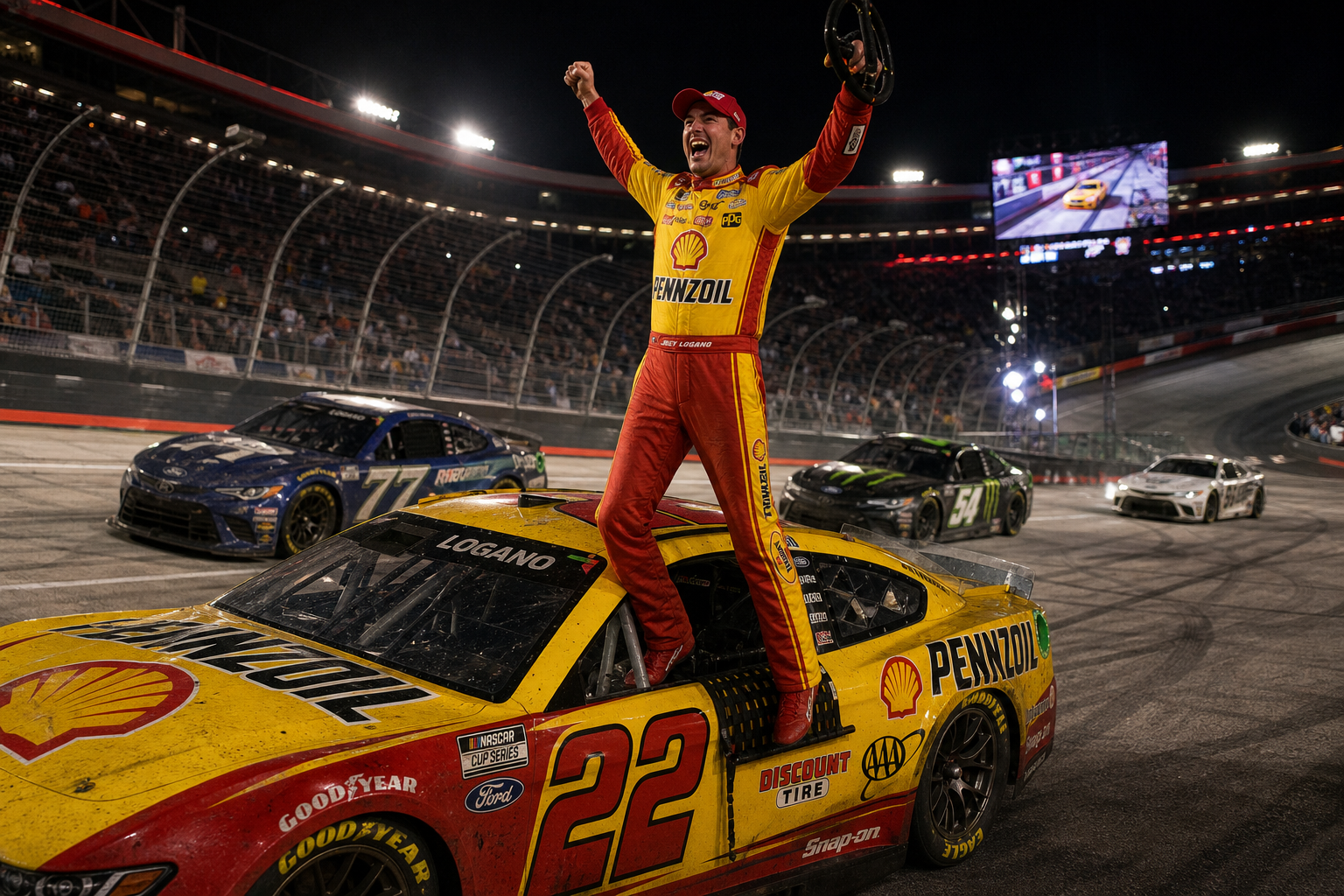

Joey Logano waited until the Bristol Night Race became properly unpleasant, then took control of it. With roughly seven laps remaining, the Team Penske driver passed Carson Hocevar and Ty Gibbs to secure his 40th NASCAR Cup Series victory.
That number gives the result rather more weight than a routine Saturday-night trophy. Logano is now a 40-time Cup winner, and he earned this one at a track that has a habit of turning tidy race plans into expensive scrap metal. Bristol Motor Speedway is short, steeply banked and unforgiving, a place where traffic arrives quickly and the concrete surface rarely allows a driver to relax.
A Calm Start Gave Way to Bristol Chaos
The opening two stages were comparatively orderly. Only two natural cautions interrupted the race during that portion, allowing teams to run extended green-flag stretches and drivers to settle into the rhythm of Bristol’s tight, physical layout.
That calm did not survive the final stage.
The race eventually produced ten cautions in total, meaning most of the disruption arrived after the early running had looked almost civilized. Bristol is not normally accused of being civilized, so the sudden change felt less like a surprise than the track remembering what it was supposed to do.
Repeated cautions compress the field, erase carefully built gaps and make pit-stop timing increasingly important. A driver who has spent hundreds of laps managing tire wear can see the advantage disappear in a single restart. Meanwhile, cars that have been quietly damaged or pushed beyond their limits suddenly become liabilities, particularly when the field is bunched together with only a handful of laps left.
By the finish, only 12 cars remained on the lead lap. That figure tells its own story. Bristol may be a compact oval, but it is perfectly capable of creating a substantial divide between the cars that survive the evening’s punishment and those that become part of the caution count.
Logano Made the Decisive Move Late
Logano led 93 laps and saved his most important work for the closing sequence. With approximately seven laps remaining, he moved past Hocevar and Gibbs to take the lead. The timing was crucial: late-race passes at Bristol leave little room for experimentation, and a driver cannot afford to spend several laps politely asking another car to move over.
Hocevar and Gibbs had been in position to fight for the win, but Logano’s experience in short-track traffic gave him the opportunity he needed. The finish was not built on an overwhelming display of control from the opening green flag. It was built through survival, track position and one properly timed attack when the race was finally there to be won.
That is an important distinction at Bristol. Leading early can be useful, but it also exposes a car to traffic, changing grip and the constant wear that comes from running at the front for long periods. The fastest car at the start of the night is not always the one with the best chance at the checkered flag. Sometimes the winning strategy is to remain close enough to strike without spending the whole race carrying a target on the windshield.
Why Bristol Makes the Result Significant
Bristol’s small footprint creates an unusually intense form of NASCAR racing. Drivers encounter slower traffic rapidly, and the banking encourages cars to run close together even when the track surface is becoming difficult. There is little opportunity to hide a handling problem. A car that is too loose, too tight or simply losing its tires becomes vulnerable almost immediately.
The concrete racing surface adds another layer to the challenge. Grip can change as rubber builds up, while the preferred line may shift during a long run. Drivers and crews must judge whether the car is better near the bottom, higher against the outside wall or somewhere in between. The answer can change with tire wear, traffic and track temperature, which is one reason the night race often rewards adaptability as much as raw speed.
It also explains the difference between the first two stages and the closing stage of this race. Early in the event, the field managed to run with relatively few interruptions. Later, as tires wore and the pressure increased, the margin for error narrowed. Ten cautions and just 12 cars on the lead lap are the statistical evidence of that deterioration.
There is no need to dress it up as something it was not. This was not a procession. It was a race that became progressively harder to manage, leaving the surviving contenders to sort out the result when the field had been repeatedly reset.
Hocevar and Gibbs Were Close, but Logano Had the Finish
Hocevar and Gibbs were the two drivers Logano had to clear in the closing laps, placing both in the center of the late-race story even though Logano took the victory. Their presence near the front also underlined how quickly a Bristol race can change. A driver does not need to dominate every stage to become a genuine threat once the final restart sequence begins.
For Hocevar and Gibbs, the closing laps offered a chance to convert strong track position into a first-place finish. Logano’s move denied them that opportunity, but the circumstances also show why Bristol is so compelling. The race can spend several hours sorting the field through attrition, only to leave the decisive contest to three cars separated by a small amount of asphalt and an even smaller amount of patience.
At a larger circuit, a late pass can develop over several corners or even an entire lap. At Bristol, the opportunity may appear and vanish before the television audience has finished replaying the previous one. A driver has to commit, and the car has to respond without making the kind of mistake that brings out caution number eleven.
Forty Cup Wins for Logano
The Bristol victory moves Logano to 40 career NASCAR Cup Series wins, another substantial mark in a career already defined by major victories and a willingness to race aggressively when the moment demands it.
Reaching 40 wins is not merely a tidy round number. It reflects long-term competitiveness across different types of NASCAR racing, from high-speed tracks to the short, bruising contests where patience and mechanical sympathy matter just as much as outright pace. Bristol asks a driver to manage all of those qualities at once, usually while several other cars are trying to occupy the same piece of track.
Logano’s late pass made the milestone especially appropriate. A quiet, controlled finish would have counted just as much in the record book, but Bristol rarely hands out its best moments so politely. The winning move came late, after the race had transformed from a relatively clean event into a caution-heavy fight with only a dozen cars still on the lead lap.
A Race Won by Timing and Survival
The 2026 Bristol Night Race ultimately belonged to the driver who combined both parts of the short-track equation. Logano had enough pace to lead 93 laps, enough durability to remain in contention as the cautions accumulated and enough decisiveness to pass Hocevar and Gibbs when the finish was approaching.
That combination is what makes the result more revealing than the winner’s name alone. Bristol did not reward a driver simply for being quick in clean air. It demanded a car that could remain useful as the track changed, a team that could keep working through repeated interruptions and a driver prepared to make the final move without hesitation.
Logano did all three. The reward was his 40th Cup Series win—and a trophy collected on a night when Bristol once again demonstrated that “short track” does not mean “simple.”
0 Comments