
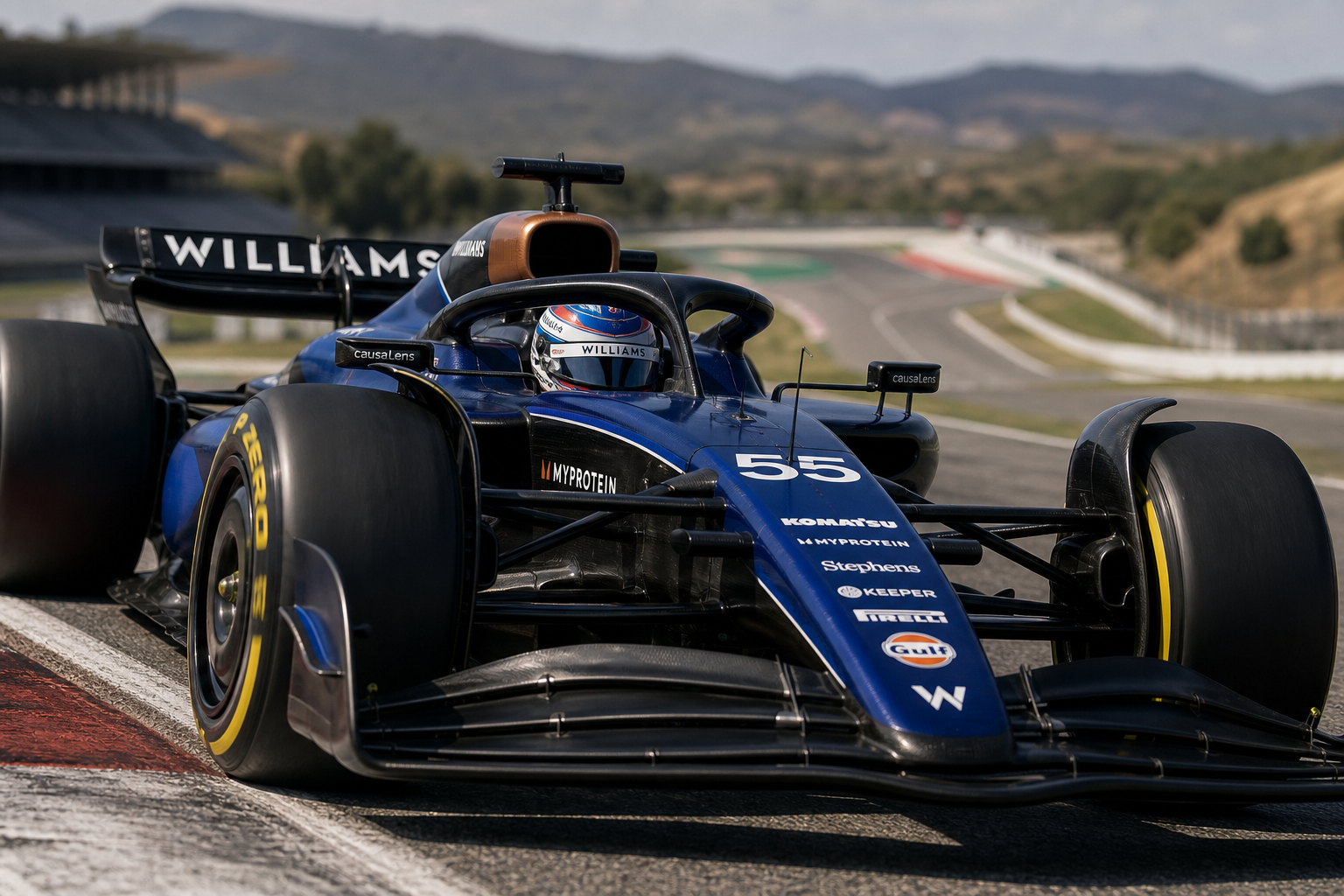

Jamie Chadwick has added another unusual entry to Formula 1’s long and painfully short history of female drivers after completing 32 laps in a Williams FW47 at Portimao, Portugal.
The 28-year-old drove last year’s Williams as part of the team’s Testing of Previous Cars program, a private testing format that allows teams to run older machinery for driver development and evaluation. It wasn’t a Grand Prix weekend, and Chadwick hasn’t suddenly been handed a race seat, but that doesn’t make the opportunity insignificant. Driving a modern Formula 1 car is a rare privilege even for professional racers, and the list of women who have done it remains remarkably compact.
Chadwick completed the test on Monday in her role as a Williams development driver. She became the second woman to drive an F1 car that year, following Doriane Pin, and once again put her name alongside a group of drivers whose opportunities in the category have been separated by decades rather than seasons.
A Short List With a Long History
Formula 1 has been around since 1950, yet the number of women who have driven its cars in an official or team-supported capacity can still be counted without needing a spreadsheet and a strong cup of coffee.
Italy’s Maria Teresa de Filippis became the first woman to start a Formula 1 World Championship race when she competed in the 1958 Belgian Grand Prix. Lella Lombardi followed in the 1970s and remains the only woman to score points in a World Championship Grand Prix, earning half a point at the shortened 1975 Spanish Grand Prix.
Other women, including Divina Galica, Desiré Wilson and Giovanna Amati, entered Grand Prix events but did not qualify for the race. More recently, Susie Wolff and Tatiana Calderón drove Formula 1 cars in testing and official practice environments, while several manufacturers and teams have used female drivers in development programs.
That distinction matters. “Drove an F1 car” can mean anything from completing a private test to starting a championship race, and those are very different achievements. A test driver may spend the day evaluating systems, tires, setup changes and procedures. A race driver has to qualify, manage a full Grand Prix distance and operate under the sort of pressure that makes perfectly reasonable people voluntarily spend Sunday afternoons arguing about track limits.
Chadwick’s Portimao run belongs to the testing side of that history, but it is still a meaningful step. The car remains a highly complex, high-performance machine, and the experience is directly relevant to anyone working toward a future Formula 1 role.
What the Williams Test Actually Involved
The Williams FW47 was the team’s 2025 Formula 1 car. Chadwick drove it under the Testing of Previous Cars regulations, which permit teams to run older cars outside the normal race-weekend schedule. These tests are not a secret method of gaining extra development mileage on the current car; the whole point is that the machinery is from an earlier season.
That does not make the work ceremonial. A driver still has to learn the car’s controls, braking characteristics, energy-management systems and operating procedures. Formula 1 cars demand precise interaction between the driver and the steering wheel, with its collection of switches, rotary controls and display functions. The car’s performance also places significant demands on braking technique, corner entry precision and physical consistency.
For a development driver, running an older car can provide valuable seat time without the competitive and logistical pressure attached to a Grand Prix weekend. It gives the team a chance to assess how a driver communicates, adapts and processes information. It also gives the driver a far more useful understanding of Formula 1 machinery than simulator work alone can provide.
Thirty-two laps is not a full-season education, naturally. It is enough to build familiarity and gather feedback, but not enough to turn anyone into an overnight Grand Prix winner. Motorsport has yet to discover a shortcut around experience, despite the best efforts of every junior driver sponsor on earth.
Why Chadwick’s Background Makes the Run Significant
Chadwick is not a celebrity passenger being wheeled into a Formula 1 car for a publicity photograph. She has built a substantial single-seater career, winning the inaugural W Series championship in 2019 and taking further titles in 2021 and 2022. She has also competed in Indy NXT, gaining experience in a different but still demanding open-wheel environment.
Her career has made her one of the most recognizable female drivers of her generation, but recognition is not the same thing as a clear path to Formula 1. The ladder is brutally expensive, highly political and short of available seats. Even male drivers with impressive junior records regularly find themselves stranded one rung below the top.
That is why development roles matter. A driver needs opportunities to remain visible, connected to a team and involved in the technical process. Simulator work, engineering meetings, media duties and private testing may not carry the glamour of a race start, but they allow a team to judge a driver over time rather than relying solely on junior-category results.
Williams has maintained a connection with Chadwick through its development structure, and the Portimao outing gives that relationship a tangible on-track dimension. It also offers Chadwick the chance to demonstrate that her value extends beyond being a pioneer in women’s racing. The relevant question for a Formula 1 team is whether a driver can deliver clear technical feedback, learn quickly and perform consistently. The stopwatch is involved, of course, but it is not the only judge in the room.
Portimao Is a Proper Test of a Driver
The Algarve International Circuit is an appropriate place for this sort of work. Its elevation changes, blind crests, heavy braking zones and fast, flowing corners expose weaknesses quickly. A driver can’t simply memorize a procession of flat, featureless bends and hope the car does the rest.
Portimao also places a premium on confidence. Several corners tighten or fall away over the crest, which makes the driver’s initial commitment and ability to read the car particularly important. A test there can reveal how quickly a driver builds trust in the brakes, aerodynamic grip and tire behavior.
That is useful information for a team, even when the car is no longer current. The FW47 may not be Williams’ latest Grand Prix machine, but the fundamental working habits required of a Formula 1 driver remain familiar: precise preparation, disciplined communication, mechanical sympathy and the ability to extract performance without turning every lap into a small personal crisis.
The Difference Between Progress and a Race Seat
Chadwick’s test should be viewed for what it is: a valuable development opportunity, not an announcement that Williams is preparing to enter her in a Grand Prix.
Formula 1 teams use previous-car testing for several reasons, including driver assessment, preparation and acclimatization. A successful run can strengthen a driver’s case for further opportunities, but it does not erase the commercial, sporting and technical decisions involved in choosing a race lineup. Those decisions are rarely governed by talent alone, however much the sport likes to present itself as a pure meritocracy in expensive uniforms.
There is also a broader benefit. Each time a woman drives a current-generation Formula 1 car in a meaningful team environment, the idea becomes less unusual for the next driver coming through the system. That does not solve the structural barriers facing women in motorsport, and it certainly does not guarantee a future female Grand Prix winner. It does, however, create experience, visibility and a reference point that did not exist for many earlier generations.
For now, the headline is straightforward: Jamie Chadwick drove a Williams FW47 for 32 laps at Portimao, adding her name to Formula 1’s exclusive list of female drivers. The lap count was modest. The historical company was not.


0 Comments