
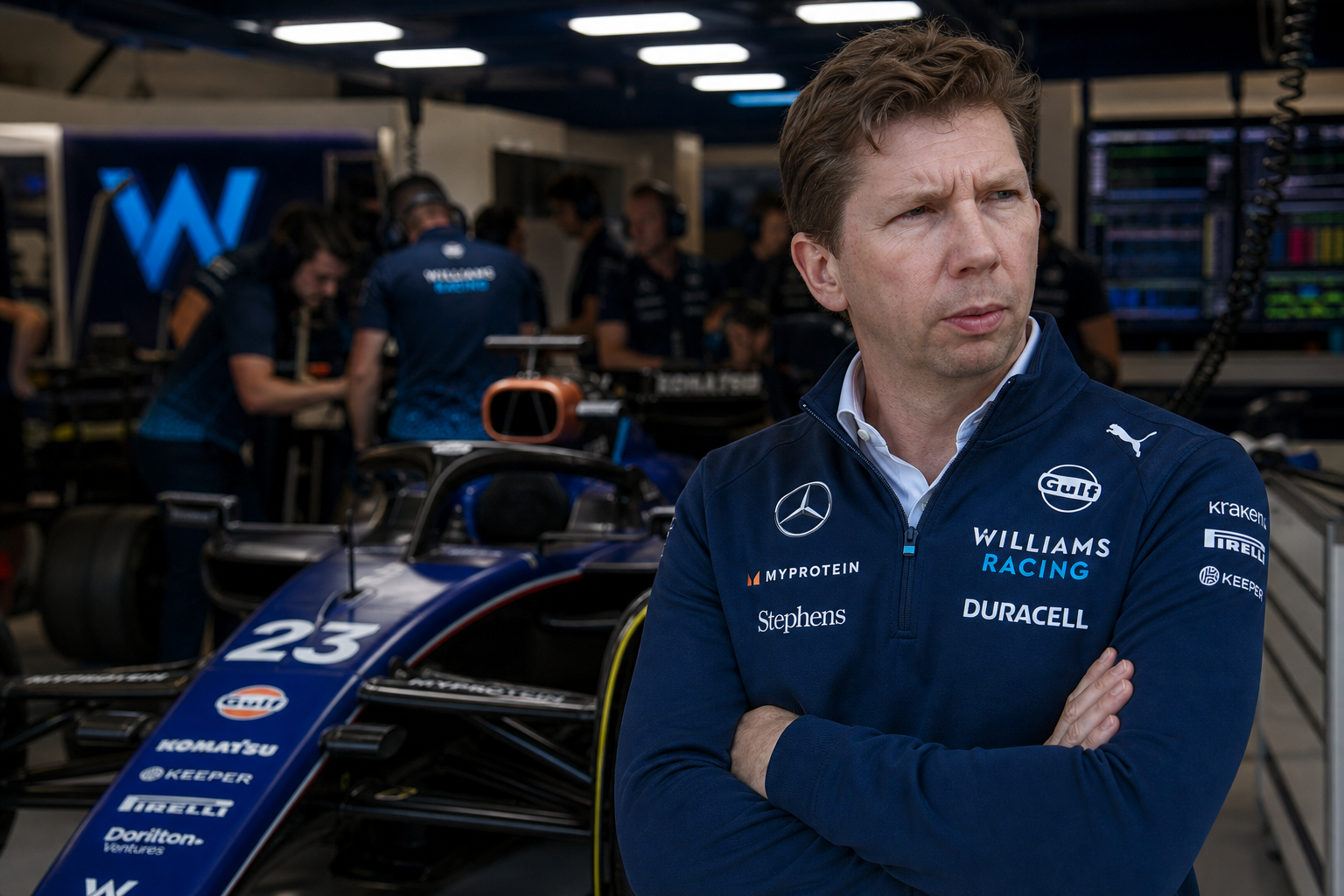

Williams has discovered, once again, that Formula 1 has very little patience for promises, brave faces, or carefully worded optimism. Team principal James Vowles has admitted the car’s remaining 2026 upgrades are unlikely to be enough to turn the Grove squad into a regular points contender. In other words: the stopwatch remains unimpressed.
The problem did not exactly arrive out of nowhere. Williams came to pre-season testing in Bahrain carrying an overweight car, which is never the sort of headline you want attached to a new campaign. Since then, the team has managed just 11 points across the opening 14 rounds. That is not the sort of tally that keeps the champagne industry busy.
A Season That Started on the Back Foot
In Formula 1, being overweight at the start of a season is a bit like turning up to a marathon in hiking boots and then wondering why everyone else looks happier. Every kilogram matters. A heavier car is harder on tires, slower in a straight line, less eager in the corners, and generally more tiresome to wrestle into a useful lap time. When a team begins from that position, it spends the rest of the year clawing back ground it should have owned in March.
That is the context behind Vowles’ blunt assessment. Williams may still have development parts to bring, but the team boss has made it clear that those updates will not magically transform the car into a dependable points machine. That kind of honesty is refreshing, if not exactly cheerful. Formula 1 does not reward wishful thinking. It rewards efficiency, consistency, and the ability to shave milliseconds while everyone else is doing exactly the same thing.
Why Weight Is Such a Pain in Formula 1
The modern F1 car already operates at a brutally tight technical limit. Once you begin a season with an overweight chassis, you are forced into a miserable balancing act. Engineers can trim grams here and there, revise bodywork, and adjust components, but those gains are usually expensive and slow to arrive. Meanwhile, the rest of the field is building pace on top of a cleaner starting point.
That is what makes Williams’ situation so awkward. If the car is structurally off the mark from the outset, upgrades can help, but only to a point. You can improve aerodynamic load, tweak cooling, or recover a bit of performance through revised parts. What you cannot do is simply wish away an inefficient baseline. The calendar is already half gone, and the points table is rarely in a forgiving mood.
Vowles’ Reality Check
Vowles speaking so plainly is telling in itself. Team principals often talk in the language of progress, data correlation, and long-term direction, which is usually code for “please stop asking whether this car is any good.” Here, the message is sharper. Williams has upgrades coming, yes, but they are not enough to consistently fight for points on their own. The implication is obvious: the team needs more than patch-up work. It needs a fundamentally better package.
That is not a small admission for a team with Williams’ history. This is a name that carries enormous weight in Formula 1, even if recent seasons have been a grind. The outfit has been rebuilding for years, and Vowles was brought in to impose some sense, some discipline, and ideally some pace. But Formula 1 has a habit of reminding even well-run teams that good intentions do not count in qualifying.
What the Remaining Upgrades Can — and Cannot — Do
There is still value in development, of course. Even a troubled car can be made better. Williams’ remaining updates may improve the car’s consistency over a stint, sharpen its balance, or help the drivers extract more from the package on certain circuits. A few extra hundredths here and there can be the difference between starting 15th and 12th, which in midfield Formula 1 is a very big deal indeed.
But “better” is not the same as “competitive.” That is the distinction Vowles seems to be drawing. If the car remains too heavy, too inefficient, or too compromised in its overall concept, upgrades can only trim the edges. They are not a resurrection. And when the midfield is as tightly packed as it is, a small deficiency tends to look much larger than it did in the wind tunnel. Very rude of it, really.
The Bigger Problem for Williams
The more worrying part is what this says about the car’s starting point. Teams can usually recover from a poor race weekend. Recovering from a flawed launch specification is harder. Once a season has begun with a performance deficit, every update has to do double duty: improve the current car while also feeding lessons into next year’s design. That makes the margins even narrower and the consequences even harsher.
For Williams, the challenge now is not merely to salvage the occasional strong result. It is to avoid wasting a development cycle on a car that was compromised before it ever turned a wheel in anger. That is where a team’s engineering discipline really gets exposed. Anyone can promise progress. The difficult bit is building a car that doesn’t start the year carrying extra baggage like an airport traveler with an alarming number of checked bags.
What It Means for the Rest of 2026
With 11 points from 14 rounds, Williams’ season is already telling a story it would probably rather not publish. The remaining upgrades may narrow the gap, but Vowles’ comments suggest the team is unlikely to turn them into a late-season surge for consistent top-10 finishes. At best, the updates may help Williams become more competitive on certain weekends or track layouts.
That may sound modest, but in Formula 1 modest gains can still be worth chasing. The midfield is where reputations are built and budgets are justified, and every point can shape the mood in the factory. Williams does not need miracles. It needs a car that behaves like a proper Formula 1 machine from the first lap of testing, not one requiring a string of fixes and a prayer.
For now, Vowles has done the sensible thing and said the quiet part out loud: the rest of the 2026 upgrade path can improve Williams, but it will not be enough to solve the season on its own. That is not a glamorous message. Then again, Formula 1 has never been especially kind to glamour when the scales and the stopwatch are involved.


0 Comments