
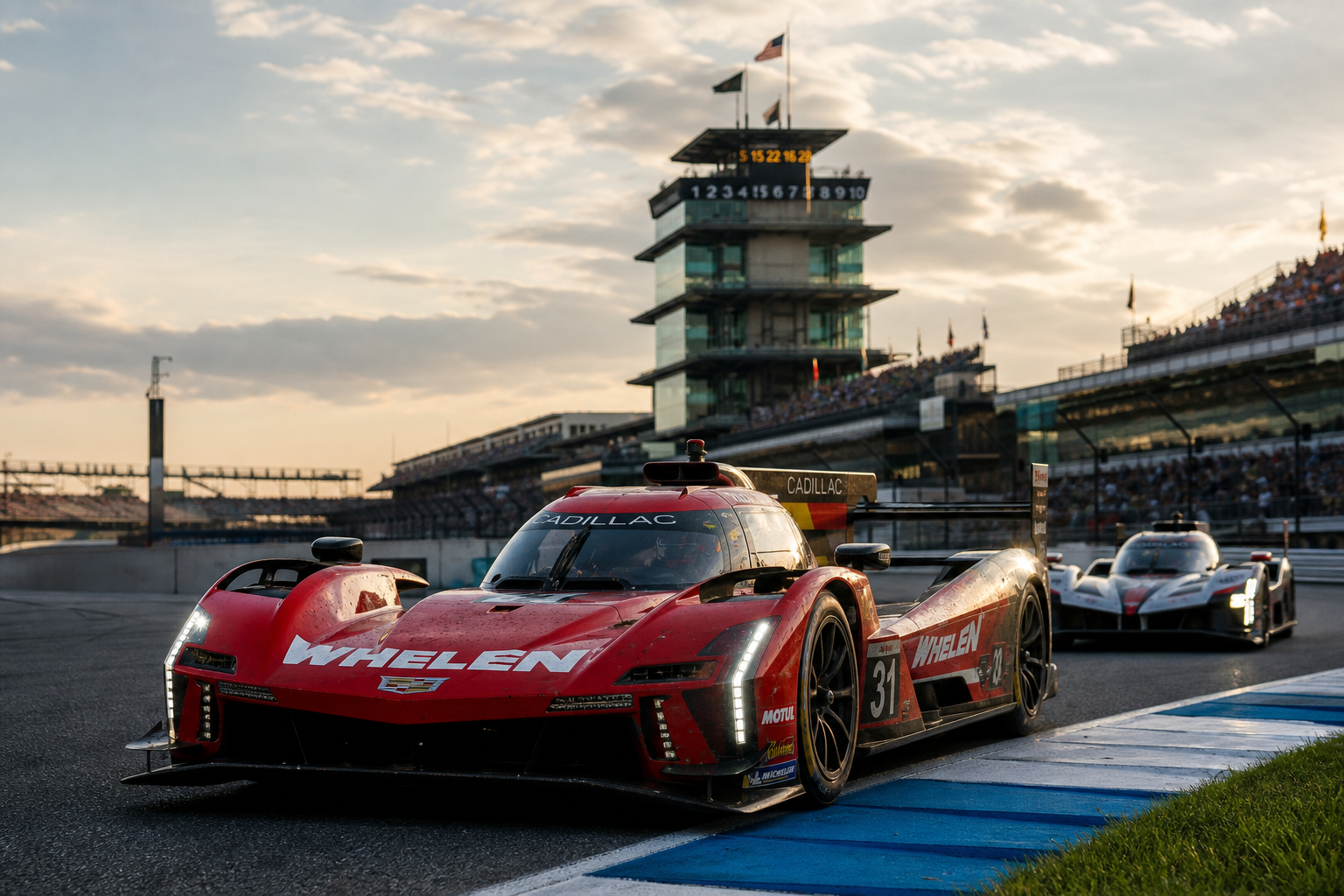

Five minutes from the checkered flag, the #31 Whelen Cadillac V-Series.R appeared to have the Battle on the Bricks under control. Then victory wandered off into the Indiana sunset.
Earl Bamber lost the lead with just over five minutes remaining at Indianapolis Motor Speedway, leaving the Cadillac team to settle for second place on the track’s 2.439-mile, 14-turn road course. It was an irritating way to finish a race that had offered the #31 crew a genuine shot at victory, but the runner-up result still delivered the more important prize for Jack Aitken: a substantial extension of his IMSA championship lead.
A Victory Lost, a Championship Position Strengthened
The Indianapolis result leaves Aitken 147 points clear in the IMSA standings. That is a formidable margin, particularly at a stage of the season when a driver can easily lose ground through a poor finish, contact, a mechanical problem, or one of the many other ways an endurance race can turn a perfectly sensible Sunday into a traveling circus.
Second place may sound slightly underwhelming when a win was within reach, especially after Bamber held the lead so late in the race. In championship terms, however, the result was highly productive. The #31 Cadillac V-Series.R brought home a major haul of points without suffering the sort of collapse that can transform a title campaign overnight.
That is the slightly cruel arithmetic of sports-car racing. A team can spend most of a race chasing the win, lose it in the final minutes, and still leave the circuit better positioned than many of its rivals. The trophy cabinet may prefer first place, but the points table has no feelings.
The Cruel Timing of Indianapolis
Indianapolis is not the sort of circuit that allows a late mistake to hide. The road course uses part of the famous oval while adding a tightly wound infield section, creating a lap that demands both outright speed and precision. Its 14 corners punish a car that cannot brake consistently, rotate cleanly, or protect its tires through a long stint.
The race’s final moments made that challenge particularly unforgiving for the Cadillac crew. With Bamber leading and only a little more than five minutes remaining, the team was close enough to victory to begin imagining the flag. Instead, the lead changed hands before the race was over.
There is no comfortable way to lose a race that late. A second-place finish secured from the start would feel useful. A second-place finish after surrendering the lead near the end feels like someone has removed the last slice of pie while you were reaching for a fork.
Still, the #31 Whelen entry did exactly what a championship contender needs to do when the win disappears: it finished near the front and avoided turning disappointment into damage. That distinction matters over a full IMSA season, where consistency is rarely glamorous but is frequently decisive.
Why the Cadillac V-Series.R Remains Central to the Story
The result also keeps Cadillac’s V-Series.R firmly in the conversation at the sharp end of IMSA’s top class. The prototype was capable of leading late at one of America’s most recognizable racing venues, which says plenty about the team’s pace and race execution even if the final result did not deliver the headline victory.
Prototype endurance racing is an awkward blend of speed, strategy, traffic management, tire conservation, pit work, and mechanical sympathy. A car can be fast enough to lead yet still lose the race through a small strategic compromise or a late change in track position. The winning margin is often less about one spectacular moment than about avoiding several ordinary problems in succession.
That makes the Indianapolis runner-up finish more useful than a simple “almost won” summary suggests. The #31 Cadillac was in contention when it counted, had the pace to hold the lead deep into the race, and emerged with Aitken’s championship advantage intact and enlarged.
Aitken’s Position Gives the Team Room to Think
A 147-point lead changes the way a championship contender can approach the races ahead. It does not make the remaining events irrelevant, and it certainly does not excuse complacency. IMSA races are too unpredictable for that sort of luxury. But it does provide breathing room.
The team can continue pursuing wins without treating every missed opportunity as a catastrophe. That is important because the Indianapolis finish could easily have become a psychological setback. Losing a lead with five minutes remaining is precisely the kind of result that can linger in a garage, particularly when victory seemed close enough to touch.
Instead, the points situation offers a constructive way to view the weekend. The Cadillac crew did not get everything it wanted, but Aitken’s title campaign moved forward. The championship margin now gives the team a valuable buffer against the inevitable rough afternoon.
There is also a practical benefit. A strong points lead allows a team to prioritize clean finishes when circumstances become messy. That does not mean driving conservatively from the opening lap; no top-level prototype team builds a race plan around merely surviving. It does mean recognizing when a second-place result is the sensible reward for a difficult situation rather than throwing away points in pursuit of a win that has already become unlikely.
The Indianapolis Result in Perspective
The emotional reading of the Battle on the Bricks is obvious: Cadillac had victory in hand late and watched it slip away. The championship reading is rather different. Aitken’s lead now stands at 147 points, and the #31 Whelen Cadillac V-Series.R remains a serious force at the front of the field.
That combination is why the result should not be filed under “missed opportunity” and forgotten. The team will quite reasonably focus on the lost win, because racers are not wired to celebrate second place when first was available. But a title is built from the finishes a driver collects after the perfect result has vanished.
At Indianapolis, Aitken and the #31 crew collected one of those finishes. It was frustrating, untidy, and probably not what anyone wanted when Bamber led inside the final five minutes. It was also extremely valuable. In a championship campaign, that is the sort of consolation prize that can become the main prize later.

0 Comments