
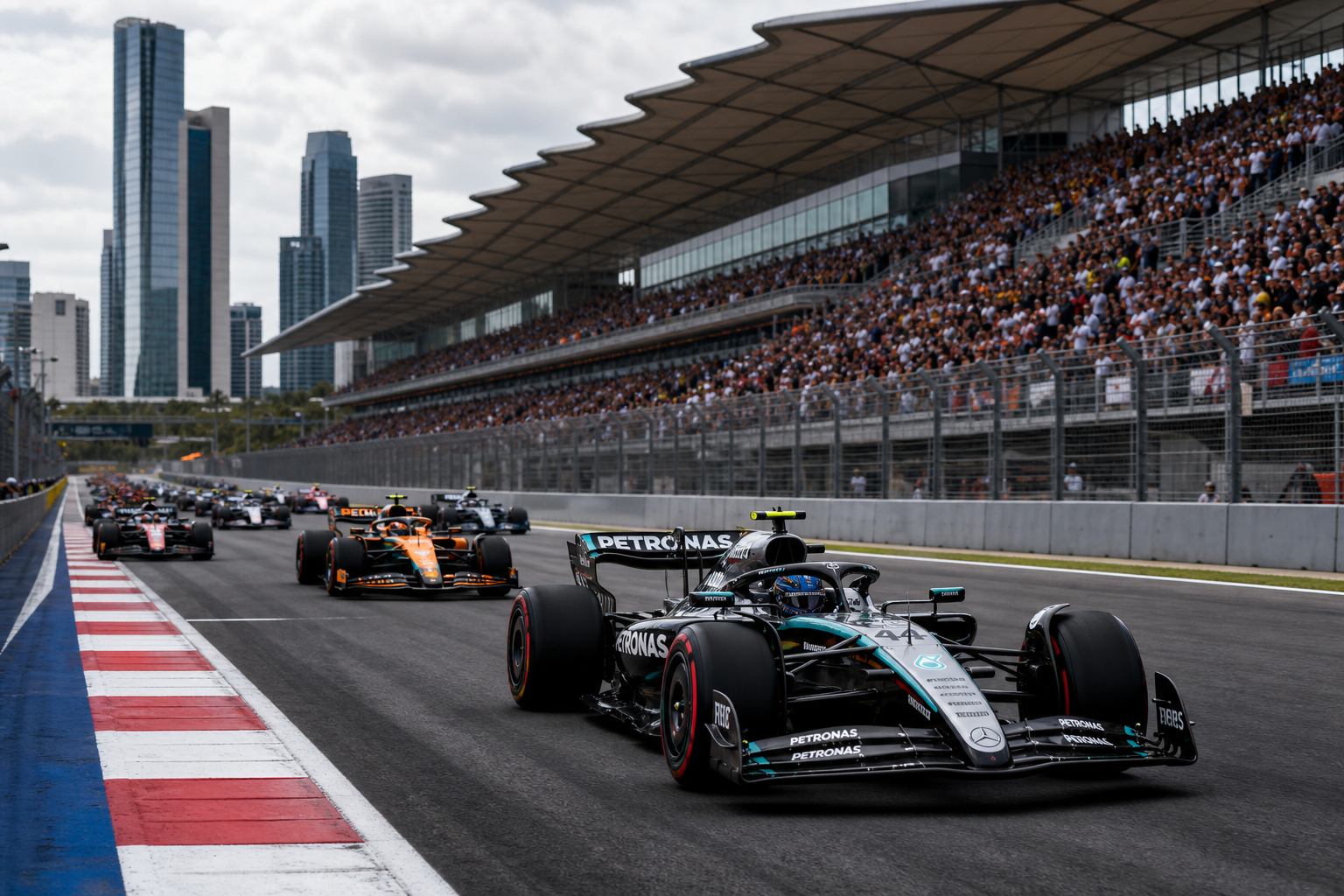

The first Spanish Grand Prix at Madrid’s Madring circuit produced the sort of Formula 1 spectacle that makes viewers wonder whether the television feed has frozen. Kimi Antonelli took victory, but the race itself drew broad criticism from drivers, fans and pundits after offering virtually no meaningful overtaking.
Former Haas team principal Guenther Steiner now believes the circuit’s organizers have a limited window to respond. His warning is blunt: Madring’s layout needs urgent attention before the 2027 Spanish Grand Prix, or the event risks becoming known for the wrong reason.
A New Grand Prix With an Old Problem
Formula 1’s modern cars are extraordinarily fast, technically complex and capable of producing spectacular qualifying laps. Racing them closely, however, remains an entirely different challenge. When the track does not provide enough opportunities to attack, the machinery’s sophistication becomes almost irrelevant once the lights go out.
That was the central complaint surrounding Madring’s inaugural race. The circuit hosted its first Spanish Grand Prix in 2026, yet the event reportedly settled into a procession rather than a genuine contest. Cars circulated in order, overtaking was scarce, and the race struggled to deliver the wheel-to-wheel action that promoters naturally promise when selling a new Grand Prix.
There is an especially awkward irony in that outcome. A new circuit arrives with a clean sheet of paper, ample opportunity to design decisive corners and carefully considered overtaking zones, and years of modern simulation tools available to its engineers. If the racing still becomes a queue with expensive carbon-fiber bodywork, fans are entitled to ask what happened during the planning meetings.
Why Steiner Is Drawing a Line Under 2026
Steiner’s comparison with the backlash surrounding the Las Vegas Grand Prix debut is significant. Las Vegas also arrived under intense scrutiny, carrying enormous promotional expectations and the burden of proving that Formula 1 could create a compelling event in a new American market. The comparison suggests that Steiner sees Madring’s first race as a difficult opening act rather than a problem that should be ignored.
That distinction matters. A debut can be forgiven for being imperfect. A second event that repeats the same mistakes becomes evidence that the organizers were not listening.
Formula 1 rarely gets unlimited patience from its audience. Spectators will tolerate a new venue finding its feet, particularly when the event has atmosphere and the surrounding spectacle feels fresh. They are less generous when the actual race offers little beyond tire management and strategic shuffling. The cars may be operating at the edge of adhesion, but viewers cannot see that from the grandstand. They see one car following another.
The Layout Is the Story
Steiner’s call for changes is not a demand for artificial entertainment. Adding a gimmicky passing zone or a clumsy extra chicane would merely move the problem around. A successful revision would need to create genuine differences in speed, braking and line choice.
That usually means giving drivers a reason to attack and the following car a realistic way to complete the move. A long enough approach into a heavy-braking corner can help. So can a sequence that rewards a driver for positioning the car properly through the preceding turn. A straightaway on its own is not magic; the corner before it determines whether a driver can get close enough to use it.
Track width also matters. A circuit can have a theoretically fast section and still produce no overtaking if the cars arrive at the braking zone nose-to-tail with nowhere to run. Modern Formula 1 cars are broad, and their aerodynamic performance can punish a driver who follows too closely through a fast corner. The layout must account for that reality rather than relying on a diagram that looks promising from above.
There is a delicate balance here. Too many slow corners can make a lap feel contrived, while an uninterrupted sequence of high-speed bends may produce wonderful qualifying laps but little racing. The best circuits force drivers to make compromises: sacrifice one corner to attack at the next, protect the inside line, or accept a poor exit in exchange for track position. That is the sort of challenge Madring will need to provide if its second Spanish Grand Prix is to feel meaningfully different.
Why Processional Racing Hurts a New Event
An established circuit can sometimes survive a dull race because its identity exists beyond a single Sunday. Historic corners, familiar rivalries and decades of accumulated memories give fans something to hold on to. A new venue has none of that inherited goodwill.
Madrid’s circuit therefore has to build its reputation quickly. If the first race is remembered primarily for a lack of overtaking, that description becomes difficult to dislodge. Every future procession will be treated as confirmation. Every strategic race with limited passing will revive the same criticism. Motorsport fans have long memories, particularly when a new track has been sold as a major addition to the calendar.
There is also a financial dimension, even if no figures are attached to the criticism. Grand Prix organizers need spectators to return, broadcasters need a compelling product, and sponsors need more than picturesque shots of cars circulating in formation. A flat race can damage interest far beyond the circuit gates. Television audiences do not tune in to admire the architectural merit of a runoff area.
2027 Becomes a Test of Intent
The demand for changes before 2027 gives Madring’s organizers a clear choice. They can treat the first race as an unfortunate one-off and defend the circuit, or they can accept that the racing exposed a design weakness and make targeted revisions.
That does not necessarily mean rebuilding the entire venue. A revised corner sequence, a modified approach to a braking zone or a change to the available racing line could have a substantial effect. But any work must be based on what the cars and drivers actually experienced during the inaugural event, not on promotional renderings or optimistic computer models.
Steiner’s warning is useful precisely because it cuts through the usual language surrounding new races. There is no need to pretend that every fresh venue is instantly perfect. Circuits are engineering projects, and engineering projects can be corrected. The important question is whether the people responsible are willing to admit when the first version did not work.
Madrid has another chance in 2027. The first Spanish Grand Prix at Madring provided a winner, but apparently not enough of a race. Unless the layout gives drivers more opportunities to fight, the circuit may discover that Formula 1 fans are quite happy to visit a new place once. Convincing them to come back is the harder trick.


0 Comments