
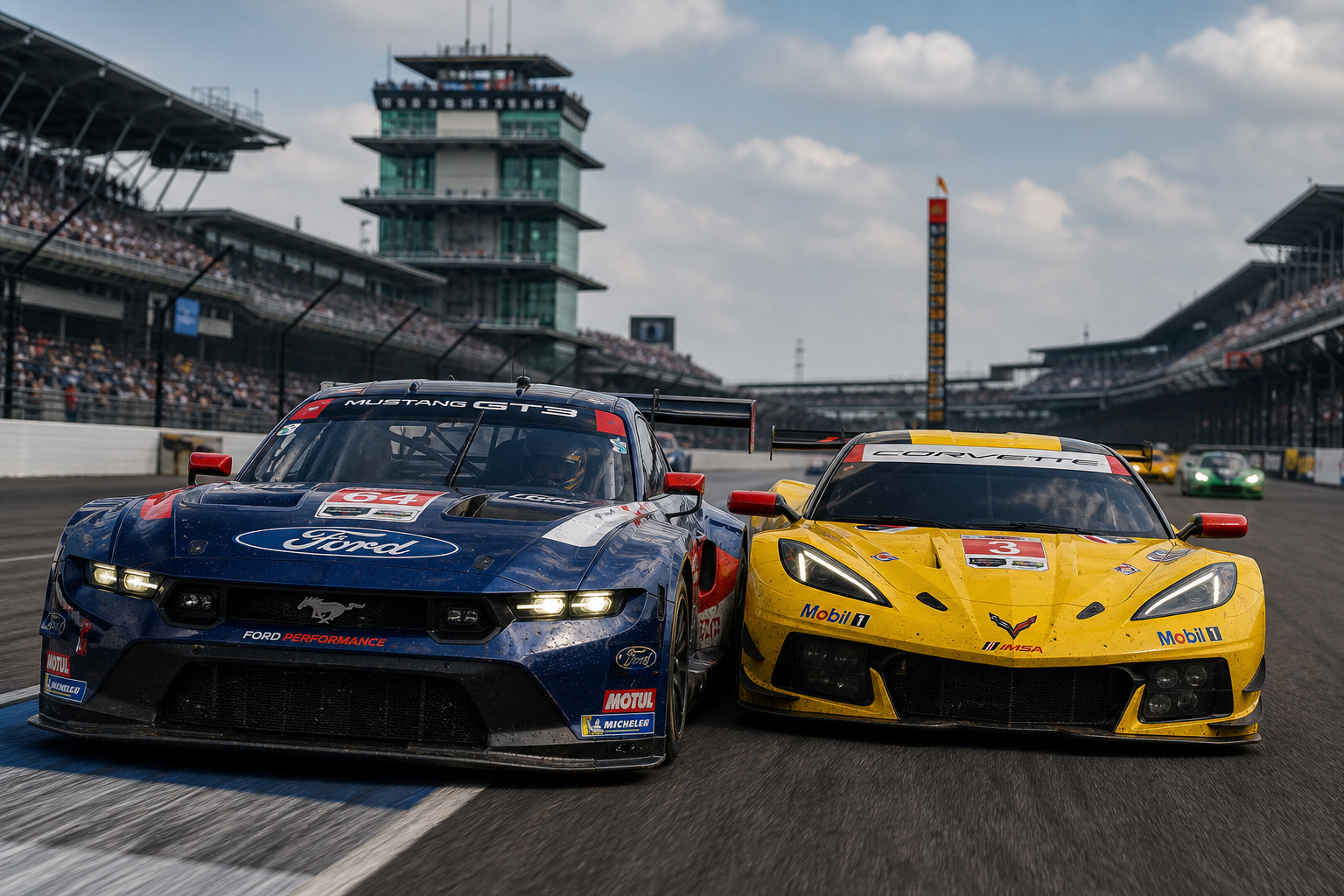

Ford’s first IMSA WeatherTech SportsCar Championship GTD Pro victory of the season arrived with all the subtlety of a shopping cart launched down a hill. Dennis Olsen and Ben Barker took the No. 64 Ford Racing Mustang GT3 to victory at Indianapolis Motor Speedway after a final-lap fight with Chevrolet’s Corvette that turned the closing moments into a proper American manufacturer grudge match.
The Battle on the Bricks was decided over the final 2.439 miles of the Indianapolis road course, a 14-turn layout that gives GT3 machinery plenty of opportunities to run out of grip, patience, or both. This time, Ford had just enough of everything left when it mattered.
A Victory That Came Down to the Final Lap
Endurance racing often rewards restraint. Drivers manage tires, fuel, traffic, brakes, and the general mechanical misery inflicted by several hours of competition. Then, occasionally, all that careful planning is reduced to one lap in which two cars occupy the same piece of asphalt and neither is especially interested in giving it up.
That was the shape of the GTD Pro finish at Indianapolis. Olsen, at the wheel of the No. 64 Ford Racing Ford Mustang GT3, and Barker shared the car’s winning drive. The Mustang reached the closing lap in contention with a Corvette, producing a tense battle between two of the most recognizable performance names in American racing.
The finish was described as wheel-banging, which is racing’s polite way of saying that the cars were not merely exchanging aerodynamic data. On a circuit with long straights, heavy braking zones, and several corners that punish a driver who arrives with too much optimism, the final lap left very little room for negotiation.
Ford ultimately came out on top. The result gave the Mustang GT3 its first GTD Pro win of the season and delivered Ford Racing a victory at one of the most famous venues in North American motorsport.
Why the Indianapolis Road Course Makes a Good Battleground
Indianapolis is best known for the enormous oval, but the road course used by IMSA asks a rather different set of questions. The 2.439-mile layout includes 14 turns and combines slower technical sections with faster passages where a GT3 car can stretch its legs. It is not a simple matter of pointing a car down a straight and hoping the engine handles the rest.
Drivers need a car that can brake repeatedly, change direction cleanly, put power down without wasting the rear tires, and remain predictable when the rubber begins to fade. That last part is especially important in a multi-driver endurance race. A car that feels magnificent for three laps but becomes awkward after a long stint is not a winner; it is an expensive way of entertaining the pit wall.
The track also makes traffic management significant. GTD Pro cars share the circuit with other classes, meaning a driver must judge closing speeds and positioning while fighting cars with different performance characteristics. A pass that looks straightforward from a television camera can become considerably less tidy when another class appears at precisely the wrong moment. Racing, as ever, is mostly the art of avoiding other people’s plans.
The Mustang GT3’s Role in Ford’s IMSA Program
The Mustang GT3 is Ford’s purpose-built GT3 racer, developed from the Mustang family but engineered for international sports-car competition rather than road use. That distinction matters. A GT3 car may carry familiar styling cues, but underneath the bodywork it is a serious racing machine shaped by aerodynamic, tire, braking, and balance-of-performance requirements.
In IMSA’s GTD Pro class, the Mustang competes against other manufacturer-backed GT3 entries. The category is intended for professional driver lineups and factory-supported programs, making it a useful arena for manufacturers that want to demonstrate the capability of a competition car without entering a prototype-style contest.
Ford’s choice of the Mustang as its GT3 foundation is hardly mysterious. The name already carries enormous weight in American performance culture, and the Mustang has a long history of racing in forms ranging from grassroots track cars to major professional championships. The GT3 program gives that badge a modern international stage, where speed must be converted into results rather than merely displayed in a promotional video accompanied by dramatic music.
The Indianapolis victory is therefore useful beyond the single result. It provides Ford with a tangible return from the GT3 program during the current season and gives the No. 64 crew a race they will remember for reasons considerably better than a suspicious noise from the rear axle.
Olsen and Barker Delivered When the Margin Disappeared
Endurance racing is built around teamwork, but a finish like this places enormous pressure on the driver in the car at the end. Dennis Olsen and Ben Barker shared the winning Ford, with Olsen handling the Mustang during the decisive closing battle.
That final stint requires more than outright speed. The driver must understand how much tire remains, where the car is strongest under braking, and how aggressively the opponent is willing to defend. A GT3 fight can change several times in a single lap because the cars are closely matched and the performance envelope is narrow. One driver may gain a few feet through a corner, only to lose them on the following straight.
When contact enters the picture, the risks rise quickly. GT3 cars are robust, but they are still precision tools carrying complex aerodynamic and mechanical hardware. A nudge in the wrong place can damage a body panel, disturb airflow, or send both cars toward an unpleasant meeting with the tire barrier. Olsen’s job was to remain aggressive without allowing the fight to become self-defeating.
He and Barker got the important part right: the Ford reached the checkered flag first.
A Familiar American Rivalry in a Modern Racing Format
Ford versus Corvette has been a recurring theme in American road racing for decades, although the machinery and regulations have changed repeatedly. The latest version is not a simple showroom comparison. The Mustang GT3 and Corvette GT3 are purpose-built race cars, and their performance is shaped by technical rules designed to keep different vehicles competitive.
That does not make the rivalry meaningless. Quite the opposite. Manufacturers still care deeply about winning against a recognizable opponent, particularly when both cars represent major performance brands with loyal followings. A victory over another marque is useful marketing, but it is also a test of engineering execution, driver performance, pit strategy, and reliability over a full race distance.
Indianapolis added some extra theater because the result was not settled comfortably in the final hour. Ford did not simply cruise away while the Corvette disappeared into the scenery. The two manufacturers remained locked together until the closing lap, creating precisely the sort of finish that makes sports-car racing addictive and slightly bad for one’s blood pressure.
What the Win Means for Ford Racing
One victory does not transform a championship campaign, and it would be foolish to treat a single result as proof that every question surrounding a racing program has been answered. GT3 competition is too close and too dependent on execution for that sort of certainty.
Still, a first win of the season carries real value. It confirms that Ford’s Mustang GT3 program can convert a competitive car into a race-winning result when the opportunity appears. It also provides momentum for the team, especially after a finish that demanded composure under direct pressure from a major rival.
For the drivers, the Indianapolis result is the sort of victory that feels earned rather than inherited. The margin was not created by a quiet afternoon at the front. It was forged during a final-lap contest on a circuit that offered both cars opportunities to attack and very little spare room for mistakes.
The Mustang GT3 now has a season victory to its name, Ford has a trophy from Indianapolis, and the Corvette leaves knowing it was beaten only after the fight had become thoroughly untidy. That is a respectable way to win a race, provided nobody asks the bodywork department how their afternoon went.


0 Comments