
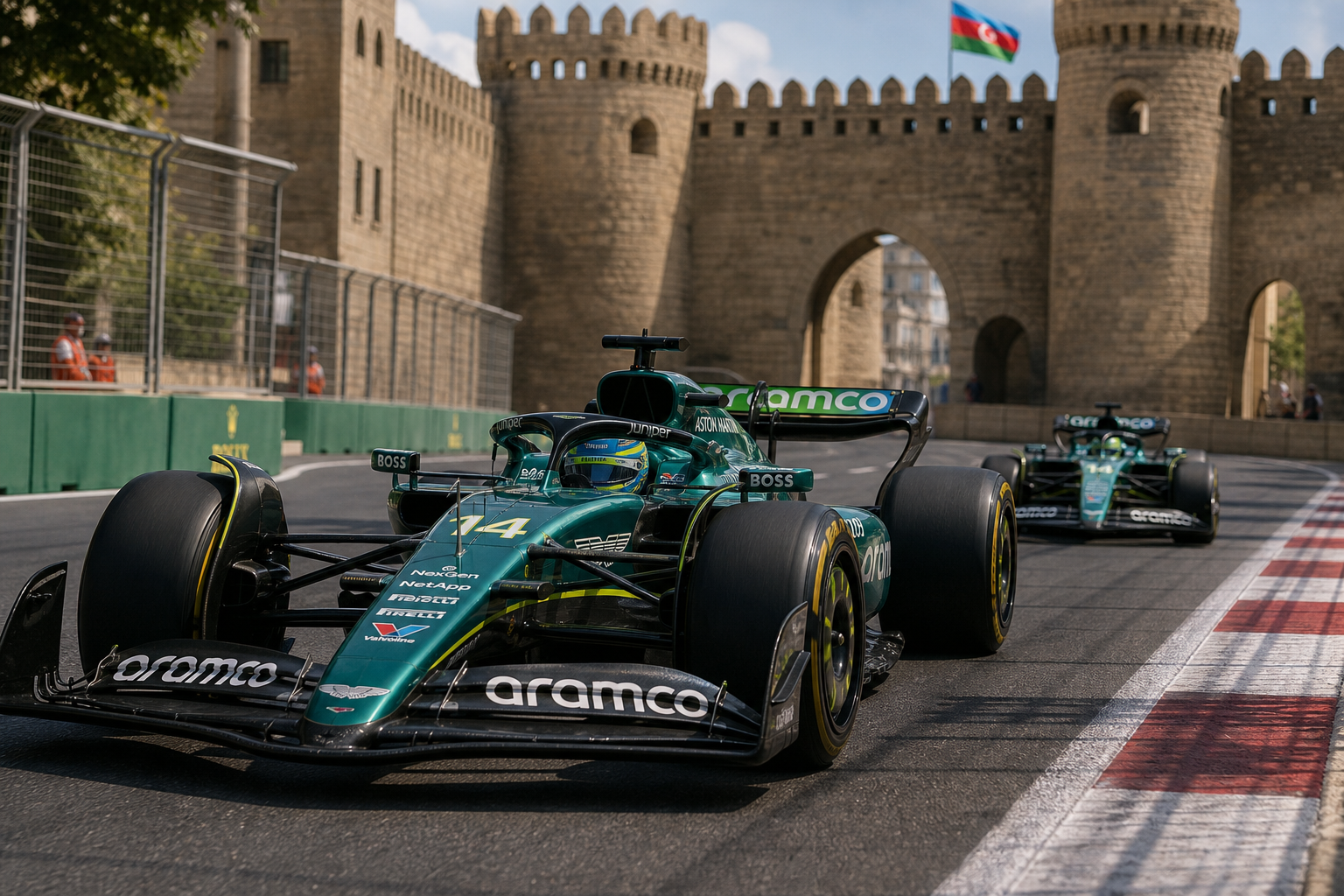

Aston Martin’s Azerbaijan Grand Prix weekend has become a recovery exercise before the cars have even reached the race. Fernando Alonso and Lance Stroll will start from the back of the grid after Aston Martin fitted new Honda power unit components to both cars, triggering further Formula 1 penalties.
It is the sort of punishment that makes a bad reliability story considerably more expensive. Replacing a component may give a car a better chance of reaching the finish, but doing so after a driver has exhausted—or is already struggling to remain within—the season’s allocation brings a grid drop with it. In Baku, where track position and clean air can be unusually valuable, that is hardly a minor inconvenience.
Aston Martin Has Run Out of Easy Choices
Formula 1’s power unit rules limit how many major engine components each driver can use during a season without receiving a sporting penalty. The allowance is deliberately tight, forcing teams to manage performance and durability over an entire campaign rather than simply bolting in fresh hardware whenever an engine begins to look slightly weary.
Aston Martin has already been forced to make changes beyond that allowance. Alonso and Stroll had suffered grid drops earlier in the season, with Honda’s reliability problems making it increasingly difficult for either driver to finish the year using only the permitted number of power unit components.
The Azerbaijan penalties are therefore not an isolated strategic gamble. They are the latest bill arriving from a problem that has been accumulating in the background. Once a driver has used up the available allocation, the team faces an unpleasant choice: accept a penalty and install newer hardware, or preserve the old component and risk a failure during a race weekend. Neither option belongs in anyone’s definition of a relaxing Sunday afternoon.
Why the Penalty Hurts in Baku
Starting at the back is damaging at any Formula 1 circuit, but Baku has a particularly awkward personality. Its long straights can create overtaking opportunities, yet the race also winds through a narrow section of the old city where following another car closely is difficult. A driver can gain positions with a strong car and a well-timed strategy, but climbing through the field is hardly automatic.
The track’s layout also makes qualifying especially important. The long run toward the finish line can produce a sizeable slipstream effect, while the tight corners punish cars that cannot place themselves accurately. Starting behind the field means Alonso and Stroll will have to deal with traffic, compromised tire management, and the possibility that rivals ahead can dictate the pace through the early stages.
There is a potential benefit to starting from the rear: the team can choose a fresh component without sacrificing an already strong qualifying position. That is useful only in the most technical sense. A penalty can convert a new power unit into a long-term investment, but it does not make the lost grid positions disappear. It merely changes the calculation from “how much will this cost today?” to “how much worse might the alternative be later?”
Honda’s Reliability Problem Has Sporting Consequences
Power unit reliability is often discussed as though it were an engineering issue confined to the garage. In Formula 1, it quickly becomes a sporting issue as well. A failure can cost points, disrupt a driver’s rhythm, force a change of setup, and eventually produce grid penalties when the team needs to install additional components.
That chain is especially painful for a team such as Aston Martin, where the drivers cannot simply treat every penalty as an opportunity to charge through the field. The car’s competitiveness, its qualifying position, and the behavior of the tires all determine whether a back-row start can be turned into a respectable result. A faster engine may help on Baku’s straights, but it cannot erase the time lost behind slower traffic or the risk of getting trapped in a train of cars.
The new Honda components should, in theory, give Aston Martin greater confidence in completing the weekend. That is the immediate engineering priority. But the team will also need to understand why the original allocation has become unsustainable and whether the replacement hardware offers a genuine durability improvement or simply resets the clock for a while.
Alonso and Stroll Face the Same Penalty, Not the Same Weekend
Both Aston Martin drivers will start from the back, but their races may unfold rather differently. Alonso’s experience in managing changing race conditions and extracting opportunities from chaotic events could be valuable in Baku. He has built much of his modern reputation on turning messy weekends into points-scoring afternoons, usually while looking as though he has been handed a puzzle with several pieces missing.
Stroll, meanwhile, will need a clean qualifying and race-weekend execution from the team around him. Starting at the rear leaves little margin for a slow pit stop, a poorly timed safety car call, or an early incident. When a driver begins near the front, a small strategic error may cost a few places. From the back, the same mistake can bury the entire race.
The penalty also complicates the usual compromise between qualifying and race setup. Aston Martin can prioritize a configuration aimed at long-run pace and overtaking, knowing that neither car needs to protect a strong starting position. That may be sensible, but it also means the team must be careful not to sacrifice too much performance in the slower, more technical sections of the circuit. Baku rewards speed in a straight line, but it is not merely a drag strip with some decorative masonry.
The Cost of Chasing Reliability
For Honda and Aston Martin, the immediate objective is straightforward: finish the Azerbaijan Grand Prix without another power unit setback. The wider concern is the effect of repeated component changes on the team’s season-long competitiveness.
Every additional penalty creates a strategic tax. Drivers begin races in traffic, the team must plan around compromised track position, and the race can become dependent on incidents elsewhere rather than outright pace. It also places more pressure on the remaining components in the pool. If the new units are used conservatively, the team may protect them for later events. If they are pushed hard to recover positions in Baku, the reliability problem could simply reappear wearing a different hat.
There is no clever headline-friendly solution here. Aston Martin cannot undo the penalties, and the drivers cannot qualify their way out of them. The team’s best route is to turn the enforced component changes into a reliability reset, maximize race pace, and hope Baku supplies the sort of disorder that occasionally makes a back-row start less terminal than it looks.
That is a thin silver lining, admittedly. Alonso and Stroll are not heading to Azerbaijan with a free strategic advantage; they are arriving with the consequences of Honda’s power unit troubles already attached to their weekend. If the replacements work properly, the damage may be contained. If they do not, Aston Martin’s engine allocation will remain the most important part of the race—and the least welcome one.

0 Comments