
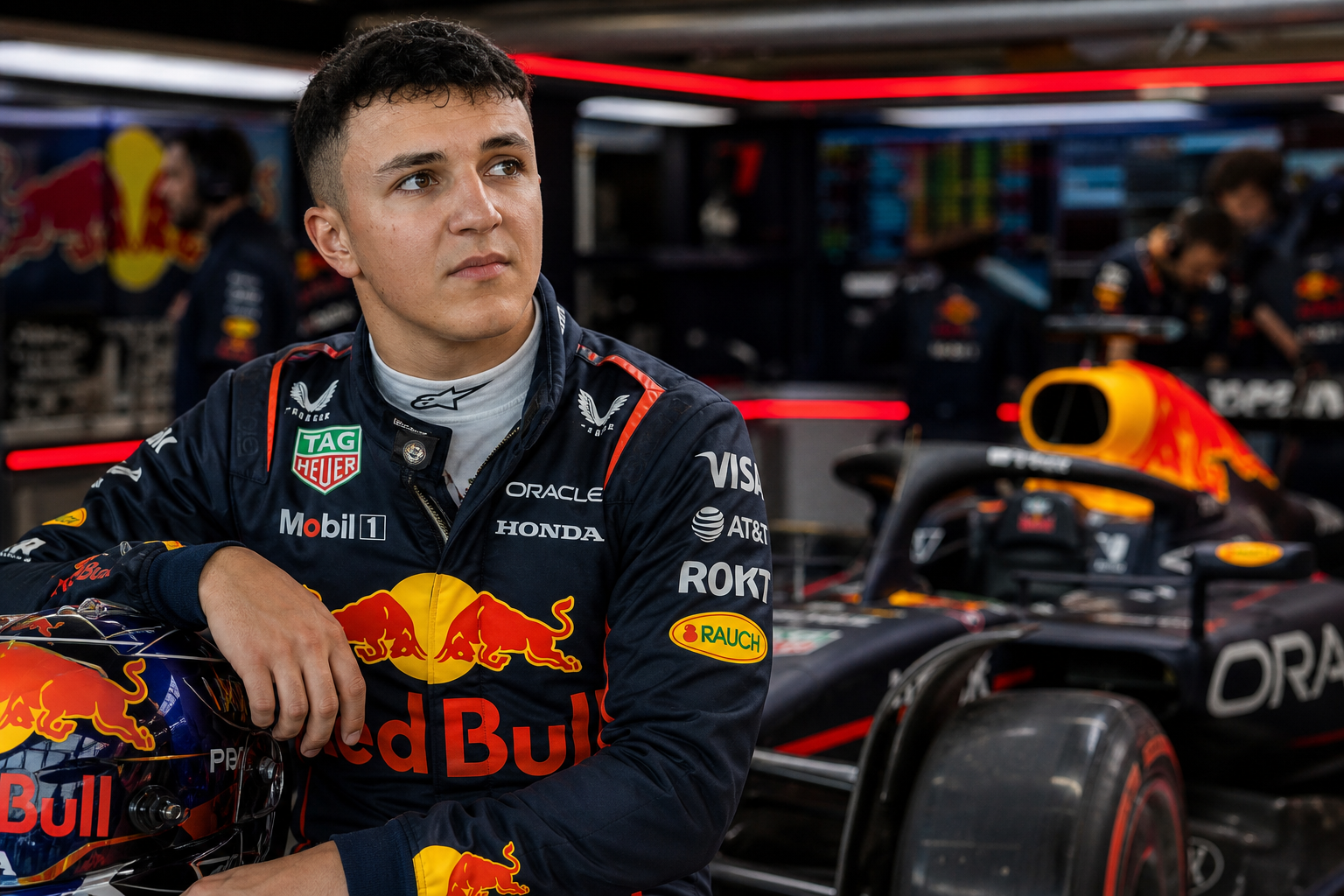

Red Bull has answered one question about its 2027 driver lineup, and Formula 1 fans appear broadly pleased with the answer: Isack Hadjar will remain alongside four-time world champion Max Verstappen.
The team confirmed the extension on September 23, shortly before Hadjar was due to return at the Azerbaijan Grand Prix. That timing gave the announcement an extra layer of interest. Hadjar had missed three Grand Prix weekends after suffering a wrist injury, so his future was being discussed at the same time as his return to competition.
Red Bull’s decision is therefore about more than filling a seat on a distant entry list. It is a vote of confidence in a young driver who has already had to manage the awkward combination of expectation, absence, and a teammate whose standard of performance is rather less forgiving than the average measuring stick.
Red Bull Keeps Its 2027 Pairing Intact
The central fact is straightforward: Hadjar will continue with Red Bull for the 2027 season, remaining alongside Verstappen. The announcement does not provide details about the contract’s length beyond that season, financial terms, performance clauses, or any future options. Those details matter in Formula 1, where contracts can sometimes resemble legal puzzles designed by people who dislike simple sentences, but the immediate message is clear enough.
Red Bull wants continuity.
That is notable because the team’s driver situation has often attracted intense attention. A seat next to Verstappen is not an ordinary assignment. It places a driver in the same garage as one of the most successful competitors of his generation, with every qualifying session and race weekend inviting direct comparison. Even a strong performance can look modest beside a driver who has spent years operating at the sharp end of the championship.
Keeping Hadjar suggests Red Bull believes the French-Algerian driver has more to offer than a short burst of promise. The team has chosen to extend the relationship rather than treat the second seat as an annual experiment.
Why the Injury Makes the Timing Interesting
Hadjar’s absence from three Grand Prix weekends because of a wrist injury complicates the usual storyline. Formula 1 drivers are rarely granted much patience by the calendar. There is always another race, another qualifying result, another junior driver waiting for a chance, and another collection of pundits ready to decide that a career has either arrived or collapsed before lunch.
Missing three events interrupts momentum. It also limits a driver’s opportunity to demonstrate progress in the car, particularly when the season is being used to assess his place in a team’s longer-term plans. A wrist injury is hardly a convenient problem for someone whose job involves wrestling with a high-downforce race car at speed, either. Steering inputs, braking loads, and the physical demands of a Grand Prix do not become gentler out of sympathy.
Yet Red Bull confirmed the extension ahead of Hadjar’s return rather than waiting for a lengthy run of races after his recovery. That indicates the decision was not based solely on the next result sheet. The team had already reached its conclusion about his value and his potential place in the program.
It also gives Hadjar a useful degree of certainty. Returning from injury while wondering whether every lap is being judged as a job interview is an unpleasant way to spend a race weekend. Knowing that his Red Bull future is secure through 2027 removes at least one distraction, even if Verstappen remains parked in the other side of the garage like a particularly intimidating benchmark.
Fans See Continuity Rather Than Another Driver Shuffle
The response from fans has been positive, according to the reaction surrounding the announcement. That support matters because Red Bull’s driver decisions are rarely viewed in isolation. The team has a large, highly engaged following, and its second seat tends to become a regular subject of debate whenever performance dips or the rumor mill finds fresh oxygen.
Backing Hadjar suggests many fans would rather see him given time to develop than watch Red Bull begin another cycle of speculation. Formula 1 supporters are perfectly capable of demanding instant results, but they also understand that young drivers need room to mature. The two positions can coexist, usually with considerable noise.
A contract through 2027 gives Hadjar a stable platform. It does not guarantee results, regular podiums, or an easy ride. Nothing in Formula 1 does, apart from perhaps the certainty that someone will complain about tire management. It does, however, create a clearer path for the driver and the team to work on development without treating every weekend as a referendum on his survival.
The Verstappen Factor
Hadjar’s challenge remains formidable. Verstappen is a four-time Formula 1 champion, and that description carries more weight than a marketing department’s usual collection of adjectives. He brings a vast amount of experience, a relentless competitive standard, and the ability to make difficult performance look routine.
For Hadjar, the benefit of staying in that environment is obvious. He will continue working alongside a driver whose racecraft, qualifying preparation, feedback, and approach to pressure provide a reference no simulator can fully reproduce. The downside is equally obvious: comparisons will be immediate and unavoidable.
That does not mean Hadjar needs to match Verstappen in every session to justify the extension. A second driver’s role involves more than copying a champion’s lap time. Consistency, technical feedback, race execution, adaptation, and the ability to contribute to the team’s wider effort all count. The challenge for Red Bull will be judging those areas properly rather than reducing the entire relationship to a television graphic showing the gap between the two cars.
That gap will still matter, of course. This is Formula 1, not a group project where everyone receives the same grade for turning up.
What Hadjar’s Return Needs to Show
Hadjar’s return at the Azerbaijan Grand Prix becomes an important checkpoint, even if the contract decision has already been made. The priority will be a clean and physically comfortable return after his wrist injury. Race drivers are often praised for toughness, but toughness is not the same as pretending a problem does not exist while driving a machine that demands precision at every corner.
From there, the useful questions are practical ones. Can Hadjar rebuild rhythm quickly? Can he manage a full race weekend without the injury becoming a limiting factor? Can he turn the security of the extension into stronger performances rather than carrying the pressure of having to prove the decision immediately?
Those answers will arrive through accumulated weekends, not one dramatic result. A single podium or a single poor qualifying session would not explain the whole driver. Red Bull has made its decision with a longer view, and Hadjar’s job now is to make that view look sensible over time.
A Clearer Path for Red Bull and Hadjar
Red Bull’s announcement removes one of the most obvious sources of uncertainty around its future lineup. Hadjar stays. Verstappen stays alongside him for 2027. The team can focus on extracting performance from the pairing instead of allowing another round of seat speculation to dominate the conversation.
For Hadjar, the extension is a chance to convert promise into a sustained Formula 1 career. The injury interrupted his season, but it has not altered Red Bull’s stated belief in his future. That is a significant vote of confidence, particularly when the driver in the neighboring garage is a four-time champion.
The fans’ approval gives the announcement a welcome dose of common sense, too. Hadjar has been handed time, stability, and another opportunity to prove himself. Now comes the less glamorous part: staying healthy, delivering on race weekends, and surviving the most demanding comparison in the paddock without allowing the noise to drive the car.
0 Comments